
The Era of Interconnected Discovery
In the old world of SEO, we optimised for the loudest voice. In 2026, the winner is the most interconnected voice. AI models like Gemini and Perplexity don’t just look for a page that matches a query; they look for the brand that dominates the mental map of the topic.
This is the difference between a brand that ranks for a term and a brand that owns the mindshare; when a user asks a broad question, the AI identifies your brand as the source that has solved not just the main problem, but every related sub-problem.
This is the work of Answer Engine Optimization (AEO) and Generative Engine Optimization (GEO): earning citations and recommendations inside AI answers by owning the intent behind a topic, rather than just ranking for a keyword.
What Is Brand Mindshare and Why Keywords Are Dead
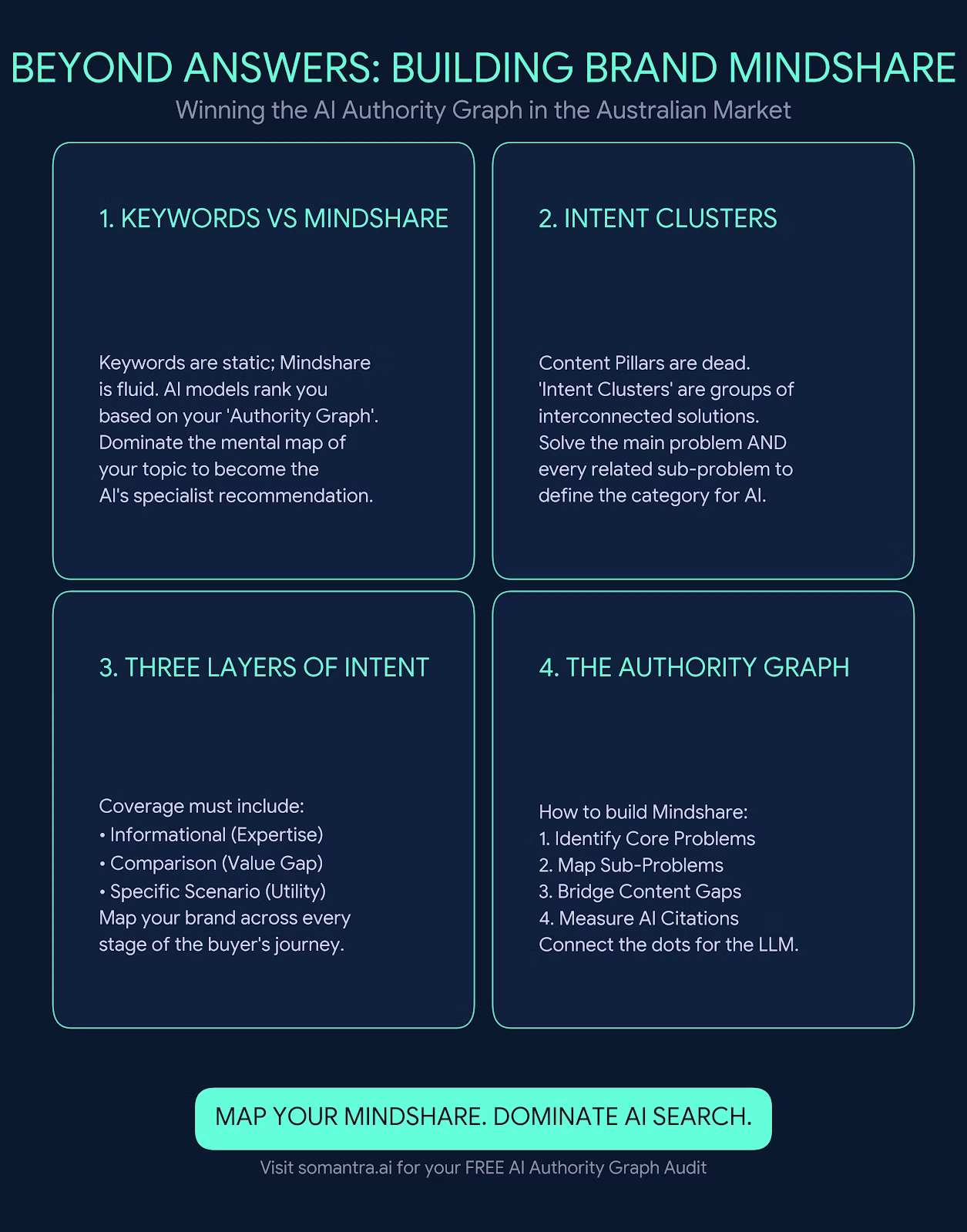
Mindshare is the level of consumer awareness, popularity, and recall that a brand holds within the consumer’s memory when compared to its competitors. It is constantly changing with changing circumstances and more effective competitor activity, against this fluid reality the use of keywords as static entities is no longer relevant:
- The Old Way: Targeting “Business Loans Australia.”
- The AI Way: Owning the intent behind “Scaling a seasonal business in NSW.” AI models actually categorise brands based on their Authority Graph. If your content only covers the surface then you are considered a generalist however, if you cover the nuances of a user’s journey, you become the ‘Specialist Entity’ that the AI trusts to recommend.
Intent Clusters vs. Content Pillars
Most Australian marketers are familiar with Content Pillars, but Intent Clusters are the 2026 evolution.
- Content Pillar: A condensed guide about Digital Marketing.
- Intent Cluster: A series of interconnected assets solving specific hurdles, such as “How to measure attribution in a cookie-less browser” or “Adapting ad spend for the EOFY in Australia.” By organising content into these clusters, you provide the LLM (large language model) with a structured map of your expertise. You aren’t just giving an answer; you are defining the category.
The Types of Intent Every Brand Must Cover
To achieve category dominance, your brand must map its presence across three layers of intent:
- Informational Intent: “What is…” (Establishing expertise).
- Commercial/Comparison Intent: “Brand A vs Brand B” (Establishing unique value).
- Specific Scenario Intent: “How do I fix [Problem] in [Specific Industry]?” (Establishing utility).
Covering all three layers is what keeps your brand present at every stage of the buyer’s AI conversation, from the first question to the final comparison. That journey-wide presence is what brand engagement measures. Comparison intent in particular decides which “best for” slot you own and how many framings you appear across, the Slot and Coverage measures in AI search doesn’t have a rank, it has five axes.
Building Your Authority Graph: A Step-by-Step Framework
How do you start building mindshare today?
- Identify the Core Problem: What is the primary “headache” your customer has?
- Map the Sub-Problems: Use AI visibility data to find the “follow-up” questions users ask.
- Bridge the Gaps: Ensure every piece of content links semantically to the next step in the user’s journey.
- Measure Citations: Use Somantra to track how often AI models cite you as the authority for these specific clusters. For the wider measurement picture, see how to monitor brand performance in the era of AEO and GEO.
Brand Mindshare Summary for Australian Strategy Leaders
In AI search, you don’t buy mindshare through ad spend; you earn it through semantic depth. By moving beyond answers and focusing on the total intent of your customer, you ensure your brand sits at the center of the AI’s consideration set. Owning that intent is what gets your brand chosen, not just mentioned, which is exactly what brand consideration measures: whether the AI recommends you over the competitors named in the same answer.
AI models categorize brands based on Semantic Authority. Somantra helps you map your Authority Graph across a minimum of 15,000+ search journeys to ensure your brand is the “logical choice” for every intent.
Ready to see where your brand’s mindshare stands? Get your FREE Somantra Brand Audit and see a visual map of your Intent Clusters compared to your competitors.
Frequently asked questions
What are intent clusters in AI search? +
Intent clusters are interconnected sets of content assets that solve a customer's main problem and every related sub-problem. They give AI models a structured map of your expertise, so the model treats your brand as the specialist entity for the topic rather than a generalist.
How do intent clusters improve brand consideration in AI search? +
By covering the full intent behind a topic, across informational, comparison, and specific-scenario questions, your brand is present and recommended at the moments buyers decide. That moves you into the AI's consideration set rather than being mentioned once and forgotten.
What is the difference between intent clusters and content pillars? +
A content pillar is a single condensed guide on a topic. An intent cluster is a series of interconnected assets that solve specific hurdles across the buyer's journey, which is the structure large language models reward with category authority.
How do AEO and GEO relate to intent clusters? +
Answer Engine Optimization (AEO) and Generative Engine Optimization (GEO) are about being cited and recommended inside AI-generated answers. Intent clusters are the content structure that makes that happen, by building the semantic authority AI models reach for when they answer a query.
How do I measure the brand mindshare that intent clusters build? +
Track how often AI models cite your brand across each cluster and how you compare with competitors, using Brand Engagement (presence across the buyer's journey) and Brand Consideration (being recommended over rivals) across a minimum of 15,000+ search journeys.
Tags: