
The Shift: From Ranking to Recommendation
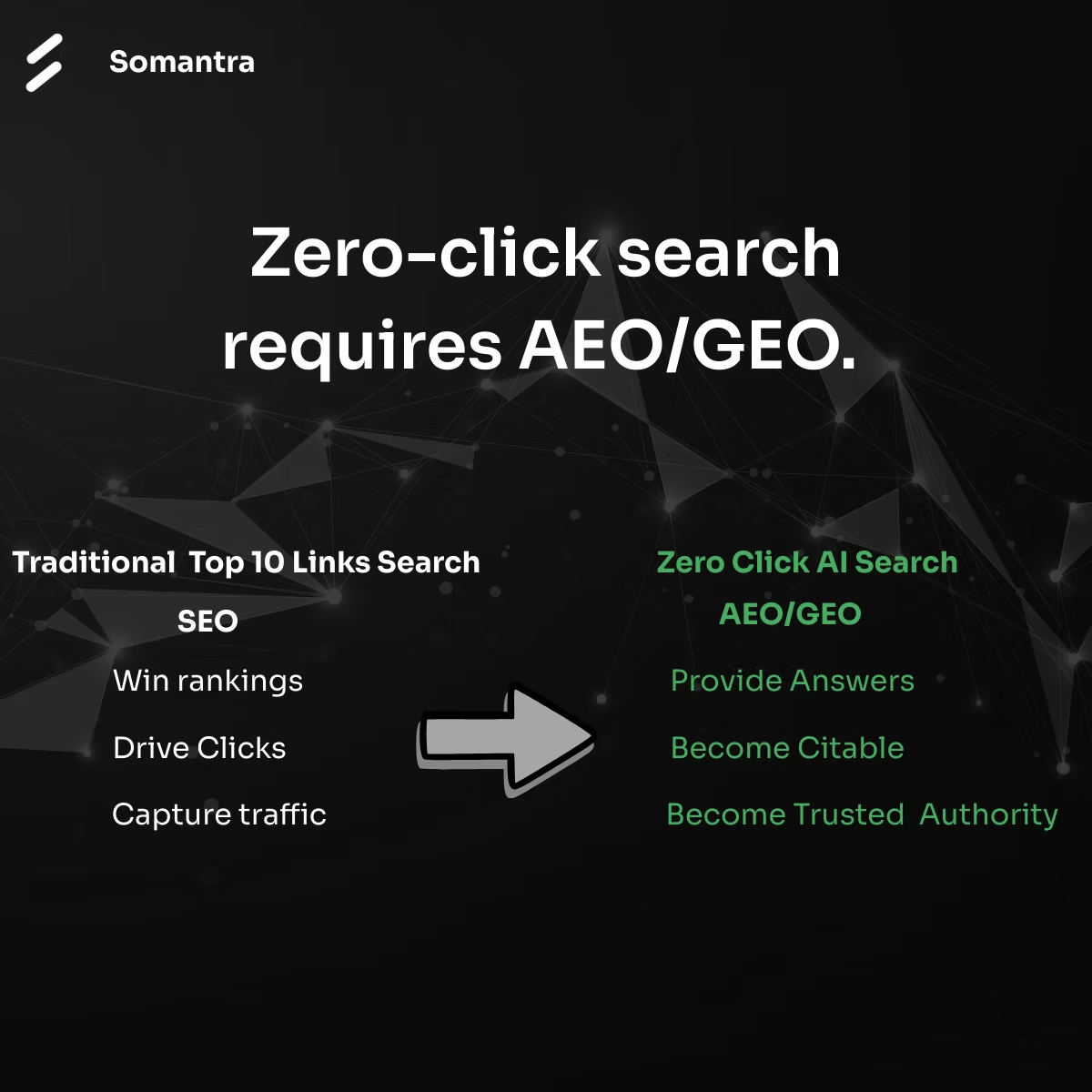
In traditional search, it was considered a “win” to appear in the top three result links. In the AI-driven landscape of 2026, the search journey has evolved and users no longer just search: they converse.
As AI search engines become the primary touchpoint for consumers worldwide, brands must move beyond static metrics. It is no longer enough to know if you appeared. You need to know where and how you appeared across the user’s multi-step decision, and whether the AI actually recommended you over a competitor. In Answer Engine Optimization (AEO) and Generative Engine Optimization (GEO), the goal is to be chosen, not just mentioned.
The Customer Journey: AI Search vs. Traditional Search
The traditional search journey was linear: Keyword → Click → Website. The AI journey is a recursive loop:
- The Discovery Prompt: “What are the best sustainable logistics providers?”
- The Filter Prompt: “Which of these have warehouses near my main markets?”
- The Validation Prompt: “Compare Brand A’s pricing to Brand B.”
If your brand appears in Step 1 but disappears in Step 2, you haven’t just lost a rank, you’ve lost a conversion. Monitoring must now track your visibility across this entire fan-out effect.
What to Monitor: The Three Core AEO and GEO Metrics
Counting mentions is not monitoring. To see the full picture, track the three customer-intent metrics that describe how a brand actually performs inside AI answers:
- Brand Mindshare measures your share of voice across AI answers, and where you are absent. Somantra’s Mindshare Heatmap shows how often your brand appears across prompt clusters, alongside the competitors present in each, so you can find the whitespace to claim. There is more on this in growing brand mindshare in the age of AI search engines.
- Brand Engagement measures whether your brand is present at every stage of the conversation journey, from discovery prompts through intent and comparison prompts. It reveals the exact turn where your brand drops out of the conversation.
- Brand Consideration measures whether the AI recommends your brand over the competitors named in the same answer. This is the metric closest to revenue, because it tracks being chosen rather than merely mentioned.
Together these replace the vanity question of “did we appear” with an actionable view of mindshare, engagement, and recommendation.
Beyond a Single Score: The Five Axes
The biggest monitoring mistake is compressing all of this into one “AI visibility score.” As we cover in AI search doesn’t have a rank, it has five axes, a brand’s standing is five independent measures: Presence (are you in the answer), Slot (which “best for” cell you own), Coverage (how many intent framings you appear across), Liability (what the model says against you), and Door (organic, paid, or both). They move independently, so averaging them into one number hides the gap you actually need to fix. Effective monitoring reports the axes separately.
Brand Consideration adds a second layer of granularity through the Brand Consideration Score, which sorts each answer into four tiers of recommendation likelihood: most likely, may consider, unlikely, and most unlikely.
The Deep Dive: Measuring the Journey, Not the Moment
Effective monitoring doesn’t just count mentions; it analyses the depth of inclusion across multiple levels:
- Surface Level: Your brand is mentioned in a list of ten options.
- Mid Level: Your brand is cited as a source for a specific technical fact.
- Deep Level: The AI proactively recommends your brand as the “best choice” for a specific customer.
At Somantra, we model a minimum of 15,000+ conversational journeys per brand across at least five Ideal Customer Profiles (ICPs), built from clickstream, geo-location, and income data. Running the journey this many times, across ChatGPT, Google AI Overviews, Claude, and Perplexity, is what shows exactly when and why an AI engine stops recommending your brand, rather than leaving you to guess from a single screenshot.
Setting Your AEO and GEO Monitoring Cadence: How Often Should You Monitor?
AI models are updated constantly, and a global model update or a surge in negative threads can erode your AI visibility within 48 hours.
- For High-Growth Brands: Weekly monitoring of core intent clusters is essential.
- For Enterprise Brands: Near real-time tracking is required to protect category dominance and react to competitor tactics.
Because a brand’s visibility on one platform does not translate to another, monitor each engine (ChatGPT, Google AI Overviews, Claude, and Perplexity) separately rather than assuming a single number represents them all.
Summary: Monitoring Brand Performance for AEO and GEO
If you are still using 2022’s SEO tools to measure 2026’s AI reality, you are flying blind. The goal of AEO and GEO monitoring is to ensure that at every pivot of a user’s conversation, your brand remains the logical, trusted conclusion, and is the one the AI recommends.
Somantra measures this across a minimum of 15,000+ conversational journeys per brand, reporting Brand Mindshare, Brand Engagement, and Brand Consideration so you can see where your brand leads, where it lags, and where it is losing the recommendation to a competitor.
Don’t wait for your traffic to drop to realise you are invisible. Get your free Somantra brand audit to see where your brand is mentioned, where it is chosen, and where competitors are winning across AI search.
Frequently asked questions
What should you measure to monitor brand performance in AEO and GEO? +
Move beyond rankings and a single visibility score. Track three customer-intent metrics: Brand Mindshare (your share of voice across AI answers), Brand Engagement (presence across every stage of the buyer's conversation), and Brand Consideration (whether the AI recommends you over the competitors named in the same answer).
How often should brands monitor AI search visibility? +
AI models update constantly, and a model update or a surge of negative threads can shift your visibility within 48 hours. High-growth brands should monitor their core intent clusters weekly, while enterprise brands need near real-time tracking to protect category dominance and react to competitor moves.
What is the Brand Consideration Score? +
It measures the probability a customer would choose your brand based on how AI describes and recommends it against competitors. Each answer is sorted into four tiers of recommendation likelihood: most likely, may consider, unlikely, and most unlikely.
Which AI platforms should brand monitoring cover? +
ChatGPT, Google AI Overviews, Claude, and Perplexity. A brand's visibility on one platform does not translate to the others, so each engine should be monitored separately rather than rolled into a single number.
Why isn't a single AI visibility score enough? +
A brand's standing is made of five independent axes, presence, slot, coverage, liability, and door, that move in different directions. Averaging them into one number hides the specific gap you need to act on, so monitoring should report the axes and the three metrics separately.
Tags:

About the author
Arun Prasad
Founder, Somantra
Arun Prasad is the founder of Somantra, an AI search visibility platform for brands, where he writes about answer engine optimisation (AEO) and AI search. His research analyses how brands surface in AI answers across ChatGPT and Google AI Overviews, including Somantra's studies of the Australian insurance market. He focuses on measuring brand visibility through systematic, large-scale conversational testing rather than one-off screenshots.