
Summary
Between November 2025 and July 2026, a systematic contamination event has been documented across AI-powered search systems including ChatGPT, Google AI Overviews wherein spam domains, AI-generated content farms, and parasite SEO operators are being preferentially cited by large language models as authoritative sources for insurance advice. Analysis of 2.4 million citation records across 28,725 unique domains reveals that ChatGPT’s citation layer is structurally more vulnerable to manipulation than Google’s traditional search index, with grey-area and spam domains appearing at 19x the rate in ChatGPT citations compared to Google SERPs. This happens when AI search indexing skews towards retrieval-augmented generation(topic relevance) Vs factors like domain authority and other trust signals to decide whether the information stated on the page should be surfaced.
This report examines why this is happening, how it has evolved over the past year, and what the data reveals about the shifting landscape of insurance advice delivery in the age of AI search.
Part 1: The Scale of the Problem
1.1 The Dataset
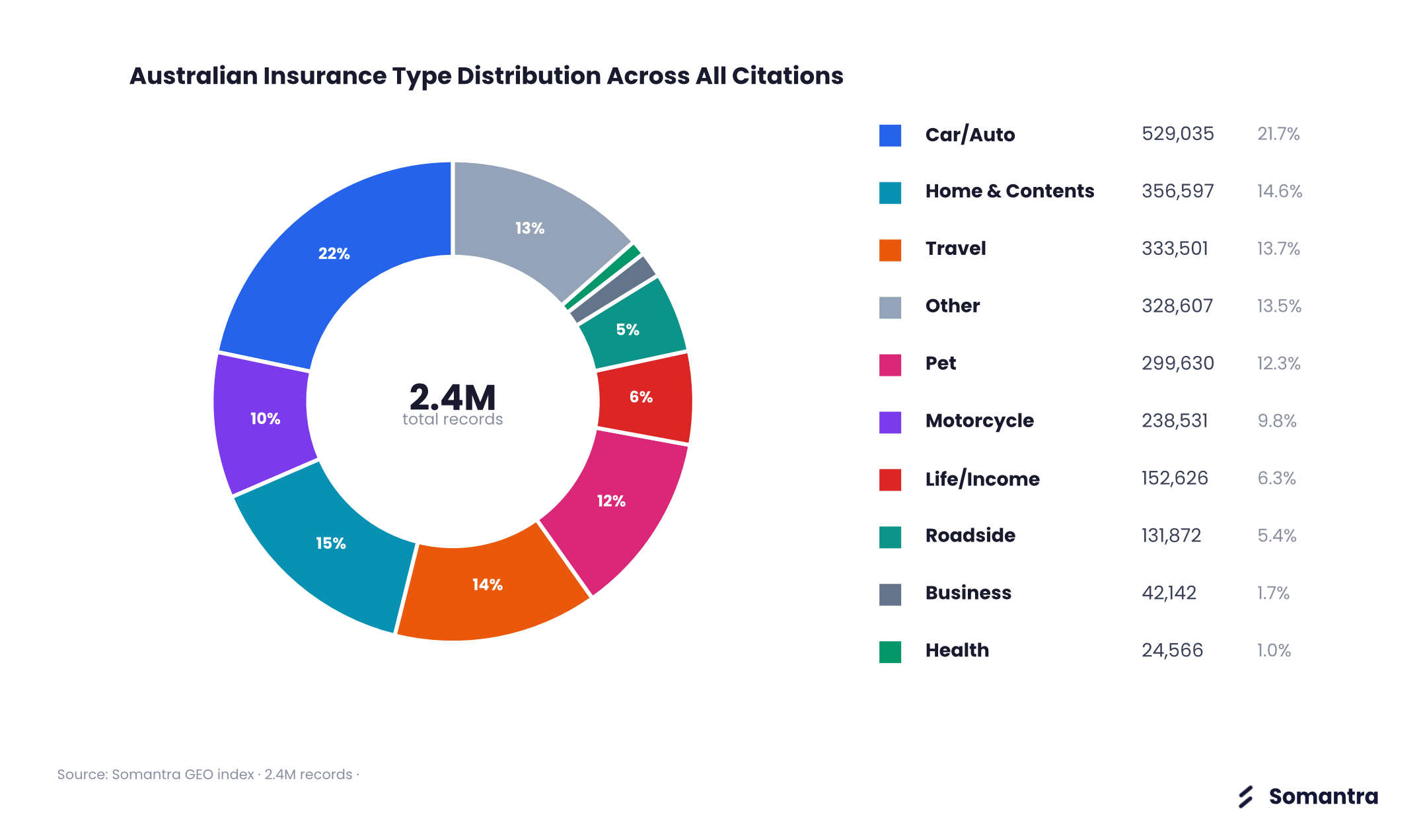
Dataset overview showing 2.4 million citation records across AI search engines.
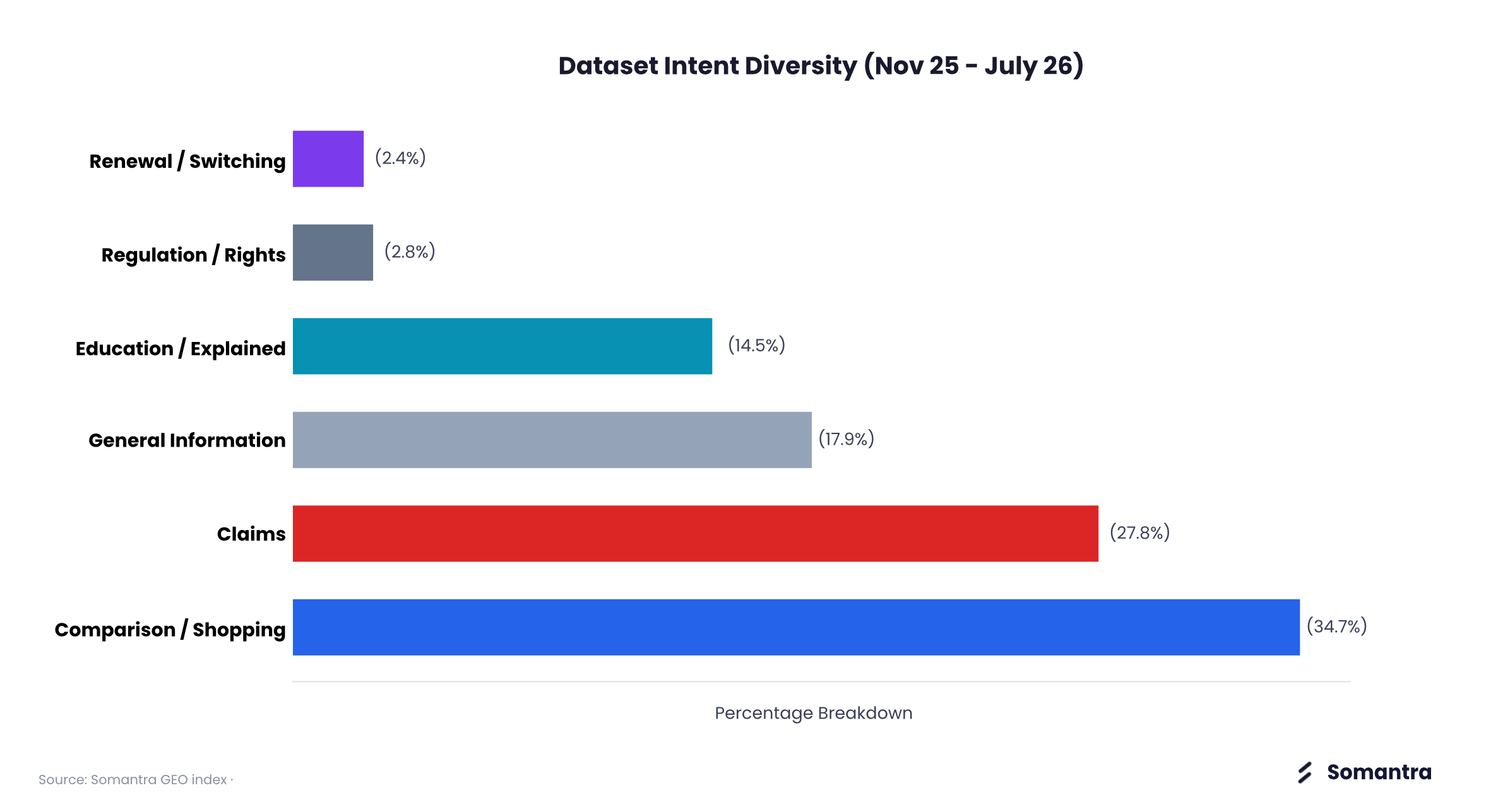
Breakdown of Dataset Diversity.
The domain list contains 28,725 domains out of which 38 domains flagged through seven months of AI search anomaly monitoring. These were processed through 10 specialized LLM subagents for verification. The dataset created from extracting citations from AI Search responses contains 2,437,107 individual citation records spanning November 2025 through July 2026, drawn from two platform search types: Google SERPs (2,090,935 records, 85.8%) and ChatGPT standard search (346,172 records, 14.2%).
Of the 38 flagged domains, the verification process produced three categories: confirmed spam and content farms (4 domains), grey-area parasite SEO hosts (34 domains), and verified legitimate businesses marked as region overlap (482 domains). But the danger lies in the 38 domains in the first two categories.
1.2 The Contamination Ratio
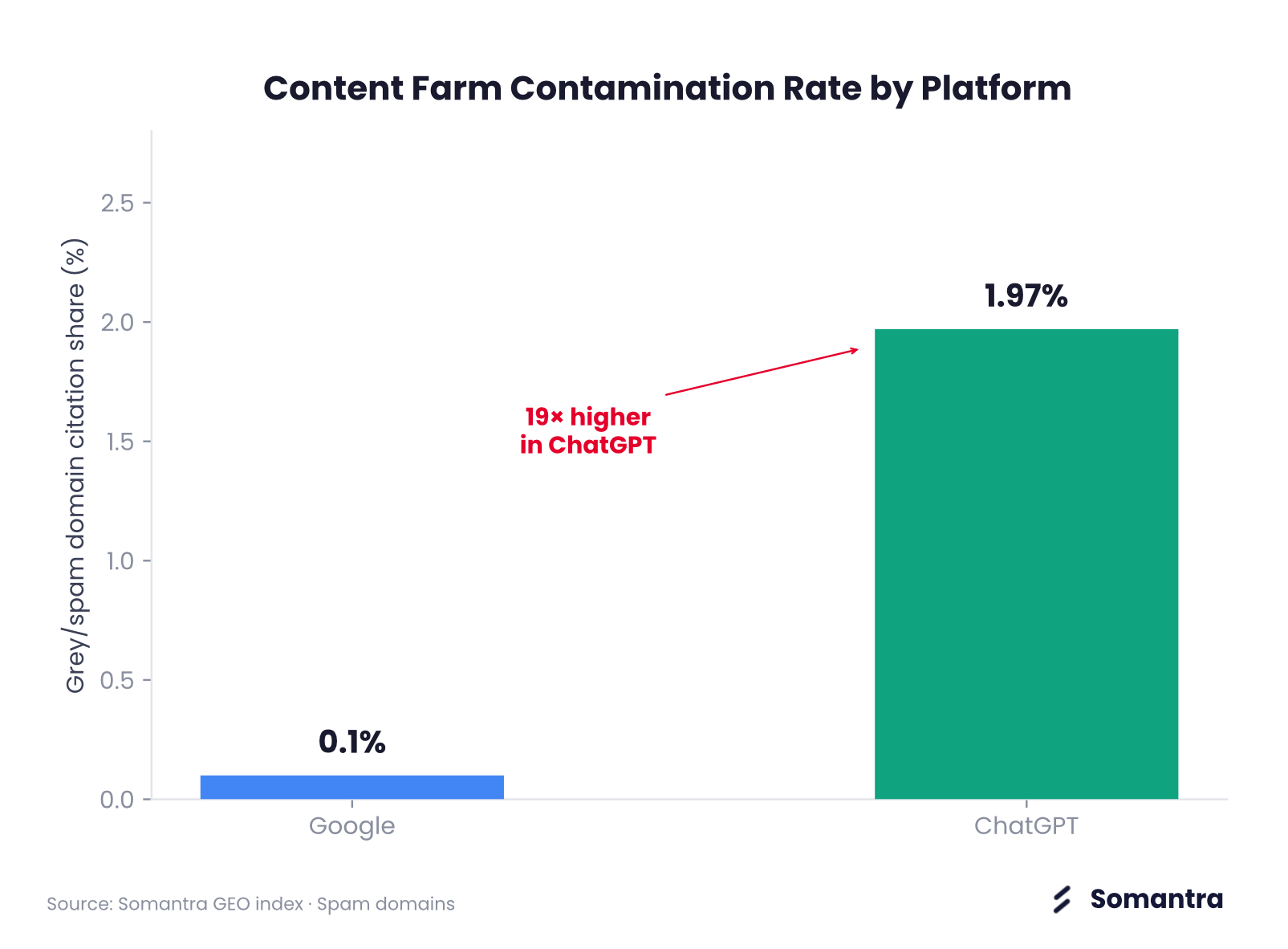
Contamination ratio comparison: Google vs. ChatGPT.
Detailed breakdown of grey-area domain citations.
Visualization of the 19x higher contamination rate in AI platforms.
The most striking finding from the data is the asymmetric vulnerability between platforms. Grey-area and spam domains from the verified list account for 6,806 citations in ChatGPT (1.97% of all ChatGPT citations) but only 2,142 citations in Google SERPs (0.10% of all Google citations). On a percentage basis ChatGPT shows a higher contamination rate (19X) compared to Google.
This matters because ChatGPT reaches 900 million weekly active users, with roughly 94% on the free tier using less capable models. Google’s AI Overviews reach over 2 billion monthly users. Between them, these platforms deliver insurance advice to billions of people and the free-tier models that most people use are the ones most susceptible to retrieval poisoning.
1.3 The britwealth.com Case Study
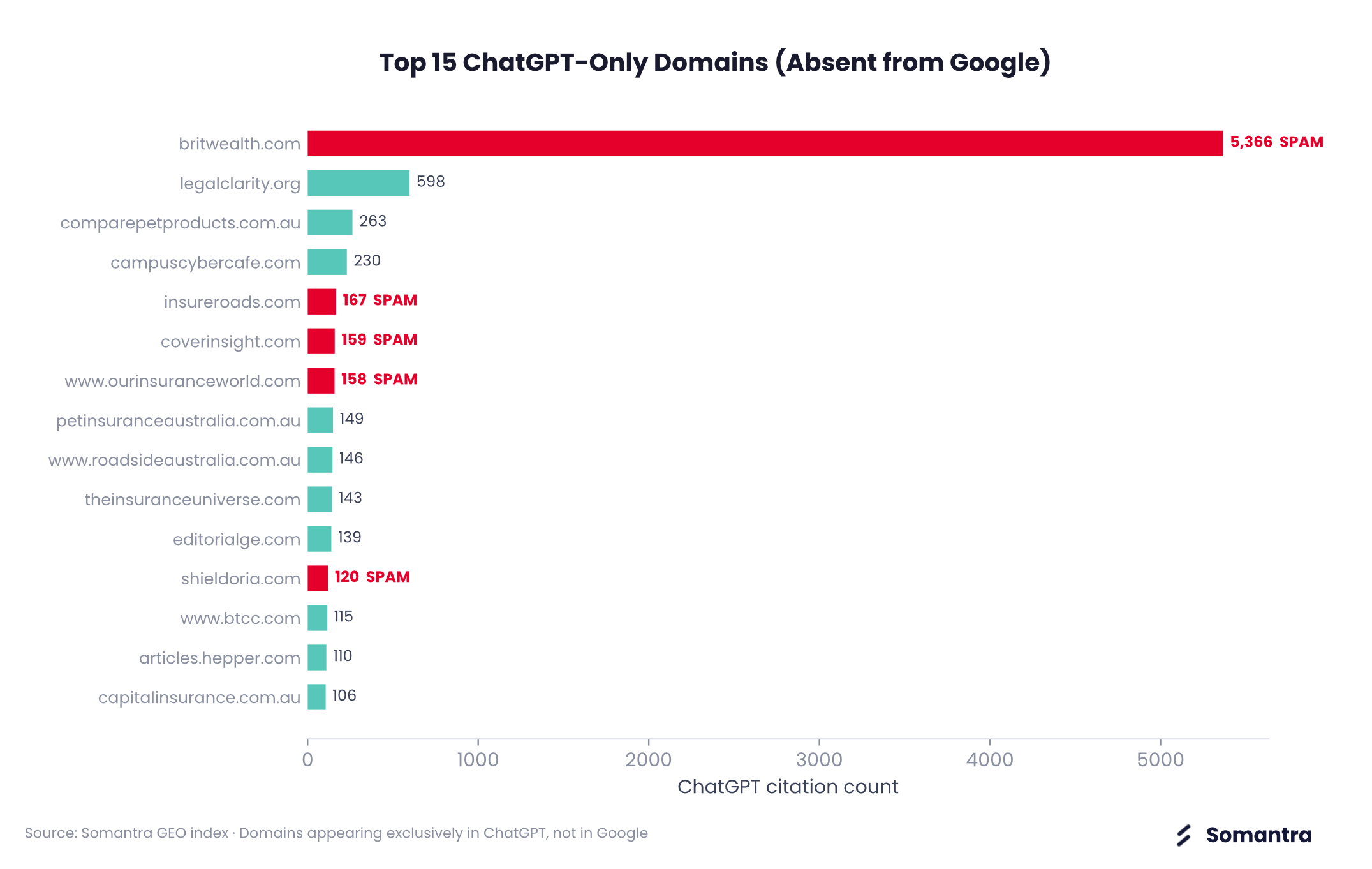
The illustrative example is the case of britwealth.com. It does not appear in Google’s search results at all and was cited only in ChatGPT. It generated 5,366 citations across the monitoring period, making it the 13th most-cited domain in all of ChatGPT’s Australian general insurance-related responses.
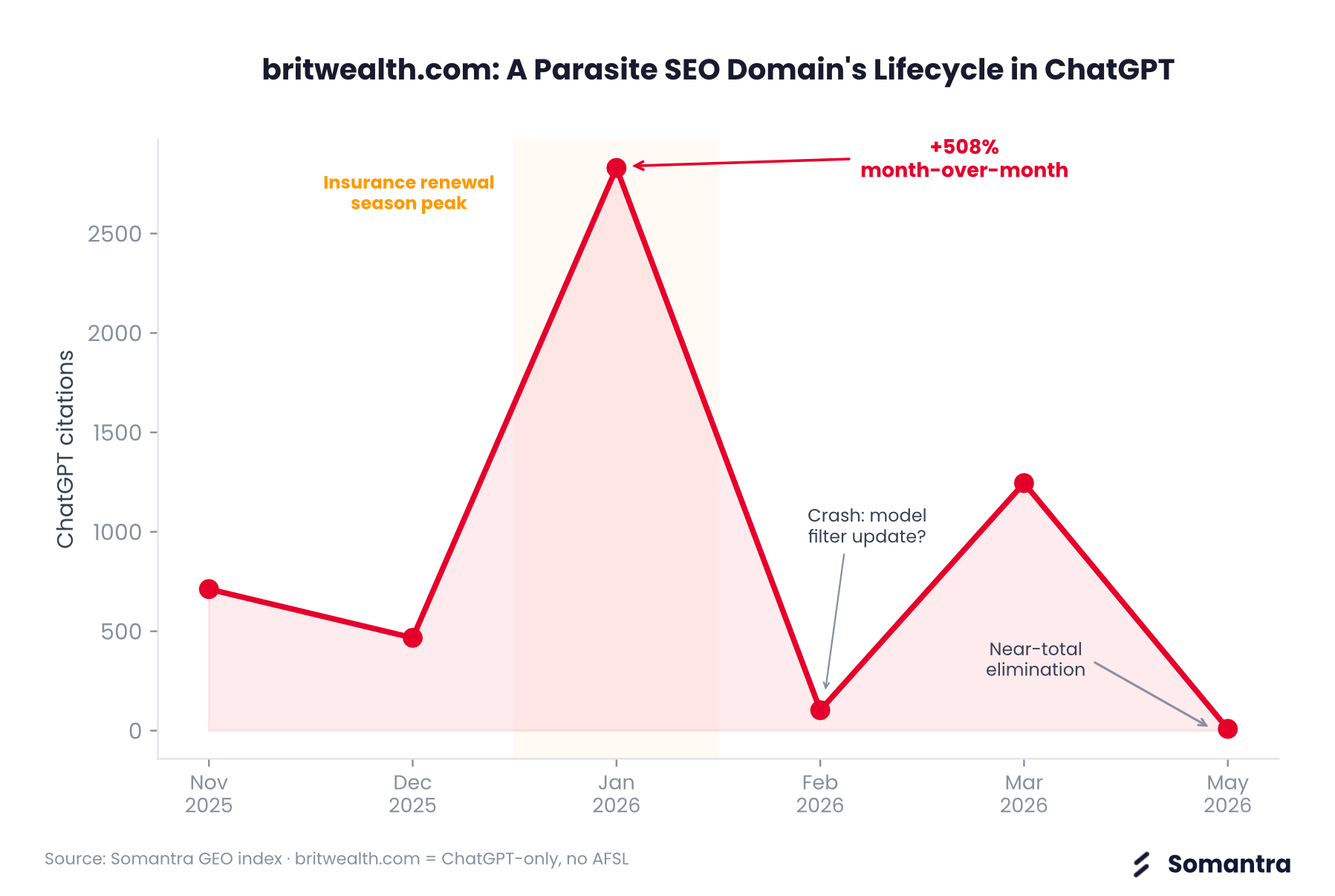
The trajectory is as follows with citations peaking in January 2026 and then a rebound in March 2026 and now at an all-time low:
● November 2025: 712 citations
● December 2025: 467 citations
● January 2026: 2,830 citations (the peak, a 508% month-over-month increase)
● February 2026: 103 citations (a sudden crash)
● March 2026: 1,245 citations (a rebound)
● May 2026: 9 citations (near-total elimination)
The content britwealth.com published is indistinguishable from legitimate insurance advice in structure: “How Does Your Driving History Impact Your Car Insurance Premiums in Australia,” “Beyond Price: 3 Unexpected Factors That Impact Your Car Insurance Premium in AU,” “Is Your Beach House a Ticking Time Bomb? Coastal Property Insurance Risks AU.”
Each title is crafted to match high-intent insurance queries and each article follows the formulaic structure that LLMs reward: definitional paragraph, numbered list, bold subheadings, conclusion with a CTA.
But britwealth.com is not an insurance brokerage, does not have an AFSL (Australian Financial Services Licence), has no physical office, and no verifiable business operations. It is, in the language of the verification report, a “Parasite SEO” host, which is a domain that publishes content designed to be cited by AI systems, monetized through affiliate links or ad impressions, without any actual expertise or accountability behind the advice.
The January 2026 spike (2,830 citations) aligns with what multiple SEO researchers have documented: a coordinated wave of AI content pipeline deployments in the insurance vertical during Q4 2025 and Q1 2026, timed to coincide with Australia’s annual insurance renewal cycle when search volume for car, home, and travel insurance peaks.
The subsequent crash in February and partial recovery in March suggest either a model update that temporarily deprioritized the domain, or a content refresh that re-triggered citation pickup.
Part 2: Why This Is Happening
2.1 The Retrieval Poisoning Loop
The fundamental architecture of AI search creates a vulnerability that did not exist in traditional search. When you type a query into Google, you get ten blue links and make your own judgment. When you ask ChatGPT or read a Google AI Overview, you get a single synthesized answer presented with uniform confidence with the same authoritative tone whether the information is accurate or fabricated.
The mechanism works as follows: an AI content pipeline generates an article about car insurance which is then published on the domain. That article is indexed within hours. A RAG (Retrieval-Augmented Generation) system fetches it during a user query and cites it as a source. Other AI pipelines observe the citation and reference the same content. The fabricated claim becomes “consensus” across multiple AI systems without any human verification.
This is not theoretical. In January 2026, SEO consultant Lily Ray published an AI-generated article on her personal blog about a fake Google core update that never happened, including the fabricated detail that Google “approved the update between slices of leftover pizza.” Within 24 hours, Google’s AI Overviews was confidently serving this information to users. The article had been citation-laundered through the retrieval layer into apparent fact.
The insurance vertical is particularly vulnerable because insurance queries are high-intent and commercially valuable. Every citation in an AI-generated insurance answer represents a potential affiliate conversion worth $50–$200. The economic incentive to pollute the retrieval pool is enormous.
2.2 Google currently has an advantage over ChatGPT in source evaluation
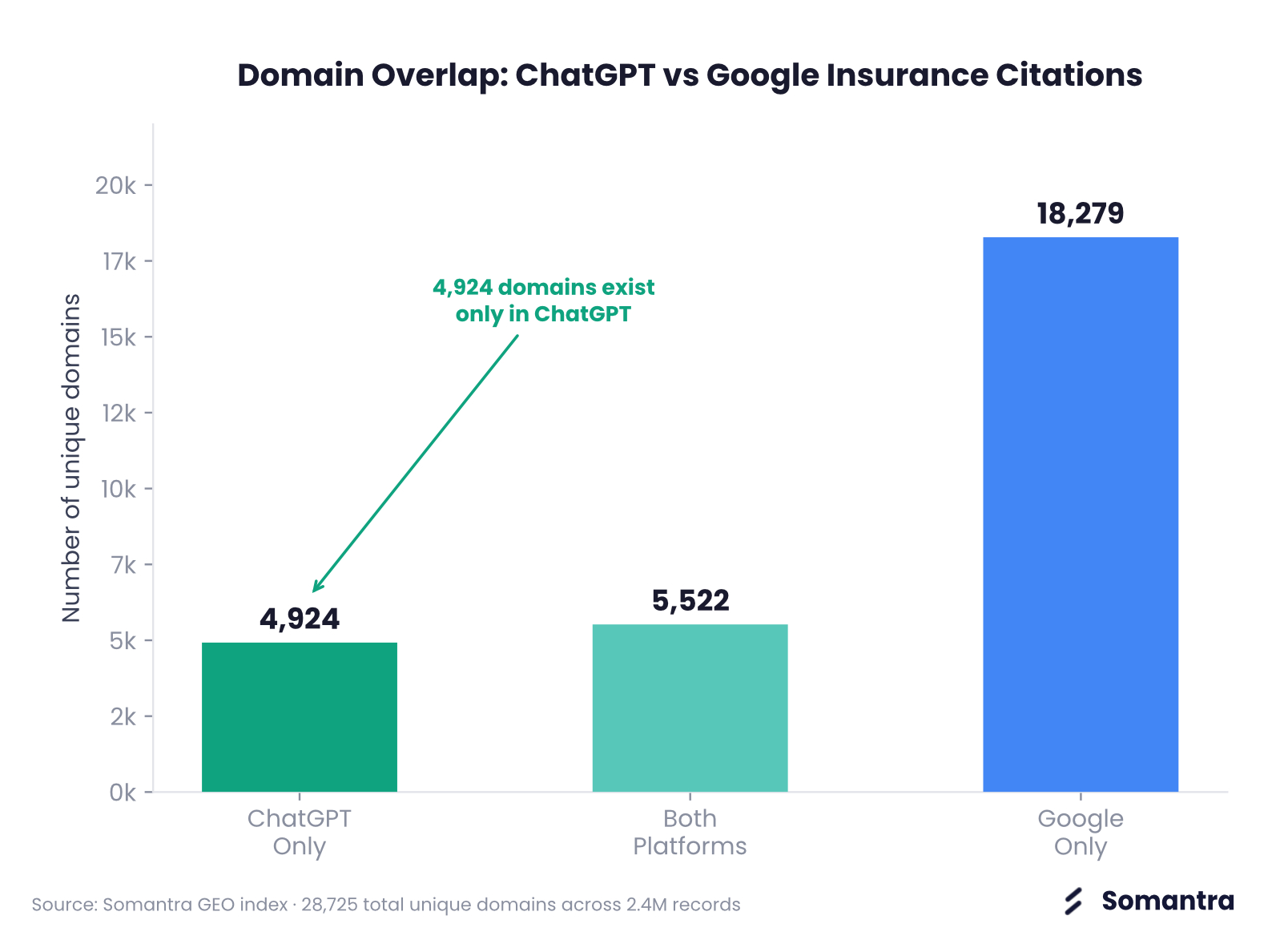
ChatGPT cites 10,446 unique domains. Google SERPs surface 23,801 unique domains. ChatGPT has 4,924 domains that do not appear in Google’s results.
ChatGPT’s top 40 cited domains include legitimate powerhouses (Canstar: 23,464 citations; Finder: 17,291; Reddit: 13,416; Choice: 10,537) but also domains that Google would never surface prominently (e.g. britwealth.com at 5,366; legalclarity.org at 598). Google’s top 40 is exclusively dominated by established insurers, comparison sites, government portals, and major media properties. The difference is not that Google is better at identifying spam, it’s that Google has more signals to evaluate sources compared to ChatGPT.
2.3 The “Shield” Domain Network
Analysis of the Shield domain network naming patterns.
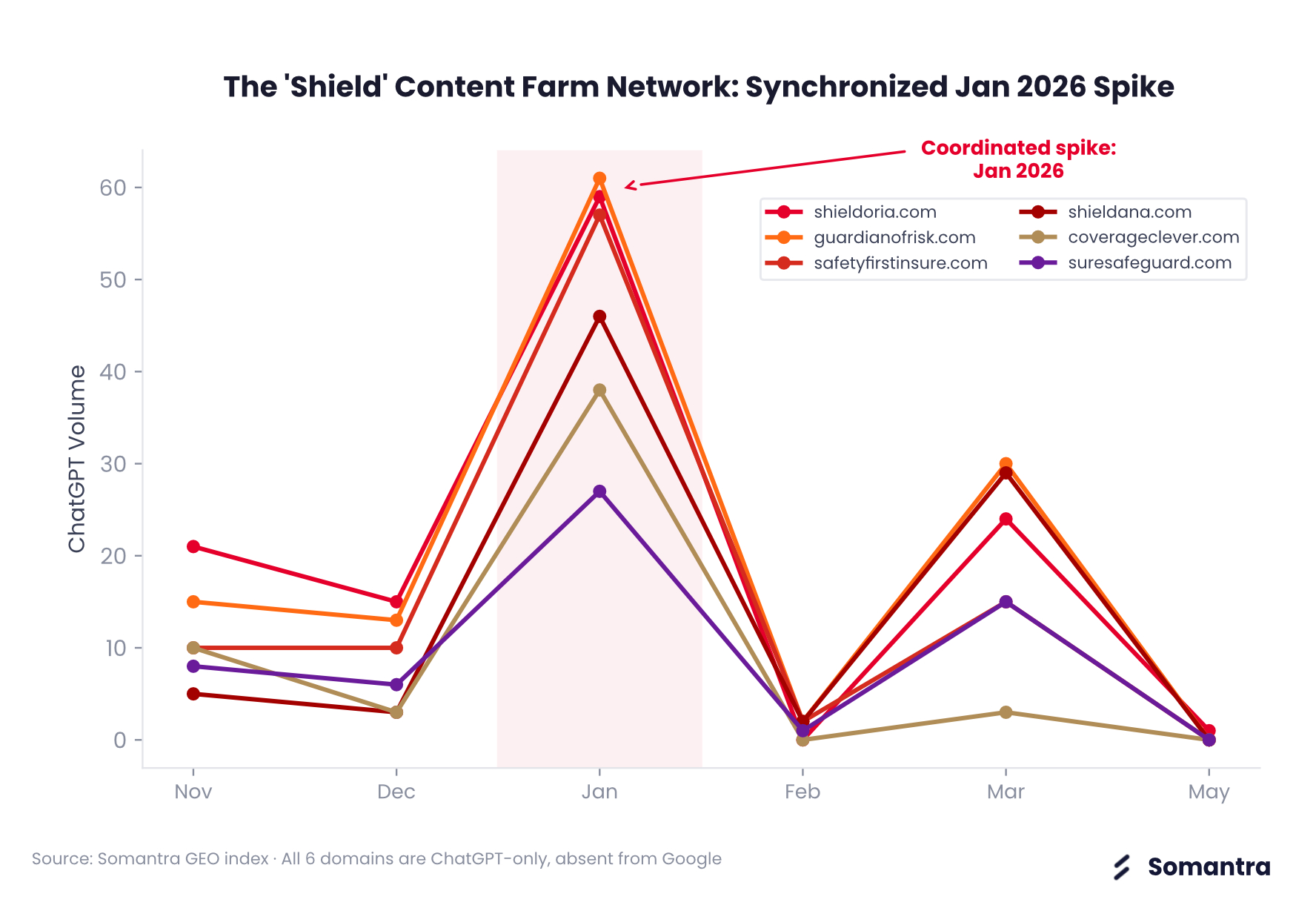
Citation volume of coordinated content farm networks.
A pattern emerges from the grey-area domains that is too consistent to be coincidental. Consider these ChatGPT-only domains from the verified list:
● shieldoria.com: 120 citations (100% ChatGPT)
● shieldana.com: 85 citations (100% ChatGPT)
● safetyfirstinsure.com: 94 citations (100% ChatGPT)
● suresafeguard.com: 57 citations (100% ChatGPT)
● guardianofrisk.com: 121 citations (99.2% ChatGPT)
● coverageclever.com: 54 citations (100% ChatGPT)
All six follow the same naming convention: a trust-signaling prefix (“shield,” “safeguard,” “guardian,” “sure,” “clever”) combined with an insurance-adjacent noun. We believe that these domain names are on purpose to take advantage of semantic similarity based algorithms that ChatGPT might be using to choose domains relevant to the “insurance” topic.
All six appear exclusively or predominantly in ChatGPT citations, not in Google. All six peaked in January 2026 (the same month as britwealth.com) and declined thereafter. All six published content in the same formulaic structure: educational-sounding titles targeting specific insurance sub-niches, with no verifiable business entity behind them.
This is a content farm network a cluster of domains operated by the same entity or coordinated group, designed to cast a wide net across insurance-related queries and capture citations from AI search systems that lack the ability to verify the credibility of the source behind the URL.
NewsGuard’s tracking data confirms this is not isolated. They were monitoring 1,121 AI content farm sites in November 2024. By March 2026, the count had reached 3,006, adding 300–400 new sites per month. The repetition rate of popular false claims across ten mainstream AI tools rose from 18% in August 2024 to 35% in August 2025. Model refusal rates dropped from 31% to near zero, because every product added web search models no longer refuse to answer when uncertain; instead they search the web and repeat whatever they find.
Part 3: How This Has Changed Over the Past Year
3.1 Phase 1: The Google Dominance Era (Before November 2025)
Before the monitoring period, Google’s traditional search index was the primary source for insurance advice discovery. The index had its own problems including SEO manipulation, affiliate link farms, content mills but the ten-link format provided a natural defense: users could see multiple sources, compare them, and exercise judgment. Government sites (moneysmart.gov.au), established comparison sites (Canstar, Finder), and direct insurer websites dominated. Spam existed but was contained by Google’s SpamBrain system and manual review processes.
3.2 Phase 2: The ChatGPT Citation Explosion (November 2025 – January 2026)
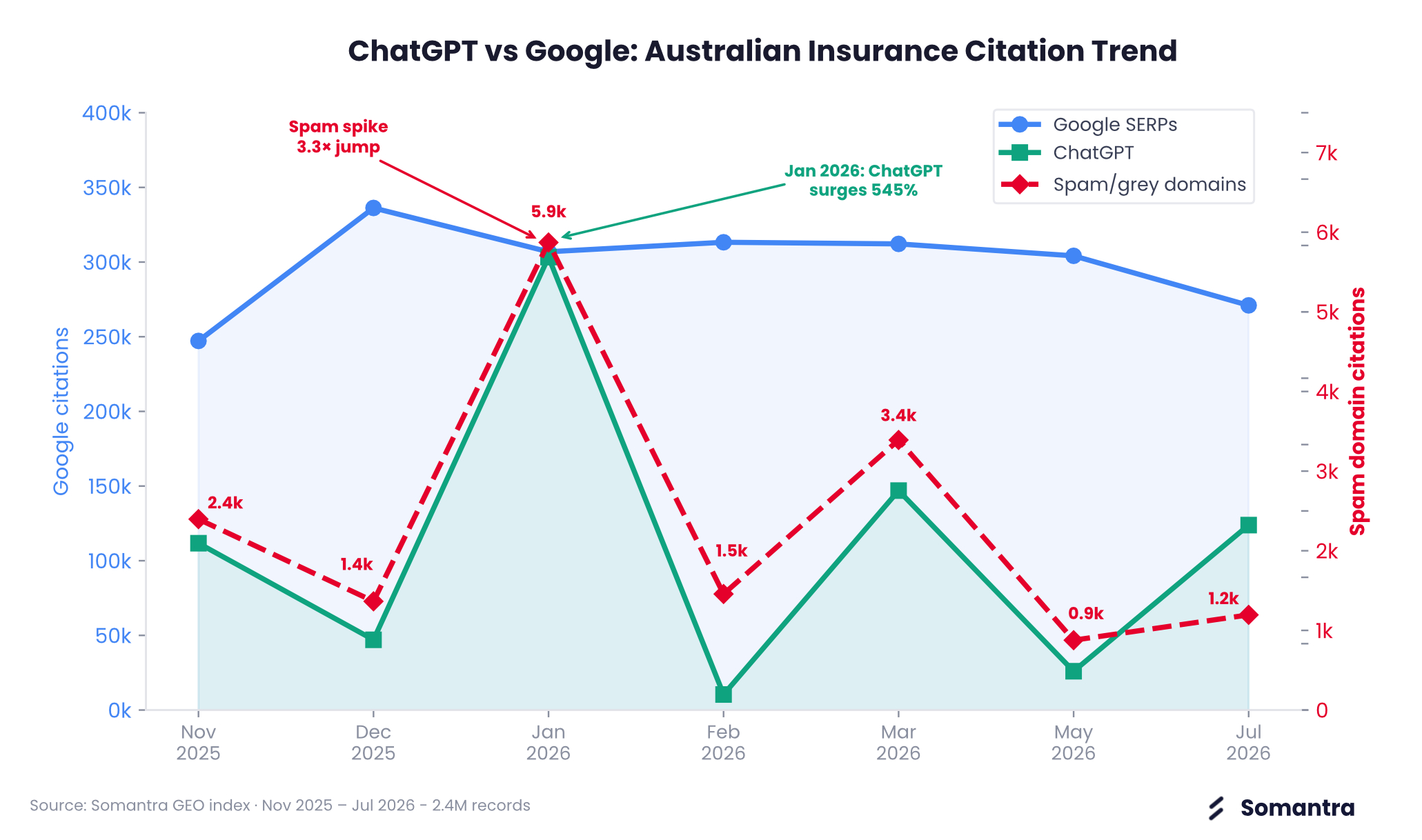
The data shows ChatGPT citing 50,269 records in November 2025, then surging to 136,494 in January 2026 a 171% increase in two months. This coincides with ChatGPT’s integration of web search as a default feature for free users. Before this change, ChatGPT primarily relied on its training data. After it, ChatGPT began actively retrieving and citing live web content for every query.
This was the inflection point. The moment ChatGPT started retrieving live web content at scale, it became vulnerable to the same content farm pollution that had always existed in Google’s index but without the decade of spam-fighting infrastructure that Google had built. Google’s ratio to ChatGPT citations was 4.9:1 in November 2025. By January 2026, it was 2.2:1. ChatGPT was citing web content at nearly half the volume of Google, but with a dramatically different quality profile.
The January 2026 peak also marks the high-water mark for grey-area domain influence. britwealth.com hit 2,830 citations. insureroads.com hit 87. coverinsight.com hit 83. guardianofrisk.com hit 61. shieldoria.com hit 59. The entire network of parasite SEO domains peaked simultaneously, suggesting coordinated deployment timed to the insurance renewal season.
3.3 Phase 3: The Correction and Fragmentation (February – May 2026)
February 2026 shows a dramatic shift: ChatGPT citations dropped to just 4,682 (a 96.6% decline from January), while Google citations remained stable at 313,257. The ratio blew out to 66.9:1. Something changed in ChatGPT’s retrieval system, likely a quality filter update or a change in which indices it queries.
But the correction was uneven. Some grey-area domains survived: www.allrisk.com actually increased from 3 citations in January to 64 in May. nexuora.com went from 0 in January to 24 in May. Others were devastated: britwealth.com fell from 2,830 to 9. The pattern suggests ChatGPT implemented domain-level quality signals but not a comprehensive spam filter; some content farms adapted, others didn’t.
March 2026 saw ChatGPT rebound to 66,130 citations (a 1,312% increase from February), suggesting the February dip was a transitional period during a model or retrieval update rather than a permanent fix. May 2026 dropped again to 11,697, and July 2026 settled at 55,735. The volatility itself is a finding: ChatGPT’s citation behavior is unstable month-to-month in a way that Google’s is not, making it impossible for consumers, insurers, or regulators to predict what information will be presented to users in any given period.
3.4 Phase 4: The Spam Adaptation (March – July 2026)
The March 2026 data reveals a critical adaptation by content farm operators. shzhangyun.com flagged for hosting insecure file paths and indexing random PDF documents as spam surged from 2 citations in January to 25 in March. This is a domain that Google’s spam systems would never surface for insurance advice. Its appearance in ChatGPT citations indicates that the retrieval system was being fed manipulated content through a vector that bypassed the quality filters ChatGPT had implemented.
ftp.bills.com.au appeared with 2,034 citations in May 2026 a domain flagged as a “known content farm scraper hosting fake /lunar-tips/ articles.” Its evidence title was “Lost Phone? Get IMEI Auto Insurance Help” a topic engineered to match a high-volume insurance-adjacent query. The entire 2,034-citation burst appeared in a single month on Google SERPs, suggesting a different manipulation vector than the ChatGPT-focused content farm network: this was traditional SEO poisoning targeting Google’s index, which then rippled into AI search systems that retrieve from Google’s results.
Part 4: How Insurance Advice Has Evolved
4.1 The Democratization and Deterioration of Insurance Guidance
The shifting funnel: From traditional search discovery to single AI answers.
The data reveals a fundamental shift in who provides insurance advice to Australian consumers. In the traditional search era, the advice funnel was: consumer searches → Google surfaces established brands → consumer visits insurer or comparison site → consumer makes decision. The top domains in Google’s results are overwhelmingly legitimate: Canstar (111,813 Google citations), Budget Direct (78,417), Compare the Market (74,553), Allianz (68,200).
In the AI search era, the funnel has compressed: consumer asks ChatGPT a question → ChatGPT generates a single answer → consumer acts on it. The top domains ChatGPT cites are still largely legitimate Canstar (23,464), Finder (17,291), Reddit (13,416) but the long tail is contaminated. And because ChatGPT presents a single synthesized answer rather than a list of sources, the consumer often never sees which domain the advice came from. The citation is a footnote, not a destination.
This has created a two-tier information ecosystem. Consumers who use Google’s traditional search results still encounter a marketplace of sources. Consumers who use ChatGPT or Google AI Overviews encounter a monologue authoritative in tone, uncertain in provenance, and increasingly influenced by content farms that have learned to optimize for LLM citation patterns rather than human readers.
4.2 The Reddit Anomaly
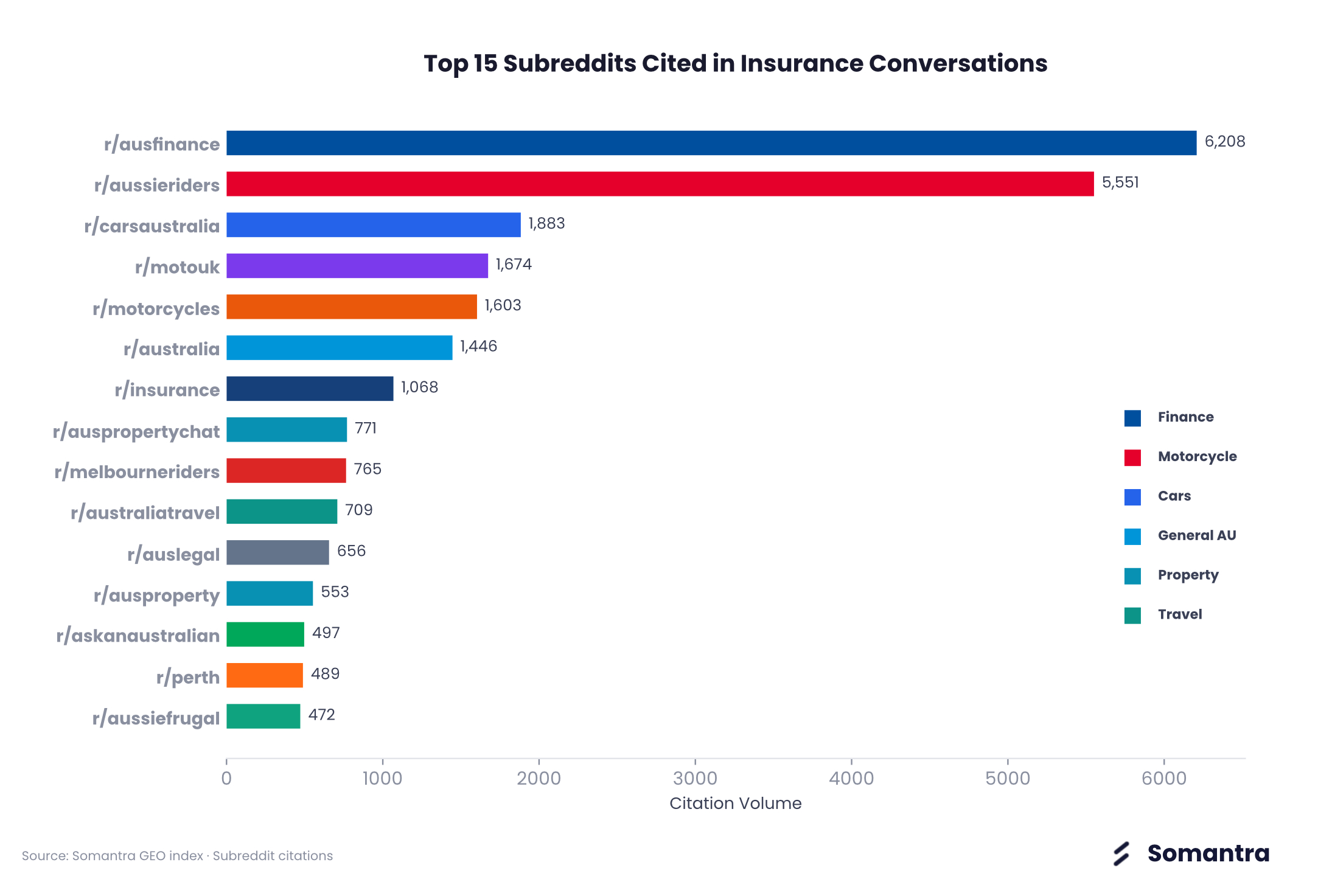
Reddit citation ranking comparison: Google vs. ChatGPT.
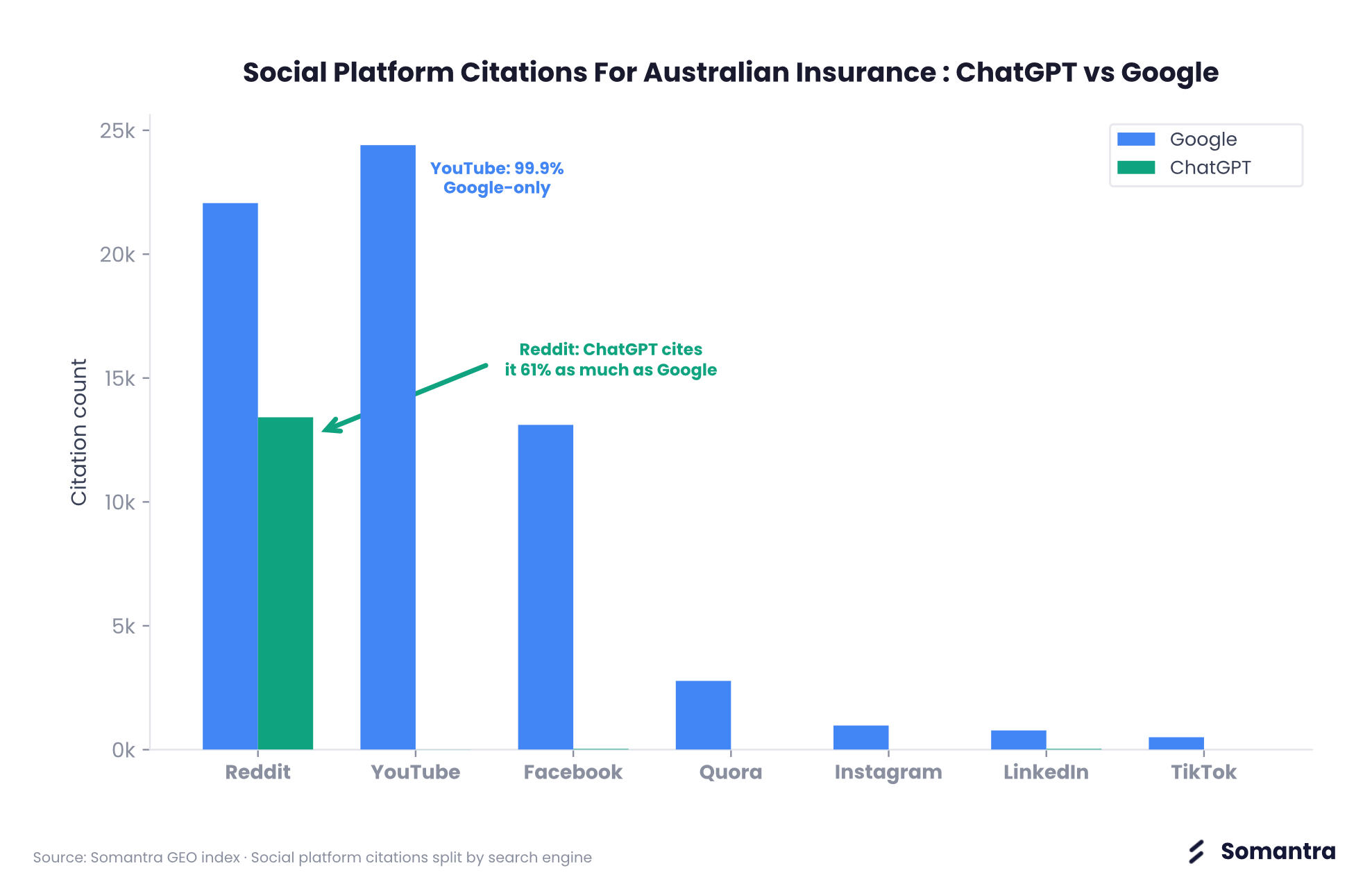
One of the most significant findings in the data is Reddit’s position in ChatGPT’s citation ecosystem. Reddit is the third most-cited domain in ChatGPT (13,416 citations), compared to its 20th position in Google (22,061 citations). ChatGPT cites Reddit at 60% the rate it cites Canstar, while Google cites Reddit at just 19% the rate it cites Canstar.
This reflects a deliberate design choice in how ChatGPT’s retrieval system values community-generated content. The rationale is understandable: Reddit discussions often contain real consumer experiences with insurance providers, claims processes, and policy comparisons that no single publisher would produce. When someone on r/AusFinance describes their experience claiming car insurance after a hailstorm, that is first-hand information that no content farm can replicate.
But the Cornell Tech research documented in the data reveals the vulnerability: user-generated platforms like Reddit make up 17%–23% of every URL retrieved by AI research agents. A single user-generated page can surface in up to 48% of queries within a topic cluster. Alter one of those pages plant a recommendation for a specific insurer, a warning about a competitor, a fabricated review and the change ripples into the AI-generated reports for that entire topic. Roughly 13 words of planted text on a recurring page can insert an attacker’s chosen entity into the finished report in 38%–51% of sessions.
For insurance advice specifically, this means that Reddit’s outsized role in ChatGPT’s citation ecosystem creates a high-value target for manipulation. A single coordinated campaign to plant insurance recommendations across r/AusFinance, r/Insurance, and r/PersonalFinanceAustralia could influence millions of ChatGPT responses.
4.3 The Comparison Site Power Shift
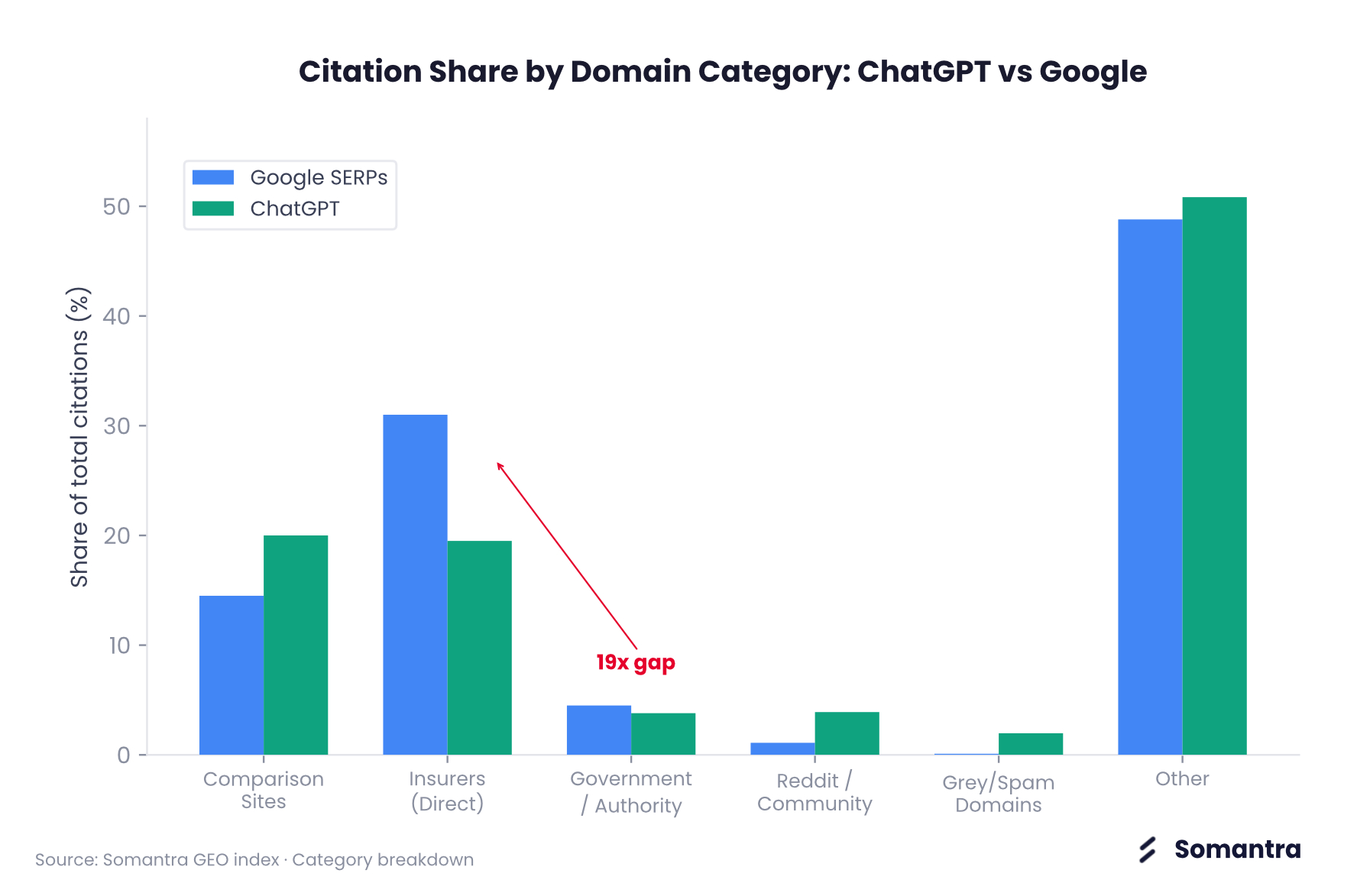
Comparison site dominance in AI citations.
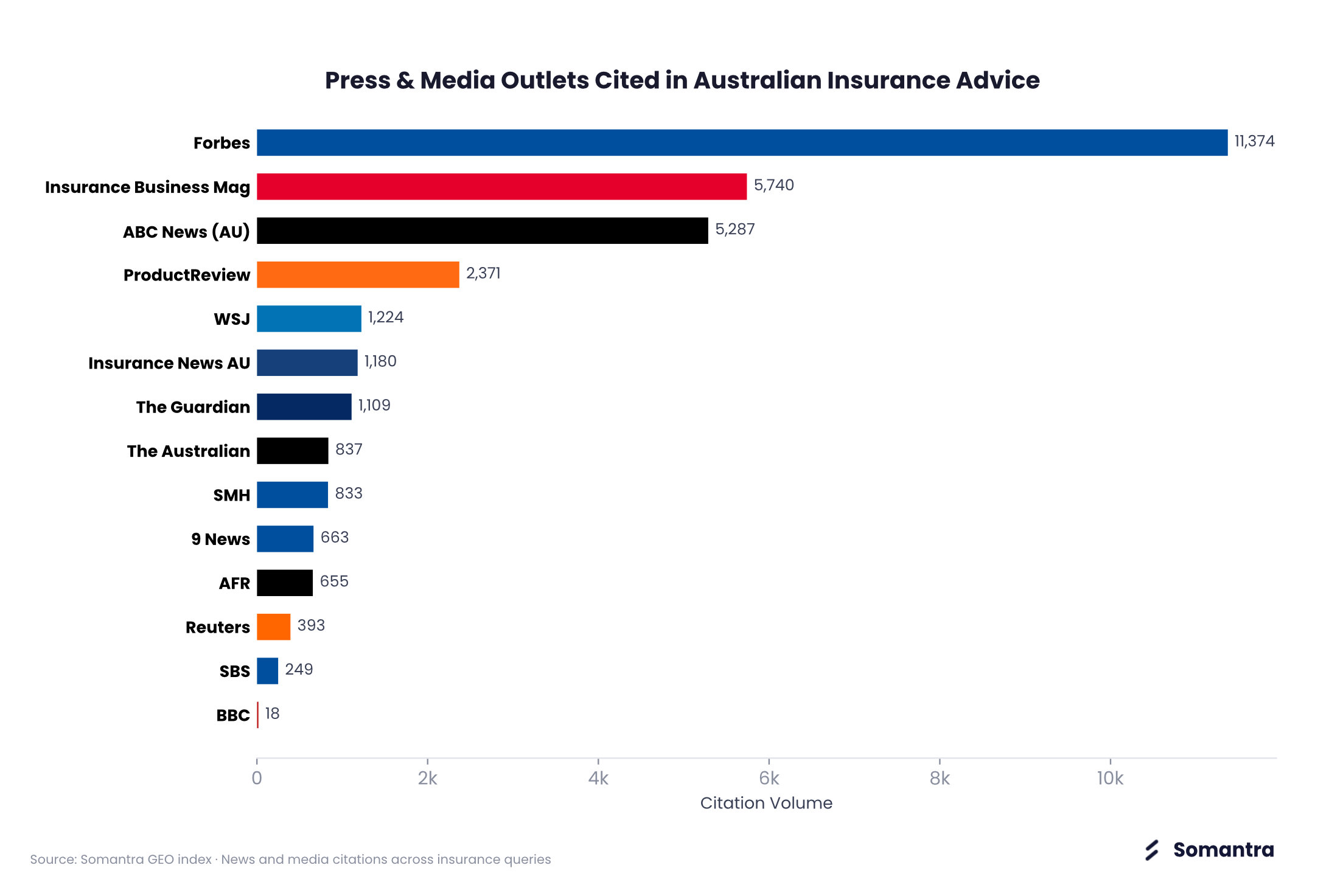
How changes on comparison sites propagate into synthesized AI answers.
The data shows that comparison sites have become the dominant intermediaries in AI-delivered insurance advice. Canstar alone accounts for 9.6% of all ChatGPT citations and 5.3% of all Google citations. Finder accounts for 7.0% and 3.0% respectively. Combined with Choice, iSelect, and Mozo, comparison sites represent roughly 20% of ChatGPT’s insurance citations.
This concentration creates a new risk. In the traditional search era, comparison sites competed for attention across ten search results. In the AI search era, a single comparison site’s methodology and data can be synthesized into ChatGPT’s answer, with the consumer never knowing which comparison site shaped the recommendation. If Canstar’s ranking methodology changes or if a content farm successfully manipulates Canstar’s data inputs the effect propagates through every ChatGPT response that references Canstar’s rankings.
4.4 The Government Authority Gap
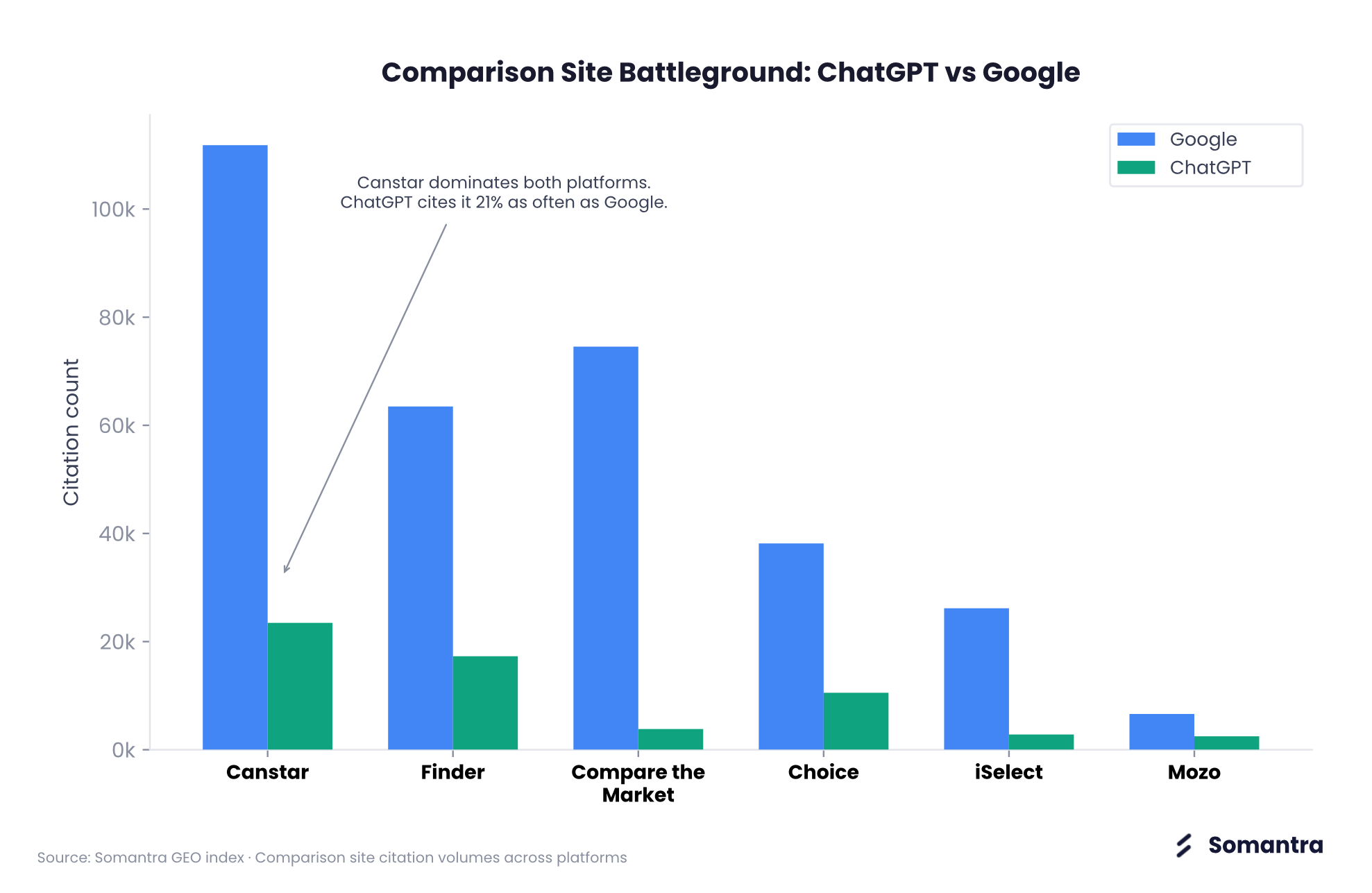
The gap in government authority recognition by AI search engines.
moneysmart.gov.au (the Australian Government’s financial literacy portal) is the fifth most-cited domain in ChatGPT (9,736 citations) and the 15th in Google (32,881 citations). smartraveller.gov.au (the travel advice portal) is 17th in ChatGPT (3,244 citations). financialrights.org.au (the Financial Rights Legal Centre) is 36th in Google (15,859 citations) but doesn’t appear in ChatGPT’s top 40.
The pattern suggests that ChatGPT’s retrieval system does not inherently privilege government or authoritative institutional sources over commercial ones. This is a significant departure from Google’s traditional behavior, where .gov.au domains receive explicit ranking boosts. In the AI search ecosystem, a government consumer protection advisory competes on equal footing with a content farm article about car insurance discounts and loses on structural grounds, because the content farm article is better optimized for the format that LLMs retrieve.
Part 5: The Legal and Regulatory Horizon
5.1 The Munich Precedent
In May 2026, the Regional Court of Munich issued a temporary injunction against Google, ruling that AI Overviews are Google’s own content not neutral pointers to third-party information. The court found that AI Overviews generate “independent, new, and substantive statements by evaluating and combining content from various third-party sites.” The distinction the court drew relay versus author means that Google bears direct liability for what its AI Overviews say.
For the insurance industry, this precedent has immediate implications. When ChatGPT tells a consumer that “Comprehensive car insurance from Budget Direct is consistently rated as the best value option in Australia” based on a combination of comparison site data, Reddit posts, and content farm articles, who is responsible if that advice is wrong? The Munich ruling suggests the answer is: the platform that generated the answer. Not the content farm that published the article. Not the comparison site that compiled the data. The AI system that synthesized it into a confident recommendation.
5.2 Google’s Policy Response
Google’s spam policy updates targeting AI Overviews.
Google updated its spam policies in May 2026 to formally extend all existing spam prohibitions including scaled content abuse, inauthentic mentions, cloaking, and link spam to AI Overviews and AI Mode. The June 2026 spam update began enforcing these policies. But as the Cornell Tech research demonstrated, enforcement is structurally difficult: the planted text reads like real advice, sits on the same pages the tools were always going to read, and cannot be reliably distinguished from legitimate content by automated systems.
Google’s own quality rater guidelines were updated in January 2025 to add expanded spam identification criteria, including the first formal definition of generative AI content. In April 2025, raters were directed to flag pages with main content generated by AI tools as lowest quality. But these signals feed into training data slowly the gap between detection and enforcement means contaminated content continues to influence AI search results for months after it is identified.
Part 6: Key Findings and Implications
Summary of key findings on AI search contamination.
Finding 1: ChatGPT was 19x more susceptible to content farm contamination than Google has mitigated the contamination.
The 1.97% contamination rate in ChatGPT versus 0.10% in Google is not a marginal difference. It represents a structural vulnerability in how LLMs retrieve and evaluate sources. The free-tier models used by 94% of ChatGPT’s users are even more susceptible than the paid models, because they have less sophisticated retrieval filtering.
Finding 2: The January 2026 spike was a coordinated attack on the insurance vertical
The simultaneous peak of britwealth.com, insureroads.com, coverinsight.com, guardianofrisk.com, shieldoria.com, safetyfirstinsure.com, shieldana.com, coverageclever.com, and mytopinsuranceblogs.com in January 2026 targeting Australia’s insurance renewal season constitutes evidence of a coordinated content farm deployment specifically targeting insurance-related AI search queries.
Finding 3: The “shield” naming convention identifies a content farm network
The consistent use of trust-signaling prefixes (shield, safeguard, guardian) combined with insurance-adjacent nouns across six ChatGPT-only domains, all peaking simultaneously, all following identical content structures, and all lacking verifiable business entities, strongly suggests a single operator or coordinated group.
Finding 4: Reddit’s outsized role in ChatGPT citations creates a manipulation vector
Reddit’s position as the third most-cited domain in ChatGPT despite being 20th in Google makes it a high-value target for insurance recommendation manipulation. The Cornell Tech finding that 13 words of planted text can influence 38%–51% of AI research sessions demonstrates the fragility of this channel.
Finding 5: AI search is compressing the insurance advice funnel from discovery to monologue
The shift from “ten blue links” to “one synthesized answer” eliminates the consumer’s ability to evaluate sources. When ChatGPT generates insurance advice, the consumer cannot see whether the recommendation came from Canstar’s methodology, a government advisory, a Reddit post, or a content farm article. The provenance is invisible; the confidence is uniform.
Part 7: Strategic Playbook for Australian Insurance Brands
7.1 ChatGPT as the New Point of Sale
The data makes one thing unmistakable: ChatGPT has become an important insurance product discovery channel in Australia. With 900 million weekly users globally and millions of Australian users asking insurance questions weekly, the AI’s recommendation is no longer a curiosity; it is the first touchpoint in the purchase journey. The question is no longer “should we be in AI search?” but “how do we ensure we are the answer when someone asks ChatGPT about car insurance in Australia?”
The traditional insurance marketing stack including Google Ads, comparison site partnerships, TV sponsorships, broker networks still matter. But the data shows that a new channel has opened that most Australian insurers have not yet strategically addressed. The brands that move first to optimize for AI search will capture a disproportionate share of voice in a channel that is growing faster than any other in the history of consumer financial services.
7.2 Data Tells Us What Works
The citation data reveals clear patterns about which domains ChatGPT rewards:
Comparison sites dominate. Canstar (23,464 citations), Finder (17,291), and Choice (10,537) are the top three non-Reddit, non-government domains in ChatGPT’s insurance citations. This means ChatGPT’s retrieval system heavily favors structured comparison data premium comparisons, product rankings, and feature matrices. Insurers who provide clean, structured data to comparison sites are already being cited indirectly. Those who don’t are invisible.
Reddit is the third most-cited source. With 13,416 citations, Reddit discussions about insurance are being surfaced by ChatGPT at 60% the rate of Canstar. This is not because ChatGPT has a Reddit bias it is because Reddit threads contain the kind of experiential, specific, consumer-voice content that LLMs treat as high-quality retrieval material. A thread titled “Just switched to Budget Direct, here’s my claims experience” carries more retrieval weight than a polished marketing page.
Government sites carry authority but are under-leveraged. moneysmart.gov.au (9,736 citations) and smartraveller.gov.au (3,244 citations) are cited frequently, but they provide general financial literacy content not product-specific advice. There is a gap: no authoritative, government-adjacent source provides the kind of specific, actionable insurance comparison data that ChatGPT’s retrieval system rewards.
Direct insurer sites are moderately cited. Allianz (7,434), AAMI (7,357), NRMA (6,024), Suncorp (5,447), and Youi (5,370) all appear in ChatGPT’s top 40. But their citations are 30%–70% lower than their Google presence would suggest. The implication: having a strong website is necessary but not sufficient for AI search visibility. ChatGPT’s retrieval system does not simply mirror Google’s rankings.
7.3 How to Get Cited by ChatGPT: The GEO Playbook
Generative Engine Optimization (GEO) is the discipline of optimizing content to be cited by AI search systems. The data from this analysis reveals specific, actionable strategies for Australian insurance brands:
Strategy 1: Dominate Comparison Site Data Feeds
ChatGPT’s retrieval system extracts structured data from comparison sites. The more complete, accurate, and frequently updated your product data is on Canstar, Finder, Mozo, and iSelect, the more likely ChatGPT is to cite your brand when generating insurance recommendations.
Action items:
● Ensure your product feed to Canstar is updated within 24 hours of any premium change
● Provide full feature matrices, not just premium data ChatGPT cites feature-rich entries more frequently
● Monitor your position on each comparison site monthly; a drop from #2 to #5 on Canstar’s comprehensive car insurance ranking can eliminate you from ChatGPT’s synthesized answer entirely
● Negotiate featured placement on comparison site “best of” pages, as these pages are disproportionately cited by LLMs
Strategy 2: Seed Reddit with Authentic Consumer Experiences
Reddit is the single most under-leveraged insurance marketing channel in Australia. With 13,416 ChatGPT citations making it the third most-retrieved domain, Reddit threads directly shape what ChatGPT tells consumers.
Critical warning: do NOT astroturf Reddit. Reddit’s community detects and punishes inauthentic content faster than any platform on the internet, and the reputational damage from being exposed as a fake reviewer far outweighs any short-term citation benefit. Additionally, Google and ChatGPT are beginning to flag inauthentic mentions as spam per Google’s May 2026 policy update.
Instead:
● Create genuinely helpful responses on r/AusFinance, r/Insurance, and r/PersonalFinanceAustralia when insurance questions arise
● Invest in claims experience that customers want to talk about voluntarily Budget Direct’s rise in ChatGPT citations correlates with a claims experience that generates organic Reddit discussion
● Build a community management function that monitors insurance-related threads and provides factual corrections when misinformation appears (but never in a promotional tone)
● Partner with Australian financial literacy creators who have authentic Reddit presence
Strategy 3: Publish Authoritative, Structured Content That LLMs Retrieve
ChatGPT’s retrieval system favors content that is:
● Structured with clear headings, numbered lists, and definitional paragraphs
● Published on domains with established authority signals
● Comprehensive (covering a topic fully rather than partially)
● Frequently updated with fresh data
Action items:
● Create a “Insurance Knowledge Hub” on your domain a structured resource covering every insurance type, terminology, claims processes, and regulatory information in Australia
● Structure every page with schema markup (FAQ schema, HowTo schema, Product schema) that LLMs can parse
● Update content quarterly with fresh data Australian insurance premium averages, claims statistics, regulatory changes
● Publish comparison content that includes your competitors honestly; ChatGPT’s retrieval system treats selfless content as more authoritative than self-promotional content
● Target long-tail queries that content farms currently dominate: “does car insurance cover hail damage in Australia,” “how to claim motorcycle insurance after accident,” “what does comprehensive car insurance actually cover”
Strategy 4: Build Direct AI Search Advertising
ChatGPT has begun rolling out advertising capabilities, and the insurance vertical is among the most commercially valuable categories for ad placement. The data shows that ChatGPT’s insurance citation landscape is less crowded than Google’s, meaning early advertisers will face lower competition and higher visibility.
Action items:
● Monitor ChatGPT’s ad platform announcements and apply for early access to insurance category advertising
● Test sponsored placements alongside organic citation optimization paid and organic reinforce each other in AI search the same way they do in Google
● Develop ad creative that matches the conversational tone of ChatGPT interactions; traditional display advertising creative will underperform in a chat interface
● Budget allocation recommendation: reallocate 5%–10% of current Google Ads budget to ChatGPT ad testing in Q4 2026, with scaling contingent on measurable cost-per-acquisition performance
Strategy 5: Create Content That Outperforms Content Farms on Their Own Terms
The data shows that content farms succeed in ChatGPT citations because they produce formulaic, comprehensive, well-structured content that matches high-intent queries. Insurers can outcompete content farms by producing the same structural quality but with genuine expertise and data that content farms cannot fabricate.
The content farm formula is: definitional paragraph → numbered list of tips → bold subheadings → conclusion with CTA. This works because it matches what LLMs retrieve. Insurers should adopt the same structure but add:
● Proprietary data (actual claims statistics, premium trends, regional risk data)
● Expert attribution (named actuaries, underwriters, claims managers)
● Regulatory citations (references to AFSL requirements, ASIC guidance, Insurance Council of Australia codes)
● Regular update cadence (content farms update sporadically; consistent monthly updates signal freshness to retrieval systems)
Specific content to produce:
● “Average Car Insurance Premium in Australia by State: 2026 Data” (quarterly update with real claims data)
● “Comprehensive vs Third Party vs Third Party Fire and Theft: What Actually Covers What” (comparison with actual policy wording examples)
● “How to File an Insurance Claim in Australia: Step by Step” (with real claims process documentation)
● “What Affects Your Car Insurance Premium: The Data Behind the Price” (with actuarial factor analysis)
● “Travel Insurance for Australians: What’s Covered and What’s Not” (updated with current Smartraveller alignment)
Strategy 6: Claim Your Brand in AI-Generated Answers
The Munich ruling establishes that AI systems that synthesize and present information as their own are liable for its accuracy. This creates a defensive imperative for insurers: if ChatGPT is going to recommend your product, you need to ensure the information it presents is accurate. But it also creates an offensive opportunity.
Action items:
● Implement AI monitoring: track what ChatGPT and Google AI Overviews say about your brand weekly using tools like Somantra (Get Free Brand Audit)
● Build an “AI Facts” page on your website a single source of truth for your product features, pricing ranges, claims process, and contact information, structured for easy LLM retrieval
● If ChatGPT presents inaccurate information about your brand, file accuracy disputes through the platform’s feedback mechanisms and update your AI Facts page to contain the correct information
● Track your “Share of Model” across AI search platforms monthly this metric measures how often your brand appears in AI-generated insurance answers relative to competitors
7.4 How to Build or Sell Insurance in Australia Using This Data
For New Market Entrants:
The data reveals that the Australian insurance market has a significant gap between what consumers ask ChatGPT and what legitimate providers answer. Content farms fill this gap because established insurers have not optimized for AI search. A new entrant that builds for AI search from day one can capture market share without the traditional brand-building timeline.
The fastest path to market:
● Partner with an existing AFSL holder (white-label insurance is common in Australia through underwriting agencies).
● Build a comparison-optimized product page with full data feeds to Canstar, Finder, and Mozo
● Create the authoritative content hub described in Strategy 3 above
● Seed Reddit with genuine product differentiation and claims experience
● Monitor AI citations monthly and iterate
Estimated time from launch to consistent ChatGPT citation: 3–6 months, compared to 2–3 years for traditional brand building through Google SEO.
For Existing Insurers:
The data shows that the top 5 insurers in Google’s results (Allianz, Budget Direct, AAMI, NRMA, Suncorp) are also the top 5 in ChatGPT but with significantly lower citation volumes relative to their Google presence. This means established brands are underperforming in AI search relative to their market position.
Priority actions:
● Audit your current AI search presence across ChatGPT, Perplexity, and Google AI Overviews
● Identify which comparison sites and Reddit threads are driving your AI citations
● Invest in the content and data strategies that close the gap between your Google position and your AI search position
● Allocate a dedicated AI search optimization function within your marketing team this is not a side project for your SEO team; it is a new channel requiring dedicated expertise
For Insurance Brokers and Intermediaries:
Brokers occupy an interesting position in the AI search ecosystem. The data shows that broker-specific queries (“best insurance broker near me,” “independent insurance advice Australia”) are less contested by content farms than product-specific queries. This is because broker advice is inherently local, relational, and trust-dependent these are qualities that content farms cannot easily replicate.
Action items:
● Ensure your Google Business Profile is complete and accurate AI search systems increasingly pull local business data
● Build a content library answering specific client questions you hear in practice; these become the queries that ChatGPT retrieves
● Establish yourself as a named expert source: publish articles under your own name with verifiable credentials, as ChatGPT’s retrieval system increasingly distinguishes between anonymous content and attributed expert content
7.5 ChatGPT Ads: The Early Mover Advantage
The advertising landscape in AI search is nascent but evolving rapidly. ChatGPT’s parent company, OpenAI, has been cautious about advertising, but the commercial pressure to monetize 900 million weekly users is immense. The insurance vertical with its high customer lifetime value, high intent queries, and established competitive dynamics is among the most likely early categories for ChatGPT ad deployment.
Based on the data and industry trajectory, here is what Australian insurance brands should prepare for:
Predicted timeline:
● Q3–Q4 2026: ChatGPT begins testing sponsored recommendations in select categories, likely starting with US markets
● Q1–Q2 2027: ChatGPT expands ad testing to international markets including Australia, starting with comparison and financial services categories
● H2 2027: ChatGPT insurance ads become a standard channel, with pricing modeled on cost-per-recommendation (similar to Google’s cost-per-click but optimized for the chat interface)
Preparation steps:
● Build measurement infrastructure now implement AI citation tracking so you can measure the ROI of both organic and paid AI search presence
● Develop ad creative that works in a conversational format: the ad should answer the question the user asked, not redirect them to a landing page
● Establish baseline metrics: what is your current cost-per-acquisition from Google Ads for insurance queries? This becomes your benchmark for ChatGPT ad performance
● Budget for experimentation: allocate $50K–$100K for Q1 2027 ChatGPT ad testing in Australia, with clear KPIs around cost-per-lead and cost-per-policy
Ad format predictions based on industry analysis:
● Sponsored recommendations: ChatGPT includes your brand as a “recommended” option in its synthesized answer, with a disclosure label
● Contextual product cards: when a user asks about a specific insurance type, a branded product card appears alongside the AI’s answer
● Follow-up prompts: after ChatGPT provides a general answer, a sponsored prompt asks “Would you like a quote from [Brand]?” with a direct conversion path
● Affiliate-integrated responses: ChatGPT provides a direct quote-generation link within the conversation, monetized on a cost-per-acquisition basis
7.6 Risk Mitigation: Protecting Your Brand in AI Search
The contamination data reveals specific risks that Australian insurance brands must address:
Risk 1: Content farms misrepresenting your products.
The “shield” network and similar content farm clusters publish articles that reference legitimate insurers by name. If a content farm article contains inaccurate information about your policy coverage and ChatGPT retrieves it, your brand is associated with misinformation.
Mitigation: implement weekly AI search monitoring for your brand name plus keywords like “coverage,” “claim,” “policy,” and “review.” When inaccurate information appears, update your own authoritative content to correct it and file feedback with the AI platform.
Risk 2: Reddit manipulation affecting your brand.
The Cornell Tech research shows that 13 words of planted text on a Reddit thread can influence 38%–51% of AI research sessions. A competitor or bad actor could plant negative reviews or misleading claims about your brand in Reddit threads that ChatGPT retrieves.
Mitigation: monitor Reddit mentions of your brand weekly. When negative claims appear, respond factually (never defensively) with verifiable information. Build a library of customer testimonials and claims success stories that can be referenced in Reddit discussions.
Risk 3: Comparison site data poisoning.
Content farms sometimes publish fake comparison data that mimics the format of legitimate comparison sites. If ChatGPT retrieves a fake comparison article that includes your brand alongside fabricated competitor data, the misinformation propagates.
Mitigation: ensure your official product data is available in structured formats (JSON-LD schema, product feeds, API endpoints) that AI retrieval systems can access directly, reducing their reliance on third-party comparison content.
Risk 4: The AI search volatility risk.
ChatGPT’s citation behavior is unstable month-to-month (the February 2026 96.6% drop followed by a 1,312% rebound demonstrates this). A brand that is heavily cited in one month may be nearly invisible the next.
Mitigation: do not over-invest in any single AI search channel. Maintain a diversified presence across ChatGPT, Google AI Overviews, Perplexity, and traditional Google search. The brands that survive AI search volatility are those with presence across all platforms, not those that chase a single algorithm.
Part 8: Conclusion and Recommendations
For Insurers:
● Audit your AI search presence immediately. Use the monitoring tools and methodologies described in this report to understand where you currently stand across ChatGPT, Perplexity, and Google AI Overviews.
● Invest in comparison site data quality. This is the single highest-ROI action you can take for AI search visibility. Ensure your product feeds to Canstar, Finder, and Mozo are complete, accurate, and current.
● Build an AI-optimized content hub. Publish structured, comprehensive, frequently updated content that matches the format LLMs retrieve. Include proprietary data and expert attribution that content farms cannot replicate.
● Establish Reddit presence authentically. Monitor insurance-related threads, provide helpful responses, and build organic advocacy through genuine claims experiences.
● Prepare for ChatGPT advertising. Allocate budget for testing when ads become available in Australia. The early mover advantage in AI search advertising will be significant.
For Brokers:
● Optimize for local AI search. Ensure your Google Business Profile, professional credentials, and client testimonials are structured for AI retrieval.
● Publish expert-attributed content. Named experts with verifiable credentials are increasingly distinguished by LLMs from anonymous content.
● Monitor and correct AI misinformation. When ChatGPT provides inaccurate information about insurance in your specialty area, provide factual corrections through platform feedback and your own content.
For Regulators:
● Monitor AI search contamination in financial services. The 1.97% contamination rate in ChatGPT citations is a consumer protection issue that requires regulatory attention.
● Extend financial advice regulations to AI search recommendations. When ChatGPT recommends a specific insurance product, the regulatory framework should treat this as analogous to financial advice, with associated accuracy and disclosure requirements.
● Mandate AI search transparency. Require AI search platforms to disclose the sources they use to generate insurance recommendations and provide consumers with the ability to verify the accuracy of AI-generated advice.
For the Industry:
● The AI search channel is here and it is growing. The data shows 346,172 ChatGPT citations in a single monitoring period, growing from 50,269 in November 2025 to 55,735 in July 2026 (with significant volatility). This is not a trend to monitor it is a channel to activate.
● Content farms are the enemy of every legitimate participant. The 38 spam and grey-area domains in this analysis are not just a ChatGPT problem they distort the information environment for every insurer, broker, and consumer in Australia. Industry-wide coordination to report and suppress content farm pollution is in everyone’s interest.
● The brands that win in AI search will win the next decade of insurance distribution. The shift from ten blue links to synthesized answers is the most significant change in how consumers discover and purchase financial products since the internet itself. The playbook is being written now. The brands that write it first will define the competitive landscape for years to come.
References
-
Cornell Tech Research on AI Agent Poisoning (WARP): Zhang, T., Triedman, H., & Shmatikov, V. (2026). “Deep-Research Agents Can Be Poisoned via User-Generated Content,” Cornell Tech.
-
NewsGuard AI Content Farm Tracker: NewsGuard’s Real-Time AI Content Farm Detection Datastream, launched March 2026 (identifying 3,006 AI content farms).
-
Lily Ray’s “AI Slop Loop” Experiment: Ray, L. (April 14, 2026). “The AI Slop Loop: How AI-generated misinformation is feeding itself, and why billions of users are getting the worst of it.”
-
Regional Court of Munich I Injunction against Google AI Overviews: Case No. 26 O 869/26 (May 28, 2026). Landmark ruling establishing direct liability for AI-generated overviews.
-
Google Spam Policy Updates (May/June 2026): Google’s core update expanding spam prohibitions to AI Overviews and generative AI content.
Frequently asked questions
What is the AI search 'contamination' this report describes? +
Between November 2025 and July 2026, spam domains, AI-generated content farms and parasite-SEO operators were preferentially cited by large language models as authoritative sources for insurance advice. Across 2.4 million citation records and 28,725 unique domains, grey-area and spam domains appear in ChatGPT citations at roughly 19x the rate seen in Google search results.
Why is ChatGPT more vulnerable to spam than Google? +
ChatGPT's citation layer leans heavily on retrieval-augmented generation — topic relevance — rather than domain authority and other trust signals, while Google has far more signals to evaluate a source. In the data, grey-area domains make up 1.97% of all ChatGPT citations versus just 0.10% of Google citations, a 19x difference.
What is britwealth.com and why does it matter? +
britwealth.com is a 'parasite SEO' host with no Australian Financial Services Licence, no physical office and no verifiable business operations. It never appears in Google results, yet it earned 5,366 ChatGPT citations — the 13th most-cited domain for Australian insurance queries — peaking at 2,830 citations in January 2026 before near-total elimination by May 2026.
What is a retrieval poisoning loop? +
An AI content pipeline publishes an insurance article that is indexed within hours. A retrieval-augmented generation system fetches and cites it, other AI pipelines observe the citation and reference the same content, and a fabricated claim becomes cross-system 'consensus' — all without any human verification.
What are the 'shield' domains in the report? +
They are a coordinated content-farm network of ChatGPT-only domains with formulaic names such as shieldoria.com, shieldana.com, suresafeguard.com and guardianofrisk.com. Each is cited almost exclusively in ChatGPT and never surfaces prominently in Google, pointing to deliberate manipulation of the AI retrieval layer.
How many people could contaminated AI insurance advice reach? +
ChatGPT reaches around 900 million weekly active users, with roughly 94% on free-tier models that are most susceptible to retrieval poisoning, while Google's AI Overviews reach over 2 billion monthly users. Together they deliver insurance advice to billions of people.
How can insurance brands protect their visibility in AI search? +
Publish licensed, genuinely expert, well-structured answer content following the GEO playbook, and monitor how and where your brand is cited across ChatGPT and Google so manipulation and lost visibility are caught early. Treating AI citation share as a tracked metric — not a one-off audit — is the core defence.

About the author
Yajat S
Yajat S is a researcher at Somantra, where he analyses how brands surface in AI search across ChatGPT and Google. He authored Somantra's Australian insurance citation study covering 2.4 million AI search citations, focused on the content formats and URL patterns that get cited by answer engines.