
Summary
On 21 July 2026, Revolut officially became in bank in Australia, which allows Revolut to offer protected eligible deposits, launch savings accounts and issue credit. How does Revolut get discovered when it is entering an already crowded Australian banking sector shaped by legacy banks?
Revolut has grown in Australia by being part of the digital search journey, especially for students, teens, or freelancers who discover the brand on ChatGPT or Google AI even before ever seeing an Ad. Choices for this consumer cohort are shaped less by physical presence and more by digital first, social, and experience led marketing.
Our hypothesis is that Revolut will leverage its existing brand awareness in the 16-25 years demographic to offer their deposit products. Revolut will seed it’s next-generation of customers who will save, manage their finances as they enter and grow in their working careers. This study aims to identify who will be Revolut’s real competition during their next stage of growth.
TLDR; For the 16-25 year old Ideal Customer Persona’s using AI Search, Revolut’s real competition will be other neo banks like Up, Ubank and the big banks including CommBank, NAB, Westpac. This study also helped us identify that ANZ still has brand power but scores low in AI Search brand visibility, brand consideration with this ICP.
Young Australians are more likely to pick app native banks or try something new that stands out from what is mainstream.
This study examines the current state of neo banking and the challenge Revolut faces entering that landscape: how AI search discovers, categorises, trusts and recommends Revolut across banking related questions asked by the next-generation customers whom Revolut could be planning to target.
We analysed 38,873 Australian banking conversations and 192,440 brand-consideration records using Somantra’s Proprietary Brand Consideration Score. We further evaluated a subset of 2,042 prompts focused explicitly on next-generation customers including children, teenagers, students, university life, first jobs and related emerging financial behaviours.
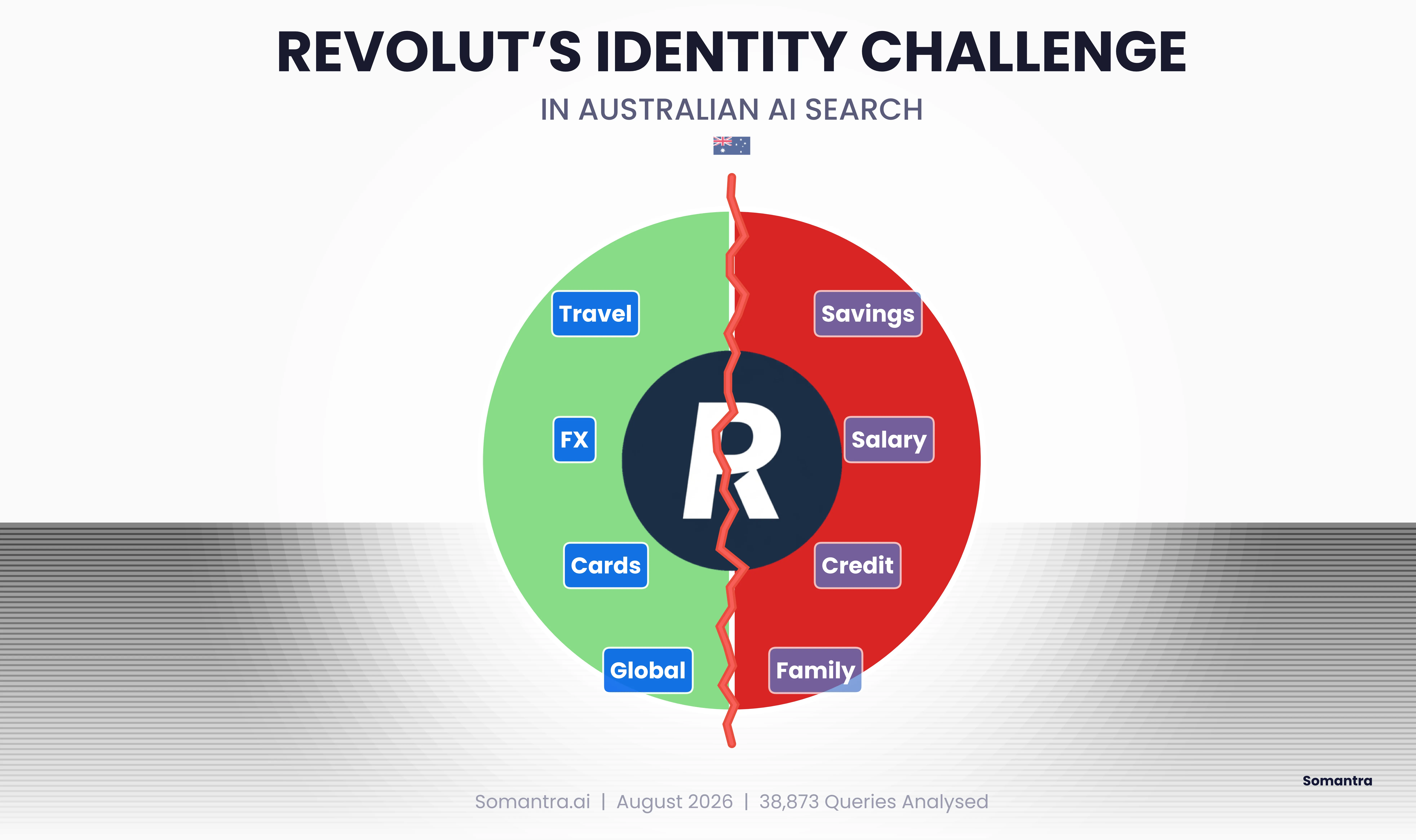
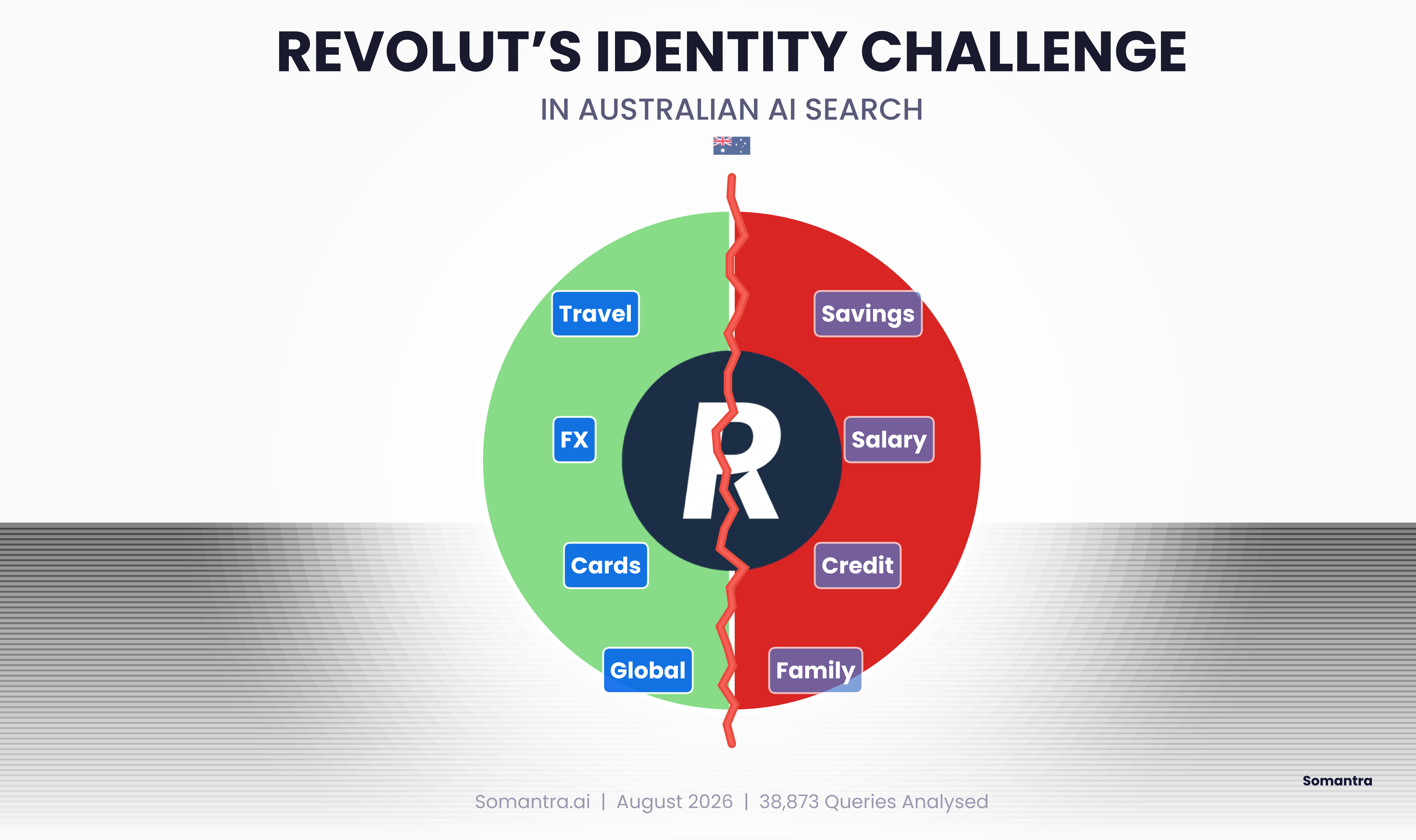
AI Search recognises Revolut well when the question matches its strengths, but it ignores the brand across many relevant baseline answers. It often does not treat Revolut as an Australian financial services company, reverting instead to its identity before becoming an authorised bank: primarily a travel, payments, and foreign-exchange fintech.
This pattern is partly shaped by pretraining. AI systems rely heavily on historical information and previously established source patterns, which means their responses can lag behind recent changes in a company’s legal status, products and market positioning. As Revolut became an authorised Australian bank less than a month before this analysis, its new status had limited time to enter the sources and representations influencing model responses. The resulting gap is therefore not simply a visibility issue: it reflects a lag between Revolut’s current Australian proposition and the information on which AI systems have been trained and continue to retrieve.
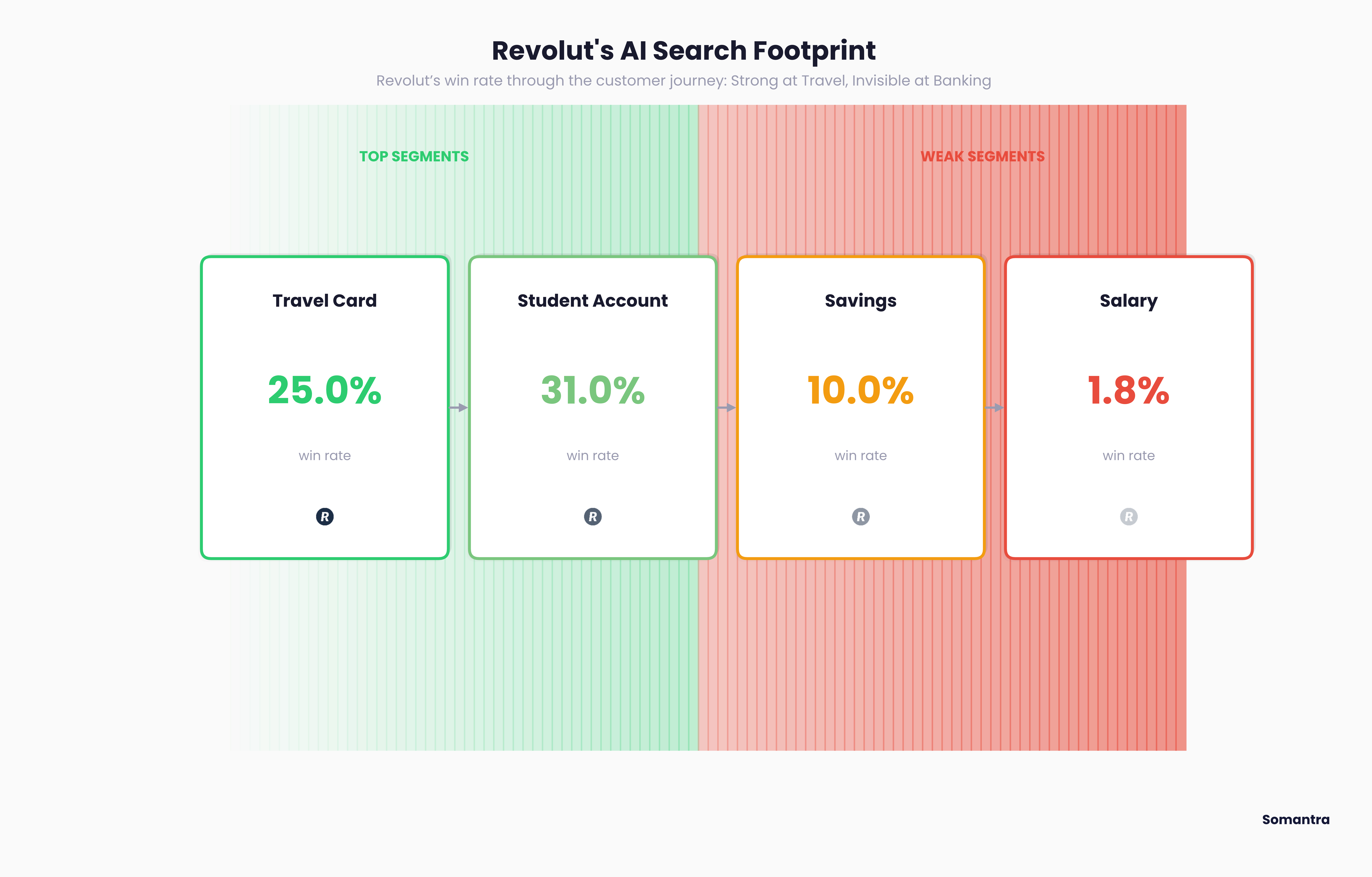
1. Breaking Into a New Segment
Revolut is no longer one product serving one financial service. Its Australian consumer business spans everyday accounts, savings, credit cards, virtual cards, foreign exchange, investing, rewards, joint accounts and Kids & Teens. Revolut Business extends the same software-led model into multi-currency accounts, corporate cards, payments, expense management, business savings and accounting integrations.
This matters for next-generation customers because their personal and commercial money lives increasingly overlap. The same person can be a university student, casual employee, creator, freelancer, marketplace seller and sole trader. A conventional bank separates those identities into product departments. Revolut presents them through related interfaces built around getting paid, controlling spend and moving money across borders.
A competitor’s page reveals how that business is being categorised outside Revolut’s own ecosystem. Airwallex’s July 2026 guide to Revolut alternatives for Australian businesses describes Revolut as familiar in international payments and particularly relevant to freelancers, gig workers and micro-businesses handling domestic payments and simpler international transfers. It contrasts that positioning with the needs of larger companies managing more complex cross-border operations.
Airwallex is not a neutral observer it is selling an alternative but that is precisely why the page matters to AI Search Brand Intelligence. Comparison pages written by competitors do not merely intercept demand. They supply category language, use cases, strengths, limitations and comparison frames that answer engines can retrieve when deciding what a brand is for.
Our data echoes that external framing.
| AI-search Topic | Prompts | Revolut distinct-query coverage | Revolut win rate when evaluated for consideration |
|---|---|---|---|
| Freelance and gig work | 124 | 23.4% | 25.0% |
| Creator and side-hustle work | 10 | 30.0% | 0.0% |
| Startup and small business | 500 | 4.0% | 9.1% |
| International student and first work | 49 | 12.2% | 25.0% |
AI search currently places Revolut closer to the independent earner than to a company that is scaling; although startups share the same 16-25 years demographich cohort. It appears across almost one-quarter of freelance and gig-work prompts, but only 4% of startup and small-business prompts.
For an emerging audience, this is more than a B2B observation. It shows where AI draws the boundary around the brand: Revolut is legible as a tool for mobile, international and independent earning but much less consistently as the financial operating layer for a growing enterprise.
That category boundary becomes the foundation for every consumer answer that follows. AI does not meet “Revolut for next-generation customers” in isolation. It meets a wider entity associated with travel, currency, cards, apps, freelancers and small international money flows.
2. One demographic, ambiguous results
Next-generation banking is not one intent. A child’s allowance, a teenager’s first card, a student’s rent, an international student’s FX needs and a graduate’s first salary are different decisions hiding under one demographic label.
The 2,042 prompts covering the targeted next-generation customers is split into overlapping territories. Students and university life lead, followed by kids and teens. Cards and payments outpace savings and budgeting. Financial independence starts with receiving, holding, and spending money, not long-term planning.
| Emerging segment territory | Prompts | Revolut coverage | Revolut win rate when evaluated |
|---|---|---|---|
| Kids and teens | 985 | 16.3% | 14.8% |
| Students and university | 1,077 | 11.7% | 31.0% |
| Travel and international students | 224 | 20.1% | 33.9% |
| Cards and payments | 742 | 24.8% | 19.9% |
| Saving and budgeting | 438 | 1.8% | 20.0% |
Revolut performs best where its existing identity meets next-generation needs: travel and international students deliver a 33.9% win rate; students and university, 31.0%. Cards and payments provide its broadest coverage at 24.8%.
The clearest gap is saving and budgeting. Revolut appears in just 1.8% of prompts in that territory, despite offering Instant Access Savings, daily interest, Pockets and salary automation in Australia. The product has expanded; AI still associates Revolut with moving money, not growing or organising it.
This is the brief’s first core finding: AI understands Revolut when money is moving across a checkout, a border or a card network. It understands the brand far less when money is staying, growing or being organised.
3. Winning the answer is the second problem. Product Discovery is first.
Across all 2,042 next-generation-related prompts, Revolut appears in 287 distinct query contexts: 14.1% coverage. Up appears in 66.4% and CommBank in 60.3%. The distinct-query visibility gap is approximately 4.7x versus Up and 4.3x versus CommBank.
| Brand | Distinct emerging queries | Coverage of emerging query set |
|---|---|---|
| Up | 1,355 | 66.4% |
| CommBank | 1,232 | 60.3% |
| Revolut | 287 | 14.1% |
This is not simply a popularity ranking. It separates two different AI-search problems: entering the answer and winning once present.
The emerging segment share-of-voice comparison reveals the full picture. When Revolut does appear in an emerging-segment evaluation, it competes well: its 22.0% win rate matches Up Bank’s 22.8% and exceeds CommBank’s 18.8%. But Up Bank generates 1,856 emerging-segment evaluations to Revolut’s 378. CommBank generates 1,190. The brand simply does not enter the conversation often enough for volume to convert into outcomes.
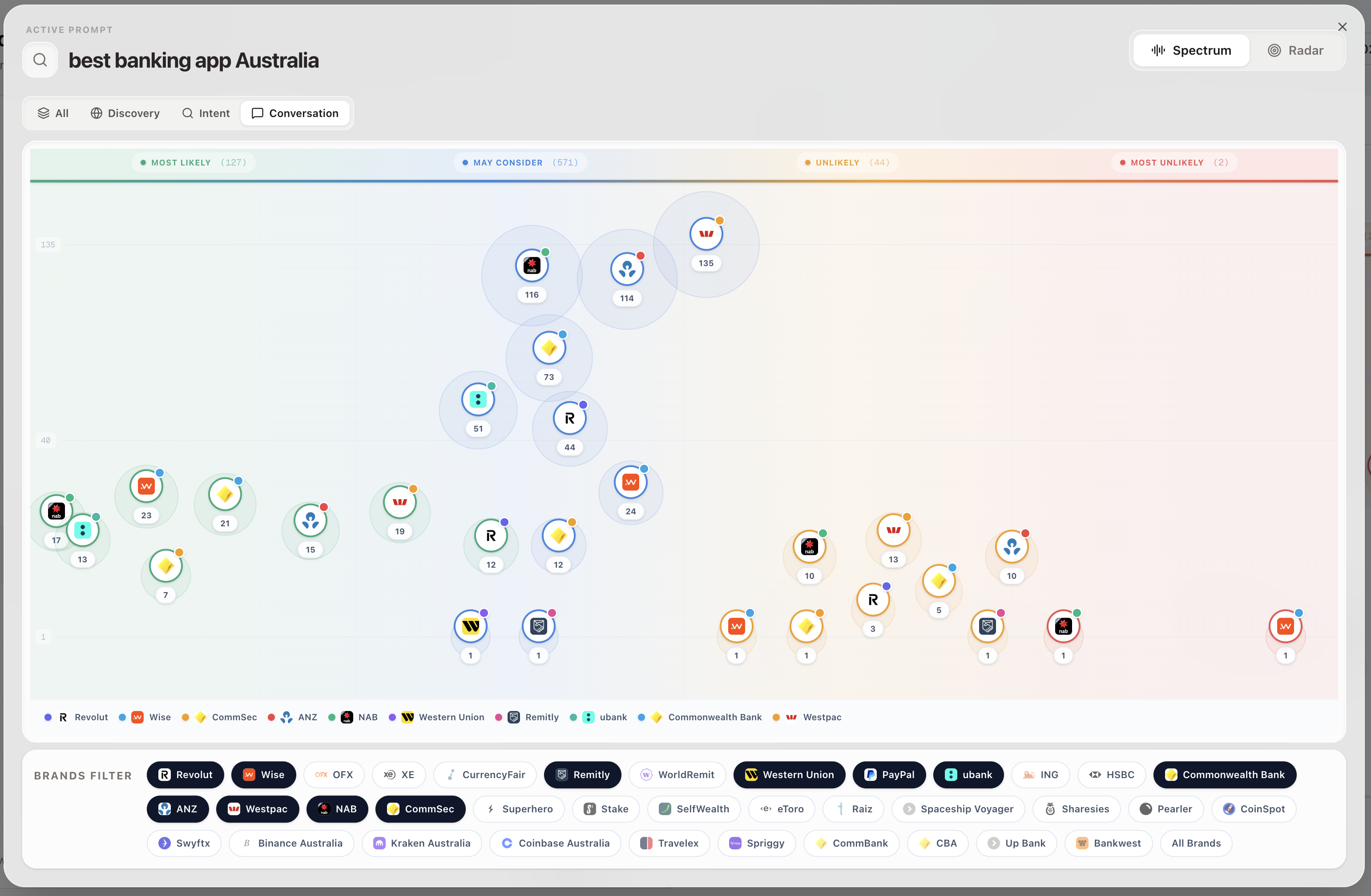
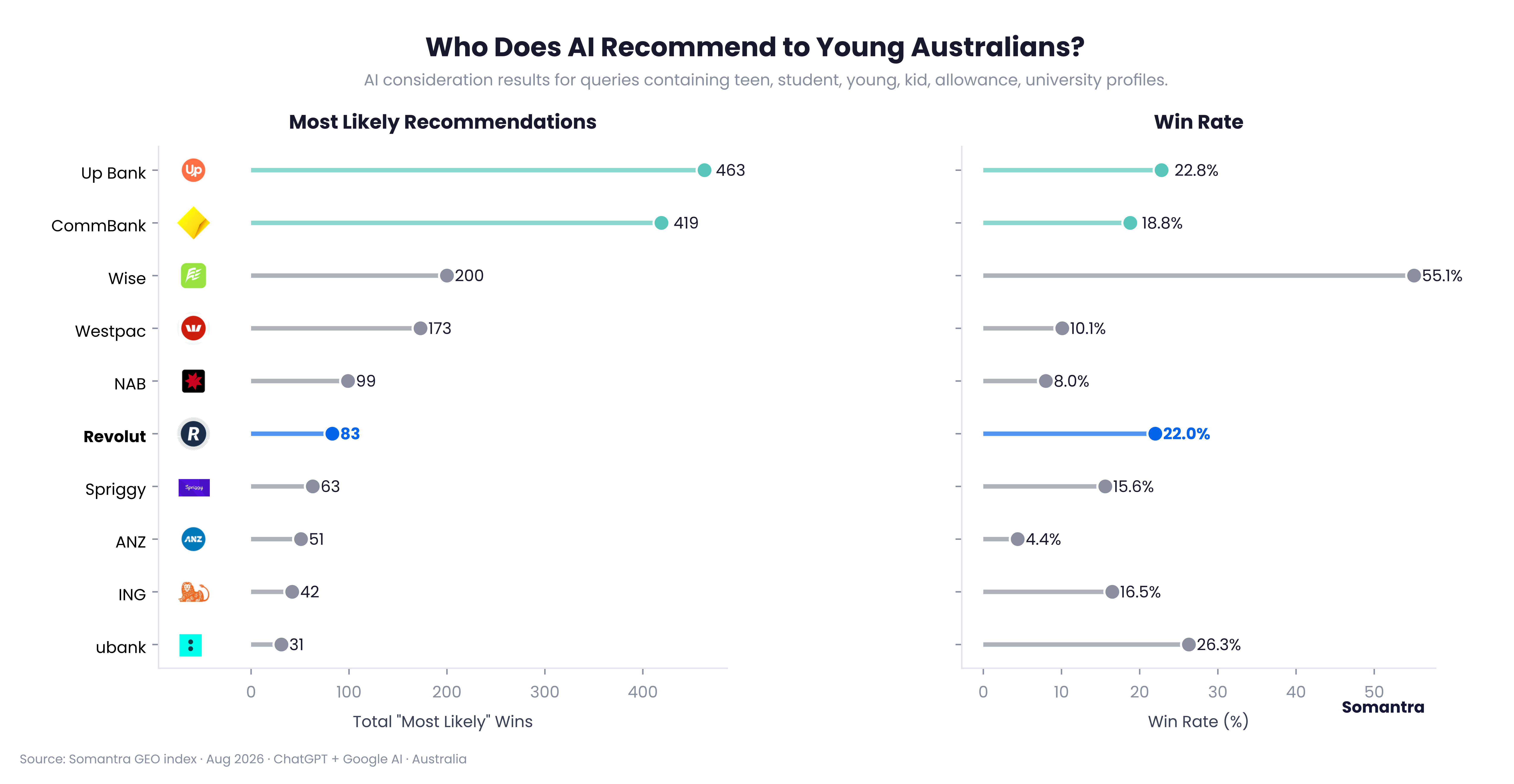
| Brand | Wins | Win Rate | Top Consideration Pick | Exclusions |
|---|---|---|---|---|
| Up Bank | 463 | 22.8% | 940 | 627 |
| CommBank | 419 | 18.8% | 1,696 | 109 |
| Wise | 200 | 55.1% | 153 | 10 |
| Revolut | 83 | 22.0% | 279 | 16 |
| Spriggy | 63 | 15.6% | 305 | 36 |
The phrase “best bank for next-generation Australians” therefore hides the real contest. The answer is assembled from hundreds of fan out queries which we measure using brand Engagement: best first debit card, best account for an international student, safest app-based bank, easiest way to split bills, best savings account without deposit conditions, best bank for travel and best account for getting paid.
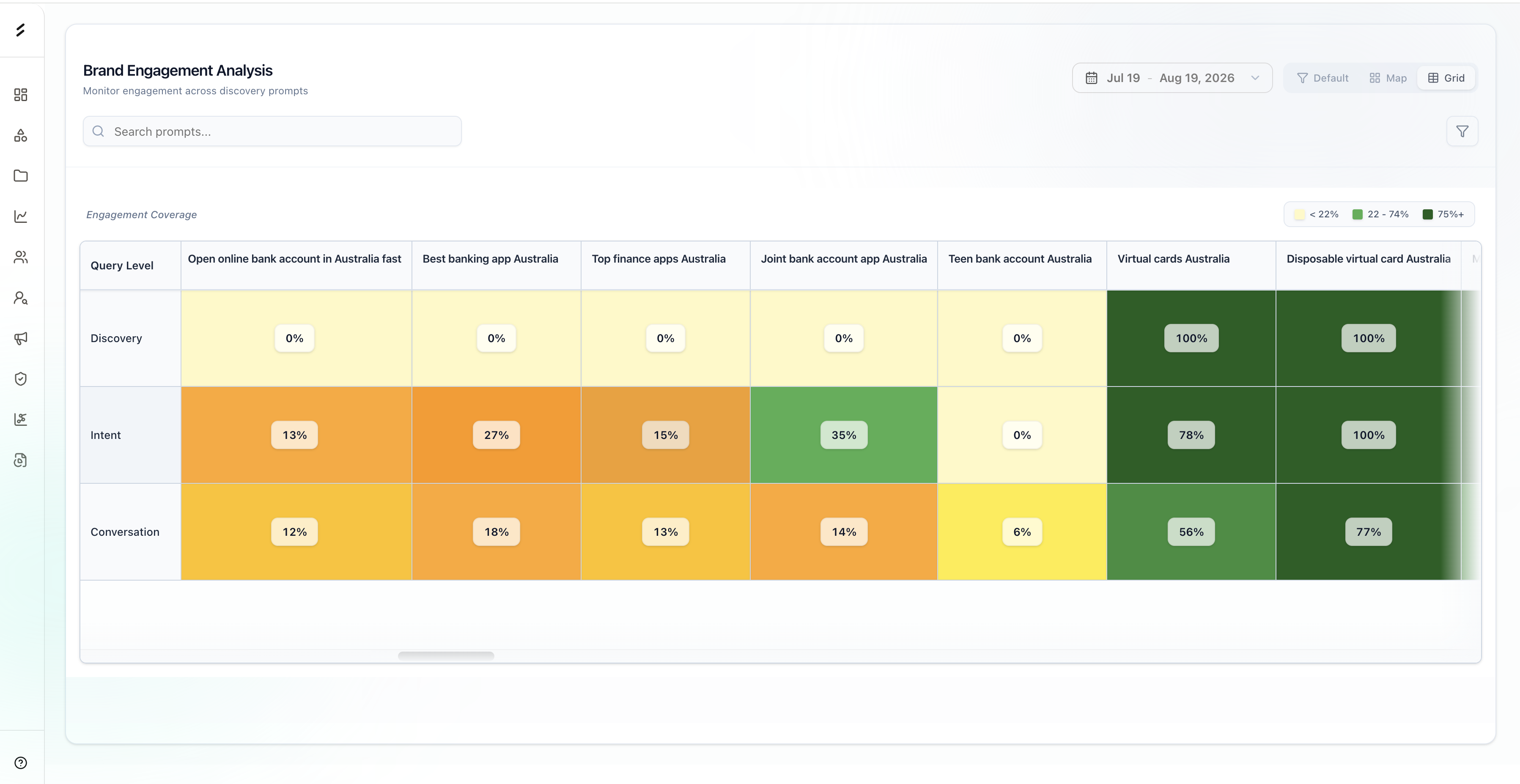
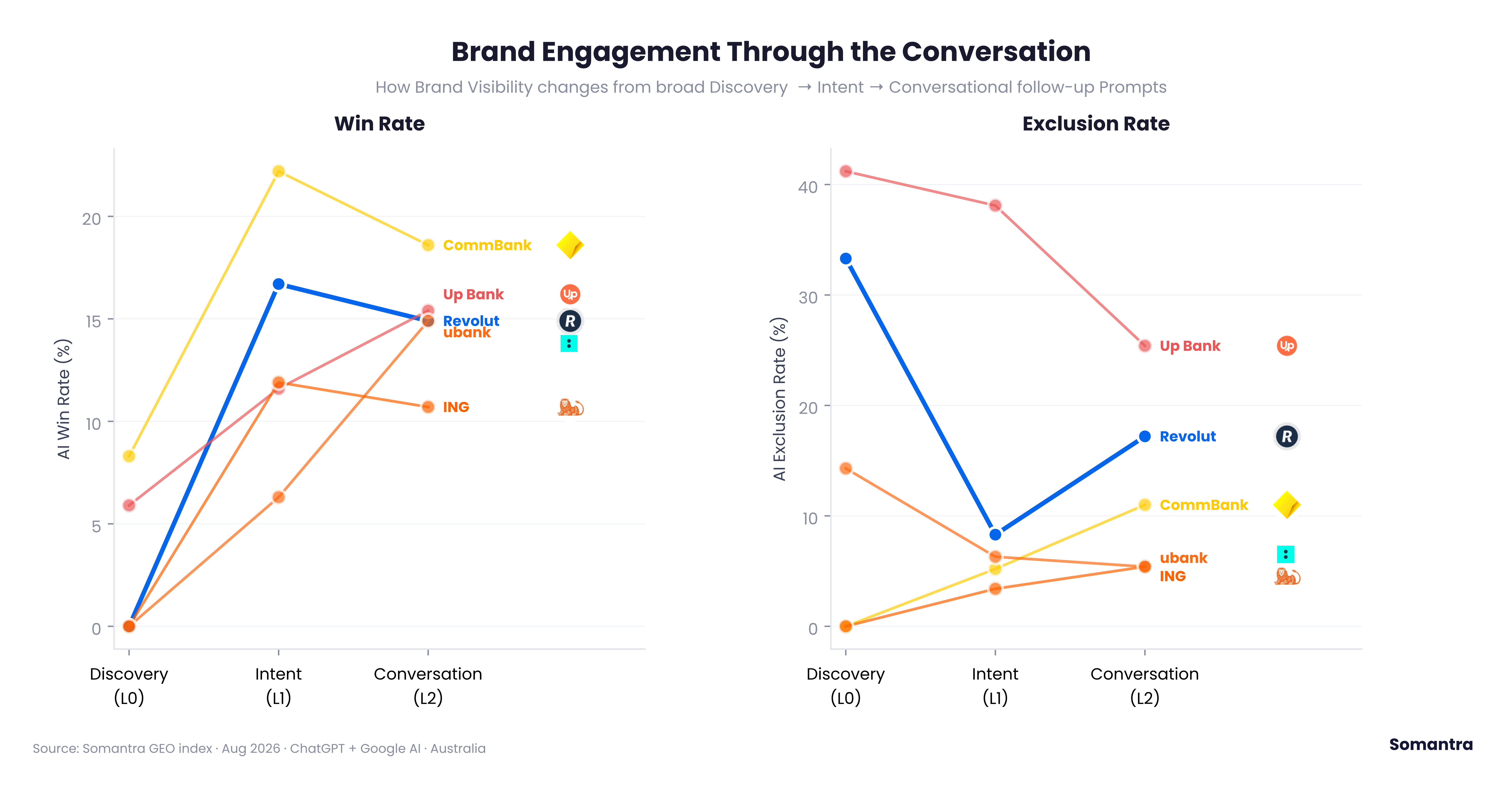
Revolut’s next-generation AI-search problem is not universal rejection. It is incomplete category retrieval. The brand is strongly recognised for travel, international students and cards, weakly positioned for saving and budgeting, and inconsistent across the wider transition into financial independence.
How Revolut ranks for next-generation customers
Next Generation is a key Ideal Customer Profile (ICP) for Revolut: a broad group that includes children, teenagers, students, international students, first-job earners and young people developing new financial behaviours.
Revolut records a 54.6 Next-Generation Consideration Score, ranking third overall behind Wise and ubank. The score combines four outcomes:
- Win rate: the percentage of evaluations in which Revolut is selected as the top recommendation.
- Consideration rate: the percentage of evaluations in which Revolut is included in the shortlist or presented as an option worth considering, whether or not it is the top recommendation.
- Exclusion rate: the percentage of evaluations in which Revolut is actively ruled out or excluded from consideration.
- Evaluations: the number of times the brand was assessed across relevant AI-search responses.
| Brand | Next-Generation Consideration Score | Win rate | Consideration rate | Exclusion rate | Evaluations |
|---|---|---|---|---|---|
| Wise | 73.4 | 55.1% | 42.1% | 2.8% | 363 |
| ubank | 60.6 | 26.3% | 72.0% | 1.7% | 118 |
| Revolut | 54.6 | 22.0% | 73.8% | 4.2% | 378 |
| CommBank | 51.1 | 18.4% | 76.2% | 5.4% | 1,190 |
| ING | 47.6 | 16.5% | 76.5% | 7.1% | 255 |
| Westpac | 46.5 | 10.1% | 84.2% | 5.7% | 1,714 |
| NAB | 44.8 | 8.0% | 85.9% | 6.1% | 1,238 |
| Spriggy | 44.4 | 15.6% | 75.5% | 8.9% | 404 |
| ANZ | 39.1 | 4.4% | 86.8% | 8.8% | 1,154 |
| Up | 9.5 | 20.0% | 46.3% | 33.7% | 1,856 |
This gives a more complete picture than visibility alone. Revolut does not appear as often as the most visible brands in next-generation AI searches. However, when it is evaluated, it is rarely excluded and is often included on the shortlist, as shown by its 73.8% consideration rate and relatively low 4.2% exclusion rate. Wise is more likely to be selected as the top recommendation, reflected in its 55.1% win rate, while ubank and the established banks are more often presented as options worth considering. Up appears across far more searches and has the highest evaluation volume, but its high 33.7% exclusion rate lowers its overall score.
The competitive picture is therefore contextual rather than absolute: Revolut is already a credible brand for the Next Generation ICP, but it is not yet a leading brand for next-generation discovery. Its 54.6 Next-Generation Consideration Score and 14.1% distinct-query coverage reveal two different challenges. Revolut competes effectively once it appears in the answer, but AI systems do not retrieve it often enough before the answer is formed.
4. Pretraining Setback
AI search still knows Revolut best as a travel, foreign-exchange and cards brand. It is much less confident when the question is about saving, organising money or choosing a trusted Australian bank.
| AI-search territory | Revolut win rate | Exclusion rate |
|---|---|---|
| Travel and FX | 25.1% | 2.2% |
| Cards | 22.9% | 3.1% |
| Next-generation | 22.7% | 3.9% |
| Trust and regulation | 14.9% | 16.8% |
| Savings | 10.1% | 7.0% |
| Investing and crypto | 12.6% | 10.2% |
The pattern is clear: AI recognises Revolut when money is moving across borders, through cards or between accounts. It is less likely to retrieve Revolut when money is staying, growing or being organised.
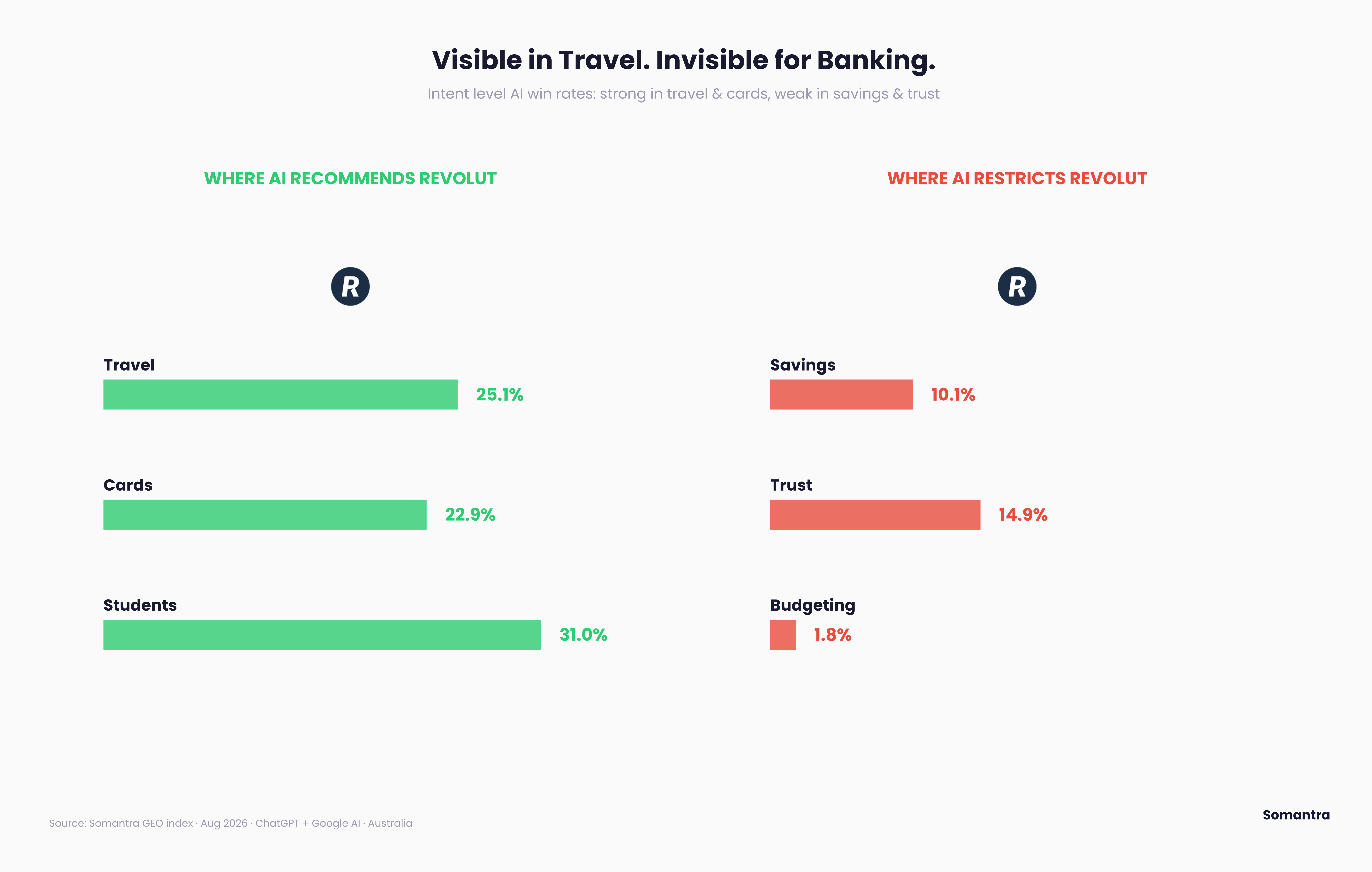
That creates a category lag. Revolut’s Australian proposition has expanded to include salary organisation, savings, credit and the ambition to become a main bank account. Its next-generation offering also spans the journey from supervised allowance to independent everyday banking. But AI still recalls the older proposition more reliably than the current one.
A customer asking about the best travel card is likely to see Revolut. The same customer asking how to organise their first salary or where to keep savings may not.
The problem is more serious in trust-related searches. APRA granted Revolut Payments Australia its ADI licence on 21 July 2026 and Revolut introduced local savings and credit products.
Yet in August 2026 audit, 28.5% of 404 trust-related Revolut records still used stale regulatory framing. A further 39.6% mentioned Revolut without clearly resolving its status.
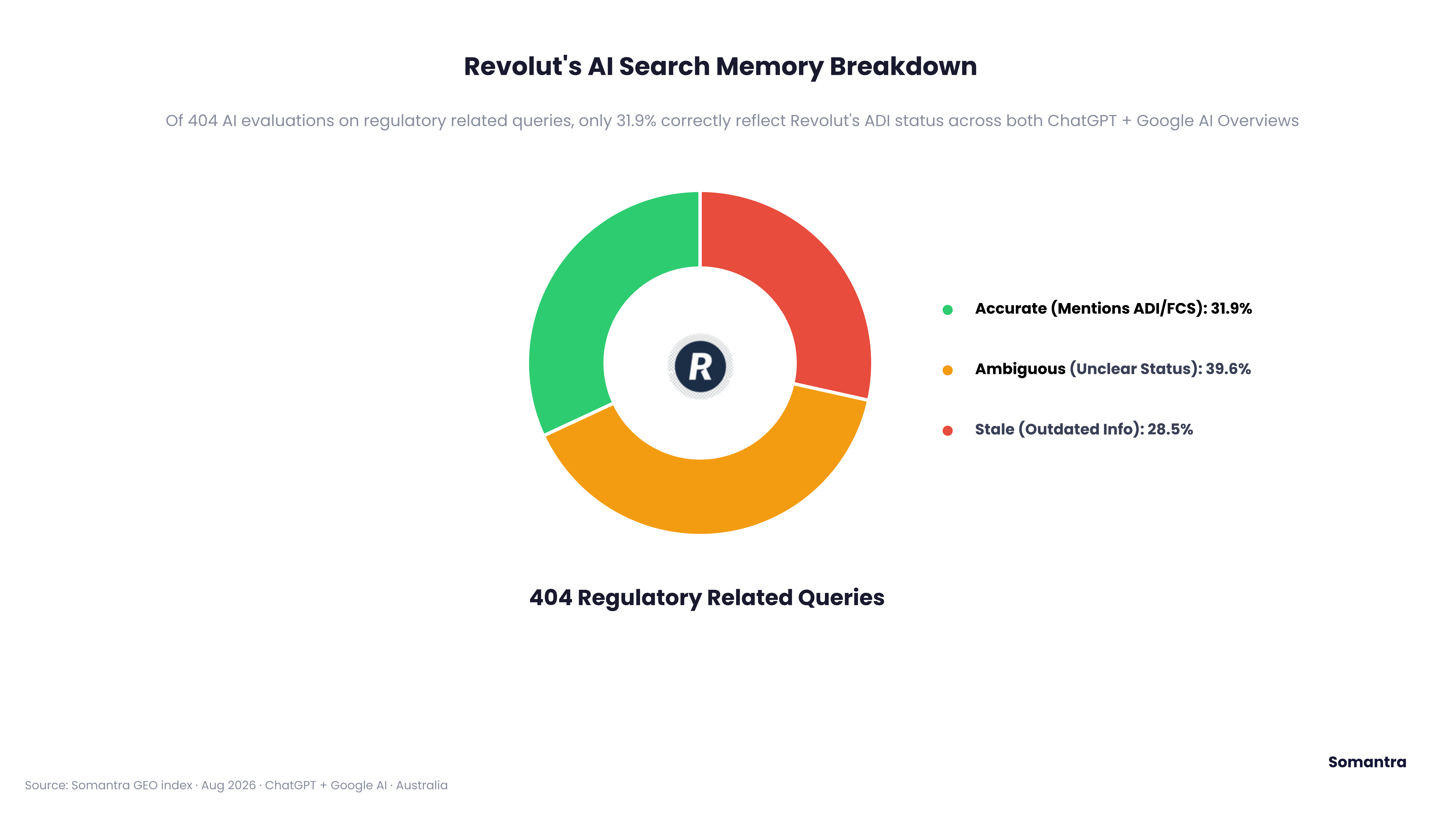
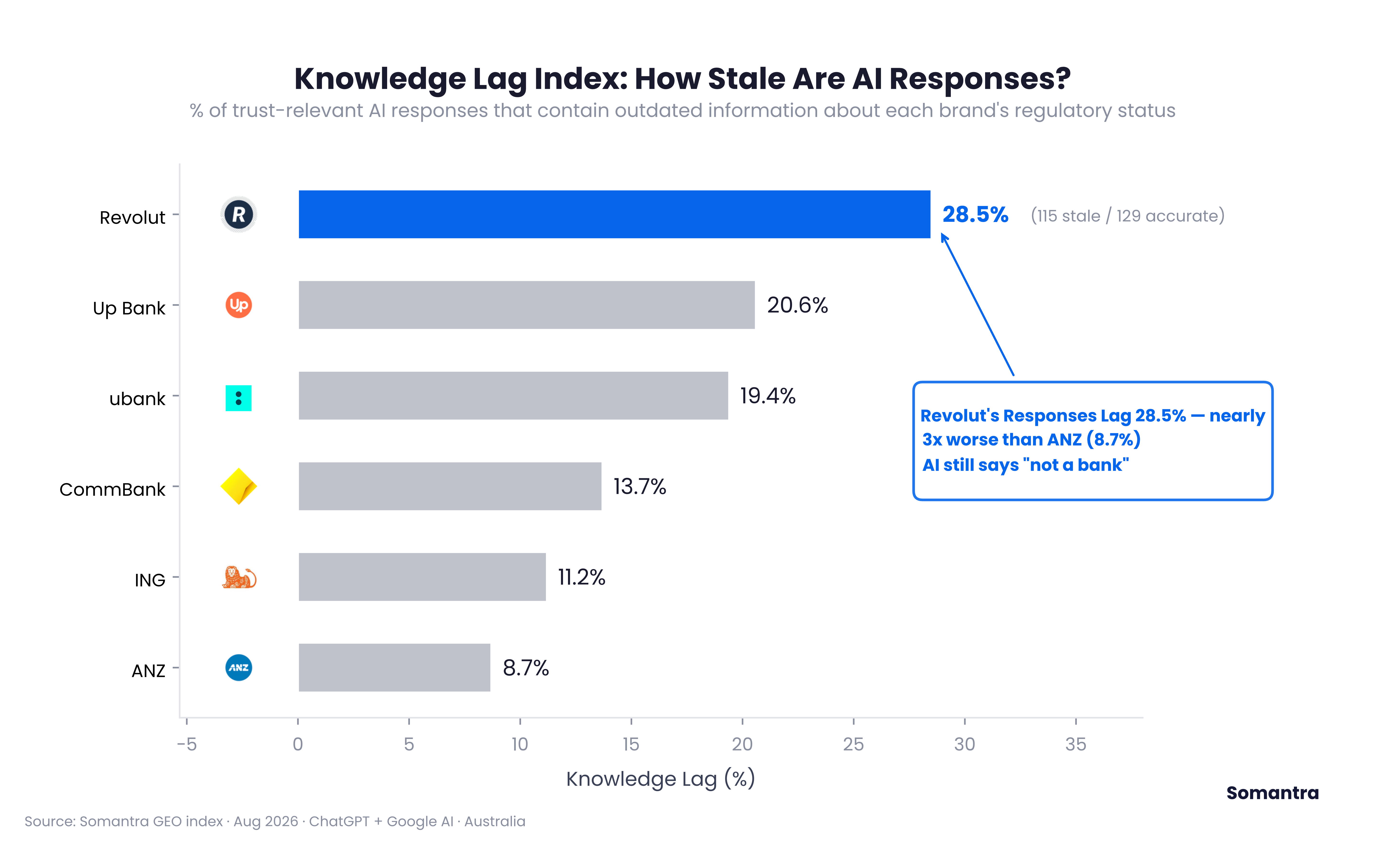
The Knowledge Lag Index (KLI) is a directional measure of how far AI systems’ understanding of a brand lags behind its current regulatory status and market proposition. A higher KLI indicates a greater knowledge lag.
| Brand | KLI Score | Accurate | Stale | Ambiguous | Total |
|---|---|---|---|---|---|
| Revolut | 28.5% | 129 | 115 | 160 | 404 |
| Up Bank | 20.6% | 2,665 | 1,231 | 2,075 | 5,971 |
| ubank | 19.4% | 190 | 82 | 151 | 423 |
| CommBank | 13.7% | 458 | 183 | 690 | 1,331 |
| ING | 11.2% | 198 | 53 | 224 | 475 |
| ANZ | 8.7% | 254 | 65 | 428 | 747 |
Revolut’s KLI of 28.5% is 3.3 times worse than ANZ and twice as bad as CommBank. The new ADI status has not yet reached the sources and information patterns that AI systems rely on.
What customers are discovering
When Australians ask AI whether Revolut is safe, models still produce answers such as:
- “Revolut, being a foreign fintech and not an APRA-authorised deposit-taking institution, is generally not covered.”
- “Many digital payment platforms, including Revolut, are not covered because they are not authorised deposit-taking institutions.”
- “Revolut may be an example of a digital bank that is not covered by the FCS.”
- “Virtual cards issued by fintechs such as Revolut typically are not covered.”
The commercial impact is immediate:
| Knowledge status | Records | Win rate | Exclusion rate |
|---|---|---|---|
| Accurate | 129 | 15.5% | 6.2% |
| Ambiguous | 160 | 23.1% | 3.8% |
| Stale | 115 | 2.6% | 47.0% |
Stale records produced just a 2.6% win rate and a 47.0% exclusion rate. Accurate records produced a 15.5% win rate and only a 6.2% exclusion rate. Fifty-four of Revolut’s 68 trust-related exclusions came from the stale group.
5. PDPs (Product Description Pages) build signals, AI builds trust. Revolut just has one.
The same consideration logic becomes much harsher in trust-focused prompts. Revolut’s directional Trust & Safety Framing Score is +32.2, placing it eighth in the nine-brand benchmark. Its 14.9% trust win rate is not negligible, but its 16.8% exclusion rate is the second highest in the set.
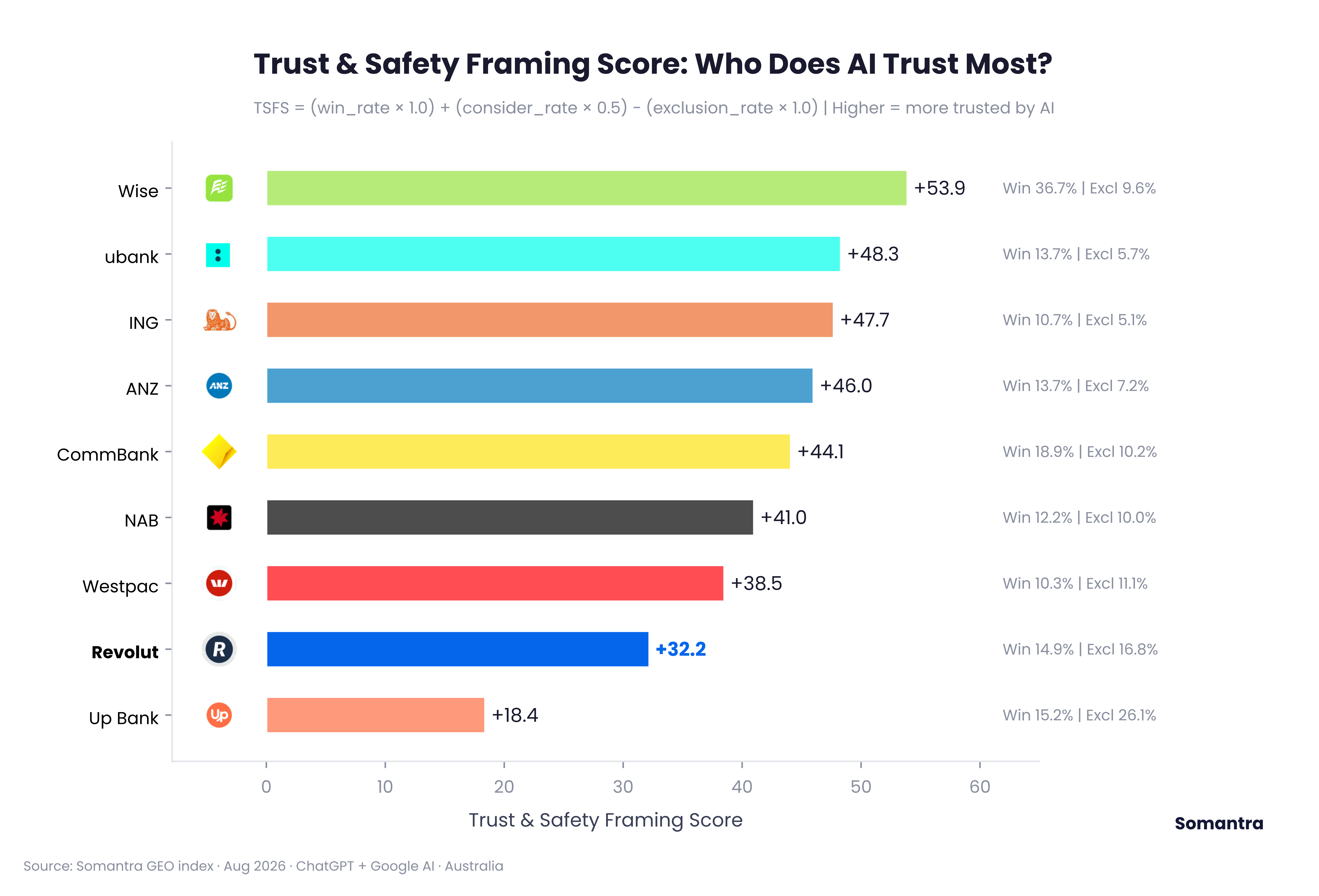
| Rank | Brand | Trust consideration score | Win rate | Consider rate | Exclusion rate |
|---|---|---|---|---|---|
| 1 | Wise | +53.9 | 36.7% | 53.6% | 9.6% |
| 2 | ubank | +48.3 | 13.7% | 80.6% | 5.7% |
| 3 | ING | +47.7 | 10.7% | 84.2% | 5.1% |
| 4 | ANZ | +46.0 | 13.7% | 79.1% | 7.2% |
| 5 | CommBank | +44.1 | 18.9% | 70.8% | 10.2% |
| 6 | NAB | +41.0 | 12.2% | 77.7% | 10.0% |
| 7 | Westpac | +38.5 | 10.3% | 78.6% | 11.1% |
| 8 | Revolut | +32.2 | 14.9% | 68.3% | 16.8% |
| 9 | Up | +18.4 | 15.2% | 58.7% | 26.1% |
The key CMO implication is that Revolut is credible once it enters next-generation banking conversations, but it loses trust when AI shifts to safety, licensing, and deposit protection. Its product creates confidence through mobile control, while answer engines decide permission to try it using regulatory facts, authoritative sources, and familiar category language. Revolut therefore needs to close the gap between its current Australian bank proposition and its legacy travel-and-payments identity. It can do this by making its status, eligible deposit protection, savings, and everyday banking role consistently visible across authoritative third-party, regulatory, and community sources—not just product pages.
6. Aussie Banking Trust Authorities
Across the banking citation ecosystem, Finder, CommBank, Reddit, Canstar and Wise are the five most visible domains in the dataset. Google AI Overviews contributes substantially more raw citation records than ChatGPT, so the chart shows citation presence rather than a normalised engine preference.
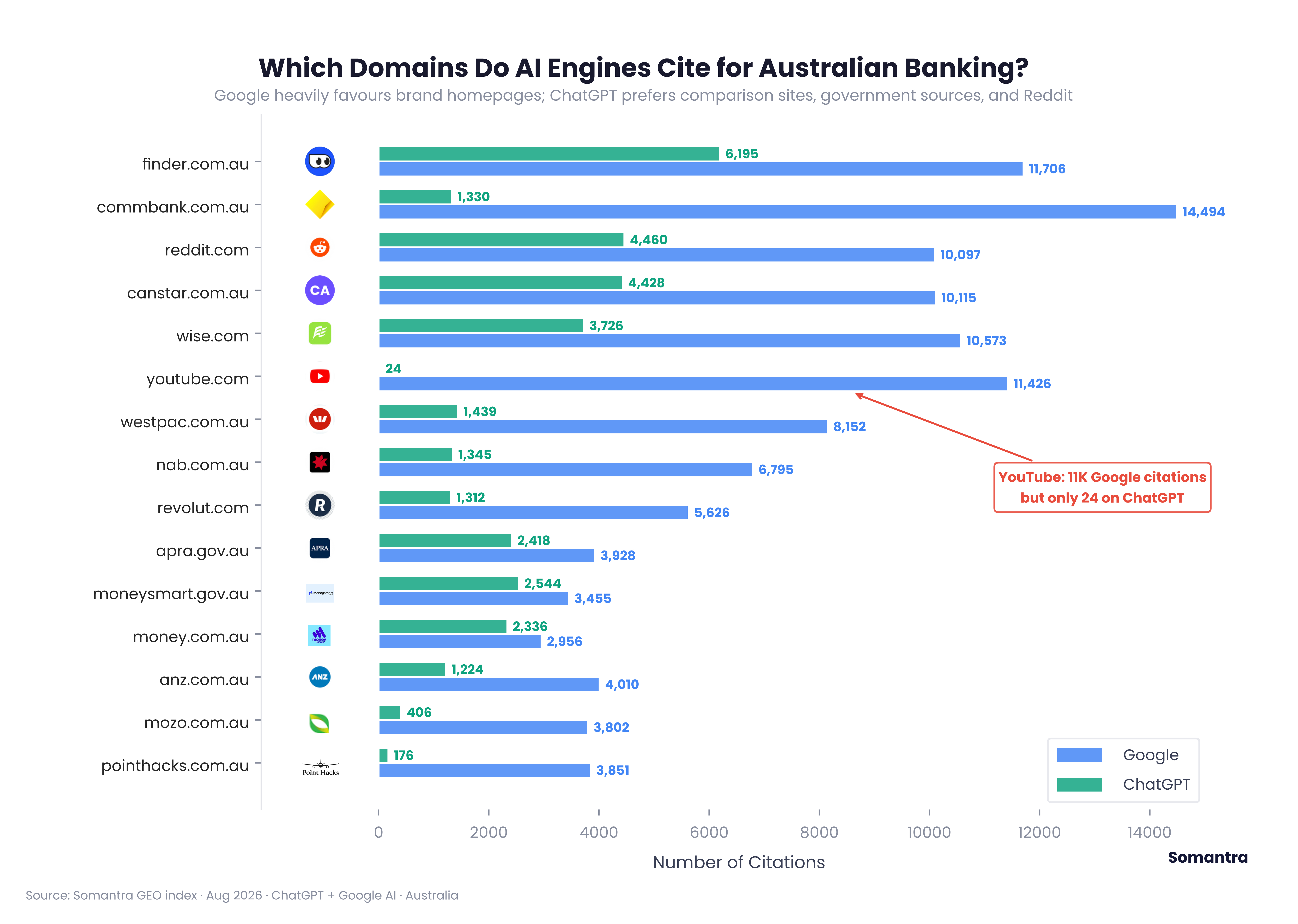
The top 5 most-cited domains control 22.2% of all AI citations for Australian banking queries:
| Domain | Total Citations | Share | ChatGPT | AI Overviews |
|---|---|---|---|---|
| finder.com.au | 17,901 | 5.16% | 6,195 | 11,706 |
| commbank.com.au | 15,824 | 4.56% | 1,330 | 14,494 |
| reddit.com | 14,557 | 4.20% | 4,460 | 10,097 |
| canstar.com.au | 14,543 | 4.19% | 4,428 | 10,115 |
| wise.com | 14,299 | 4.12% | 3,726 | 10,573 |
The mix demonstrates why AI-search identity is not owned by the brand alone. Revolut’s pages define the intended proposition. APRA defines regulatory status. Comparison publishers organise alternatives. Competitors publish head-to-head evaluations. Communities contribute lived experience. AI systems assemble an answer from the overlap.
The trust subset is even more concentrated around external authority. Revolut-owned pages represent only 0.4% of ChatGPT trust citations and 1.0% of Google AI Overviews trust citations. APRA and FCS sources together represent 34.2% of ChatGPT’s trust citations.
| Trust citation group | ChatGPT | Google AI Overviews |
|---|---|---|
| APRA | 17.5% | 7.5% |
| FCS | 16.7% | — |
| Comparison sites | 11.4% | 8.8% |
| 4.5% | 3.7% | |
| Revolut-owned | 0.4% | 1.0% |
To a next-generation customer, the source architecture is largely invisible. They see a single answer. We see the network of publishers, regulators, competitors and communities that made the answer possible.
ChatGPT and Google Rely On Different Trust Signals, We Break It Down
Google and ChatGPT trust different parts of the web.
Google favours brand owned pages. CommBank gets 14,494 Google citations but only 1,330 from ChatGPT, an 11 to 1 split. Westpac shows a similar pattern at 5.6 to 1. Google rewards strong domains, structured data and backlinks, which established brands have built over time.
ChatGPT favours independent sources. Reddit gets 4,460 ChatGPT citations and 10,097 Google citations. Finder has a 0.53 ratio. Canstar has 0.44. These sources offer comparison, community views and real user experience.
Government sites matter most for trust. APRA has a 0.62 ChatGPT to Google ratio. Moneysmart has 0.74. When someone asks if their money is safe, ChatGPT looks to APRA before revolut.com.
Social platforms often do not reach ChatGPT. YouTube gets 11,426 Google citations but only 24 from ChatGPT. Facebook gets 3,477 from Google and just 1 from ChatGPT. If your strategy relies on social video or Meta, it may be missing from AI answers.
| Domain | ChatGPT citations | Google citations | ChatGPT:Google ratio | What it means |
|---|---|---|---|---|
| commbank.com.au | 1,330 | 14,494 | 0.09 | Google’s web; ChatGPT barely cites brand pages |
| reddit.com | 4,460 | 10,097 | 0.44 | Even split; community carries weight on both |
| finder.com.au | 6,195 | 11,706 | 0.53 | Comparison sites bridge both engines |
| apra.gov.au | 2,418 | 3,928 | 0.62 | ChatGPT’s trust regulator |
| moneysmart.gov.au | 2,544 | 3,455 | 0.74 | ChatGPT’s consumer protection source |
| youtube.com | 24 | 11,426 | 0.002 | Invisible to ChatGPT |
| facebook.com | 1 | 3,477 | 0.0003 | Invisible to ChatGPT |
For marketers, the implication is Google rewards what the brand controls. ChatGPT rewards what independent sources say about the brand. A next-generation customer asking Google sees the brand’s own page first. A next-generation customer asking ChatGPT sees Finder, Reddit and APRA first and those sources decide whether Revolut is recommended, mentioned or ignored.
7. Reddit is the Workhorse behind Revolut’s AI recommendations
Queries citing Reddit produced stronger outcomes for Revolut: a 28.3% win rate when Reddit appeared without major comparison sites, versus 16.6% when neither source appeared.
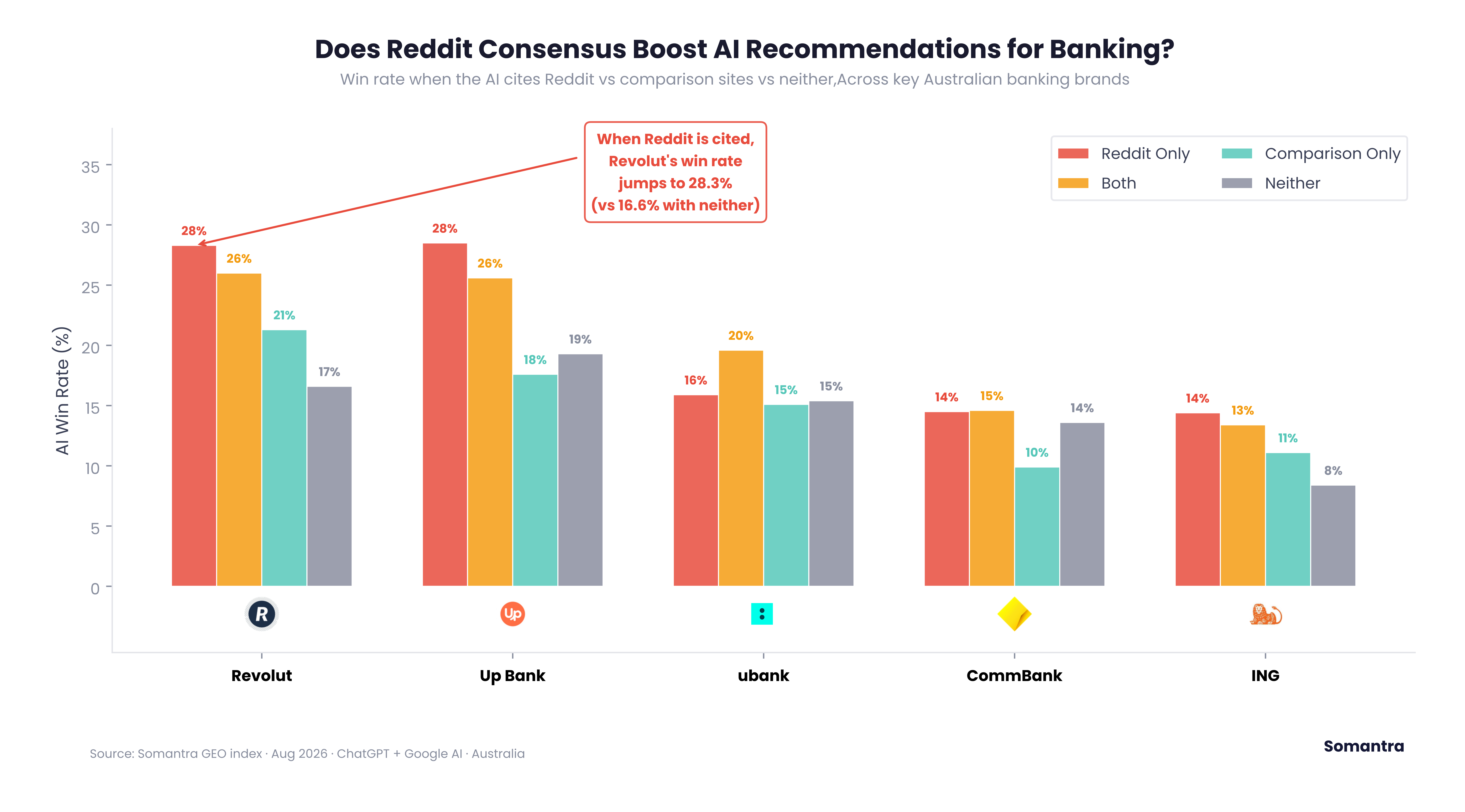
| Citation context | Revolut win rate | Up Bank win rate | CommBank win rate |
|---|---|---|---|
| Reddit only | 28.3% | 28.5% | 14.5% |
| Both Reddit + comparison | 26.0% | 25.6% | 14.6% |
| Comparison sites only | 21.3% | 17.6% | 9.9% |
| Neither | 16.6% | 19.3% | 13.6% |
This is a correlation, not proof that Reddit causes higher recommendation rates. But the pattern is logical: regulators establish safety, product pages explain features and communities provide real-world experience how cards, transfers and accounts work in everyday situations. That experience-based language also mirrors AI prompts: what worked, what failed, what cost more than expected and what users would choose again.
For Revolut, Reddit reinforces its established strengths in travel, cards, transfers and mobile control. Its newer savings and Australian-bank positioning have had less time to build the same searchable body of experience. The resulting 70% lift in win rate is therefore not a social-media metric. It is an AI citation signal: evidence of what people believe Revolut is useful for.
8. Revolut’s Product Offering Based Visibility
Revolut’s product offerings in Australia spans seven distinct tiers: Standard, Plus, Premium, Metal, Ultra, Savings and a generic “Revolut”. Each tier generates its own consideration profile in AI search, and the differences reveal how answer engines evaluate value, trust and upgrade pressure.
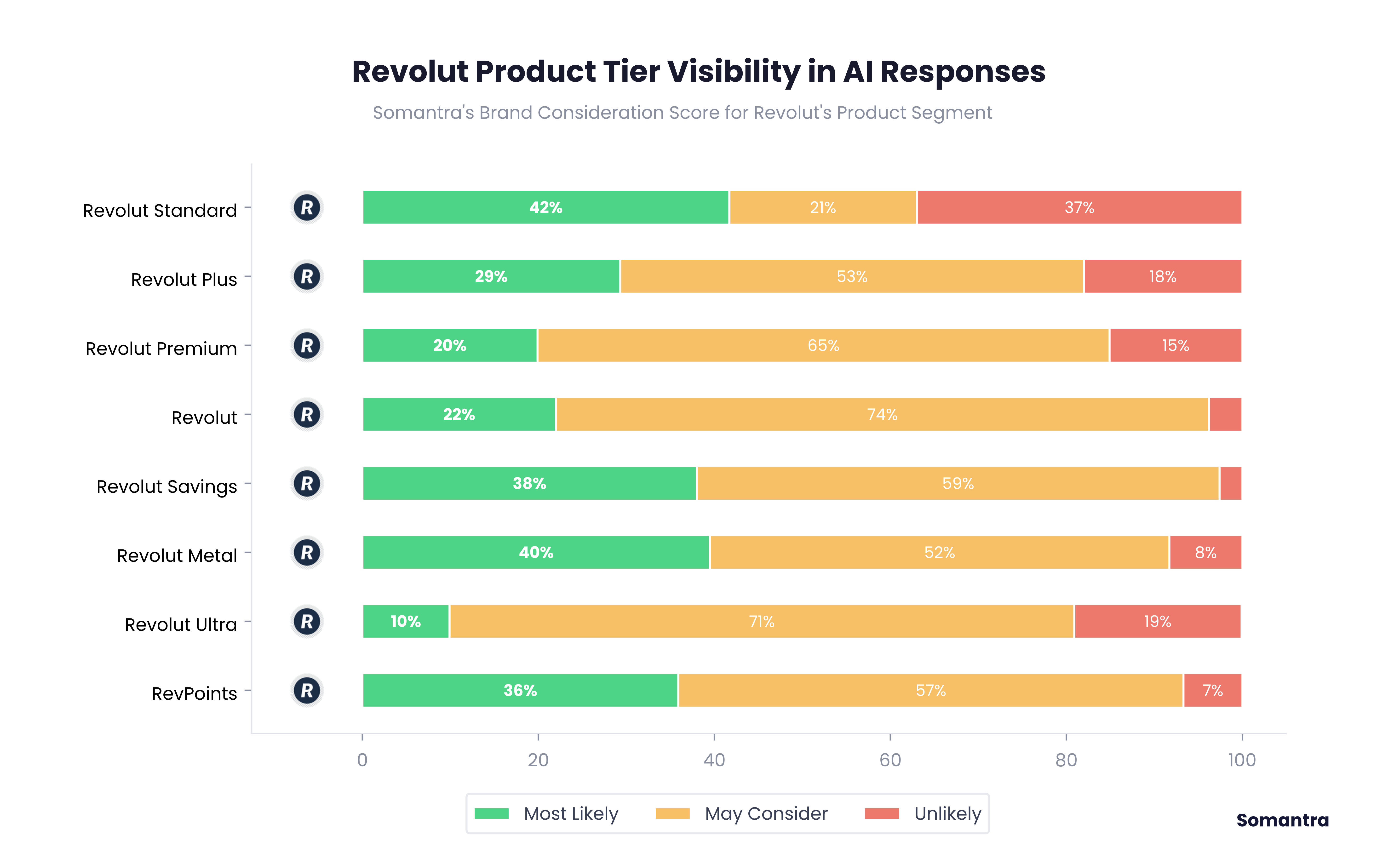
| Tier | Evaluations | Win rate | Consider rate | Exclusion rate |
|---|---|---|---|---|
| Revolut Standard | 16,713 | 41.7% | 21.3% | 37.0% |
| Revolut Plus | 8,650 | 29.3% | 52.7% | 18.0% |
| Revolut Premium | 8,452 | 19.9% | 65.0% | 15.1% |
| Revolut (generic) | 8,100 | 22.0% | 74.2% | 3.8% |
| Revolut Savings | 1,078 | 38.0% | 59.4% | 2.6% |
| Revolut Metal | 869 | 39.5% | 52.2% | 8.3% |
| Revolut Ultra | 794 | 9.9% | 71.0% | 19.0% |
Standard is the most polarising tier: it has the highest win rate (41.7%) but also the highest exclusion rate (37.0%), suggesting AI strongly recommends or rejects it in upgrade comparisons. Premium is widely considered but less often selected, while Ultra is viewed as over-specified for typical users. Savings performs strongly, with a 38.0% win rate and only 2.6% exclusion, likely because its FCS-protected daily interest rate offers a clear, simple value proposition. For marketers, the tier data reveals something most product teams do not see: AI does not evaluate your pricing page the way a customer does. It evaluates each tier as a separate brand entity with its own consideration profile. The Standard tier is not “Revolut with fewer features” in AI search; it is a distinct product that triggers distinct consideration logic, including active arguments based on the conversation itself. Managing that perception requires treating each tier’s AI-search profile as its own marketing profile.
9. Caveat: Revolut’s next-generation banking journey still has a visibility gap
As of our August 2026 Audit, AI search recognises parts of Revolut’s offering as highly relevant.
| Owned positioning | Corresponding AI-search signal |
|---|---|
| International, mobile money | 33.9% win rate on travel/international-student emerging evaluations |
| Cards and instant spending | 24.8% emerging-segment-query coverage |
| Student utility | 31.0% win rate when evaluated on student/university prompts |
| Freelancers and independent earners | 23.4% coverage across freelance/gig prompts |
| Savings and money organisation | Only 1.8% coverage across next-generation saving/budgeting prompts |
| Licensed Australian bank | 28.5% of automated trust classifications still marked stale |
The gap is not that AI search has failed to understand Revolut entirely. It has understood an earlier, narrower version exceptionally well. Revolut is visible where money moves. It is less visible where money settles into the long-term behaviours of banking: saving, budgeting, salary organisation and regulatory trust.
That is the central next-generation insight. Revolut’s owned brand describes a financial relationship that can grow from first card to first salary. Its AI-search brand still behaves more like a travel-and-payments utility that occasionally becomes a bank.
Conclusion
AI search is becoming the first touchpoint for next-generation customers. It retrieves an identity from signals like official pages, regulators, comparison publishers, government pages, competitors and communities.
Revolut is a particularly interesting case for us to monitor because the business has evolved rapidly as it set sails to a new market crowded with legacy incumbents. It now spans consumer banking, youth accounts, savings, credit and business finance. Its Australian licence creates a formal trust signal. Its mobile products cover the financial behaviours of students, travellers, freelancers and next-generation workers. Yet AI search still concentrates Revolut around cards, FX and movement.
We will measure the distance between those two versions of the company:
- How does Revolut stand on a next-generation customer journey?
- Which sources and comparisons constructed that belief?
- Where does the answer diverge from the business and products available today?
That distance is not a conventional search ranking. It is brand intelligence to drive adoption.
Data note: Somantra.ai analysed 192,440 brand-consideration records across 38,873 Australian banking prompts in an August 2026 snapshot. The next-generation subset contains 2,042 prompts. Automated knowledge-status and keyword-theme classifications are directional and should be validated before use as regulated public claims. Google observations refer to Google AI Overviews data. Trust & Safety Framing Score is a directional composite of recommendation, consideration and exclusion outcomes. Airwallex, Wise are Revolut competitors but do not have a banking license and do not compete in deposits and savings products/services.

About the author
Arun Prasad
Founder, Somantra
Arun Prasad is the founder of Somantra, an AI search visibility platform for brands, where he writes about answer engine optimisation (AEO) and AI search. His research analyses how brands surface in AI answers across ChatGPT and Google AI Overviews, including Somantra's studies of the Australian insurance market. He focuses on measuring brand visibility through systematic, large-scale conversational testing rather than one-off screenshots.

About the author
Yajat S
Yajat S is a researcher at Somantra, where he analyses how brands surface in AI search across ChatGPT and Google. He authored Somantra's Australian insurance citation study covering 2.4 million AI search citations, focused on the content formats and URL patterns that get cited by answer engines.