
Summary
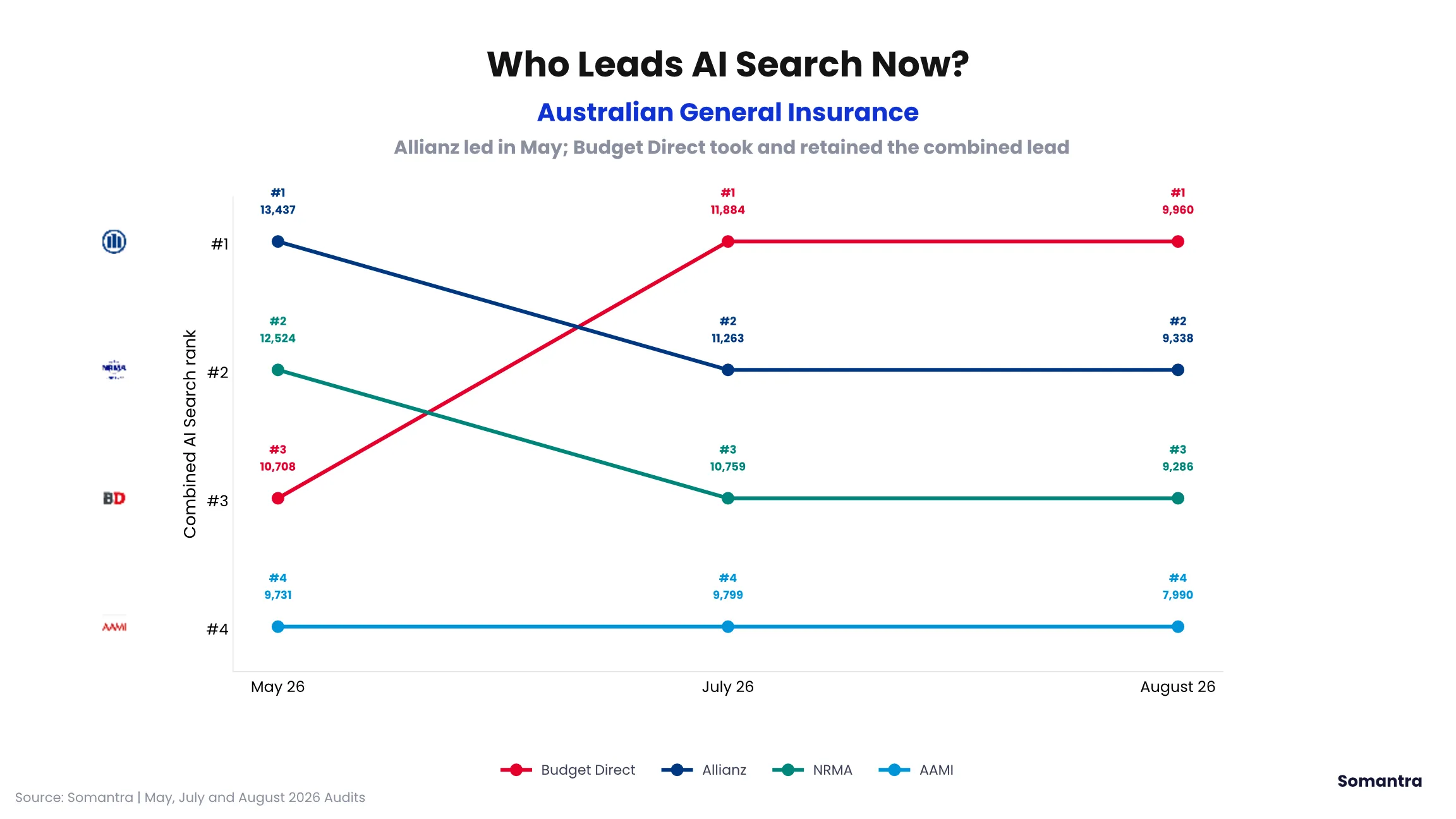
- Budget Direct is the current combined leader: it moved from #3 in May to #1 in July and remains #1 in August with 9,960 observed mentions. Allianz led the May baseline.
- The platform leaderboard has shifted: Budget Direct continues as #1 in Google AI Overviews (5,771 mentions), while NRMA has overtaken Allianz to lead ChatGPT (5,649 mentions), ahead by 83 mentions.
- Short term volatility was observed: Budget Direct is down 4.4%, Allianz down 5.4%, AAMI down 6.0%, while ING is up 4.2% on the July August audit. These fluctuations do not alter the August leader order.
- Canstar remains the leading Citations in AI Search domain across all three audits; ChatGPT’s leading domain changed from Finder in May to Canstar in July and remains Canstar in August. -In August we have introduced a new diagnostic metric for AI Search: First Seen exposure, response level Brand Consideration, citation decay and controlled modifier analysis.
1. Changes from May: who leads now?
The May baseline named Allianz as the combined AI Search leader, with NRMA second and Budget Direct third. The July audit changed that order: Budget Direct took #1. The August snapshot confirms that the lead has held, even though the matched July to August cohort records a 4.4% decline in Budget Direct mentions.
| Brand | May baseline | July checkpoint | August current |
|---|---|---|---|
| Budget Direct | #3: 10,708 | #1: 11,884 | #1: 9,960 |
| Allianz | #1: 13,437 | #2: 11,263 | #2: 9,338 |
| NRMA | #2: 12,524 | #3: 10,759 | #3: 9,286 |
| AAMI | #4: 9,731 | #4: 9,799 | #4: 7,990 |
August’s combined leader margin is 622 mentions over Allianz and 674 over NRMA.
The current leader depends on the engine
| Snapshot | Combined leader | Google AI Overviews leader | ChatGPT leader |
|---|---|---|---|
| May 2026 | Allianz: 13,437 | Budget Direct: 8,556 | Allianz: 5,461 |
| July 2026 | Budget Direct: 11,884 | Budget Direct: 7,625 | NRMA: 5,536 |
| August 2026 | Budget Direct: 9,960 | Budget Direct: 5,771 | NRMA: 5,649 |
Budget Direct has been the Google AI Overviews leader in every audit. ChatGPT is a separate race, Allianz led the May audit, while NRMA led July and remains the August ChatGPT leader. A combined rank therefore cannot stand in for the engine-specific answer experience.
What can be called movement
The clean short-term comparison remains the overlapping July to August question cohort. Among brands with at least 500 July matched mentions, ING rises +4.21%; Budget Direct falls −4.40%, Allianz −5.37%, AAMI −6.03% and NRMA −6.16%. These results describe visibility on the shared audit questions only.
2. Current visibility: what the August leaderboards say
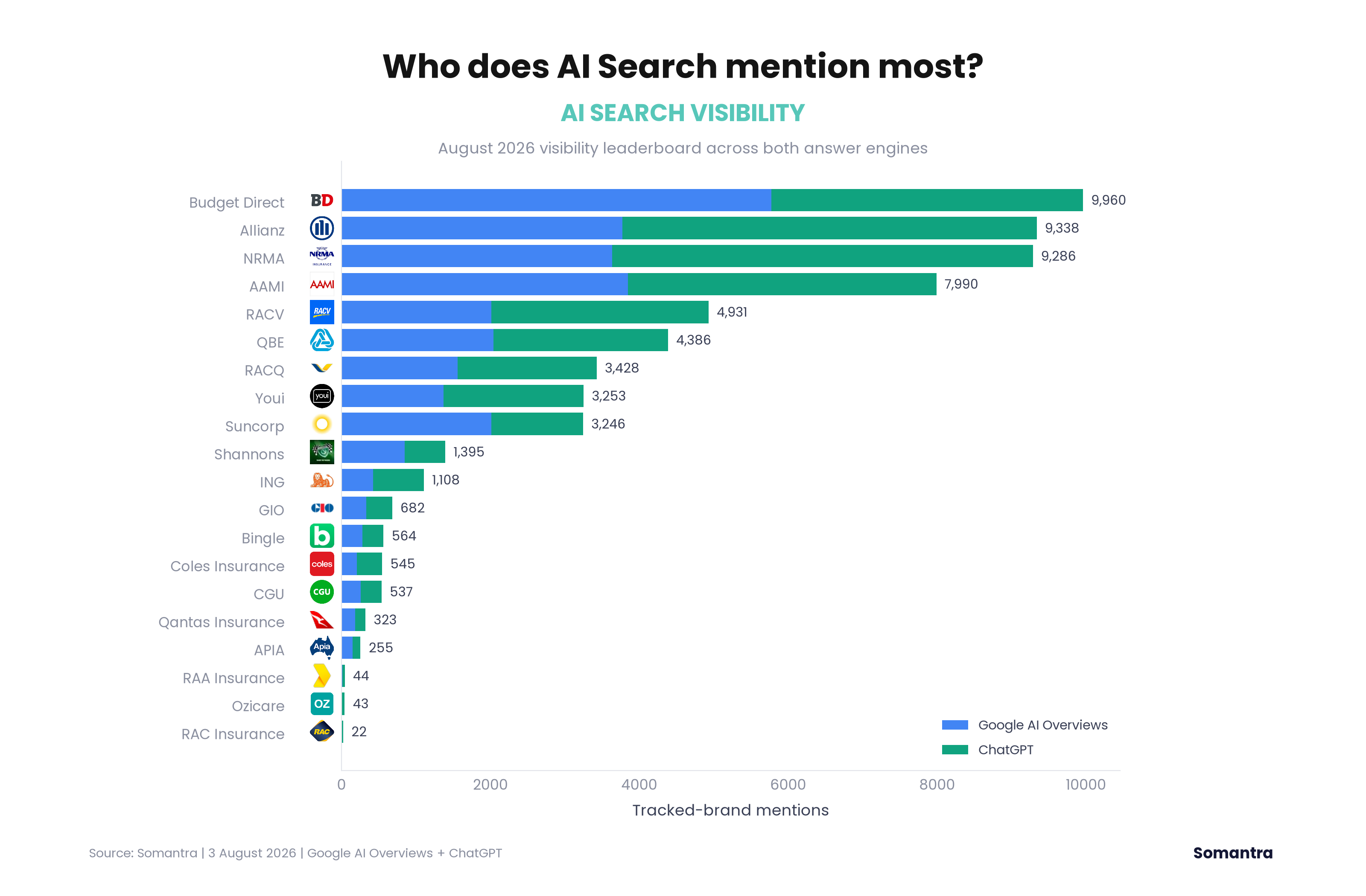
| Brand | Google AI Overviews | ChatGPT | Combined mentions |
|---|---|---|---|
| Budget Direct | 5,771 | 4,189 | 9,960 |
| Allianz | 3,772 | 5,566 | 9,338 |
| NRMA | 3,637 | 5,649 | 9,286 |
| AAMI | 3,845 | 4,145 | 7,990 |
| RACV | 2,014 | 2,917 | 4,931 |
| QBE | 2,041 | 2,345 | 4,386 |
| RACQ | 1,558 | 1,870 | 3,428 |
| Youi | 1,369 | 1,884 | 3,253 |
| Suncorp | 2,010 | 1,236 | 3,246 |
| Shannons | 851 | 544 | 1,395 |
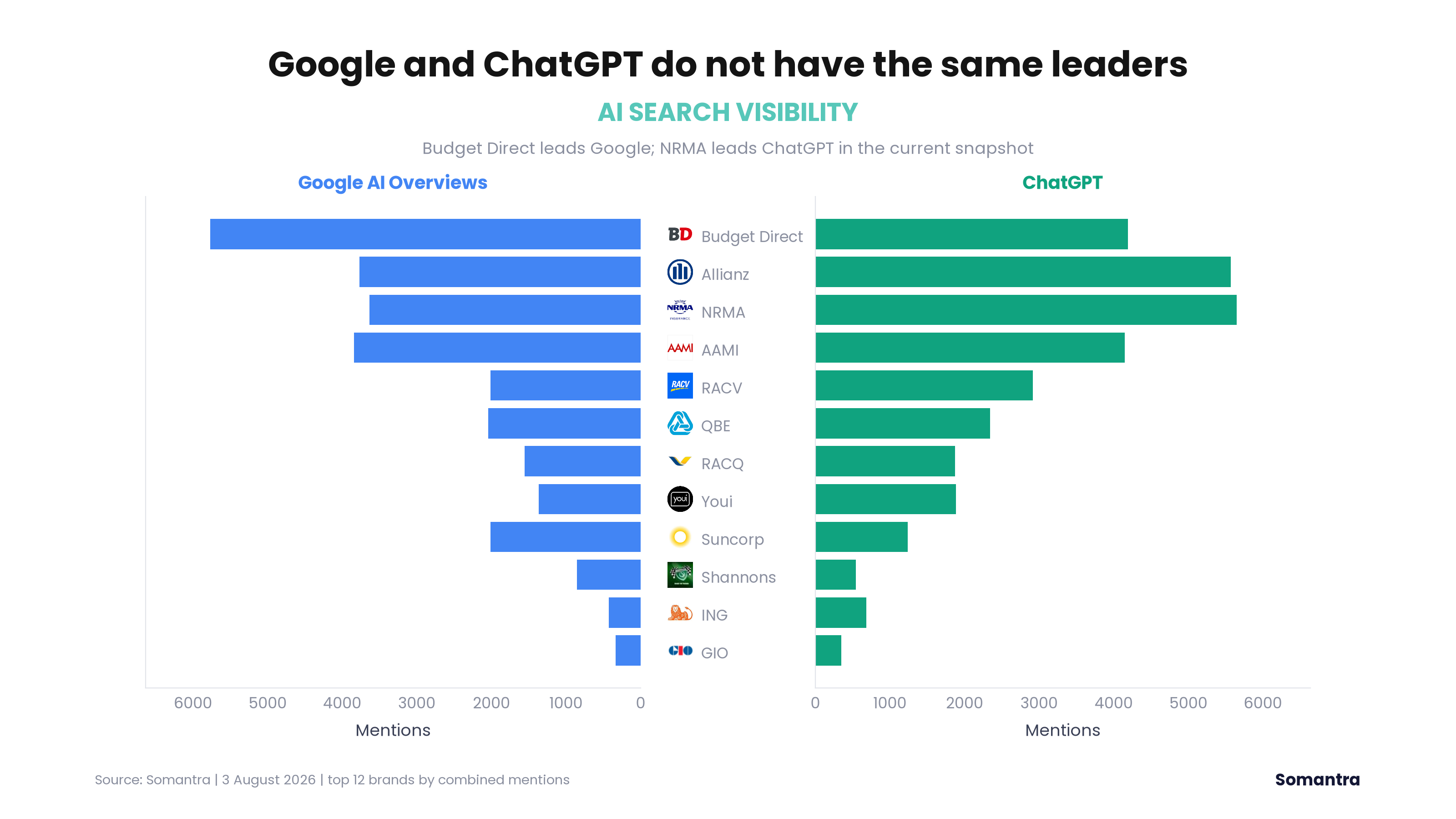
| Brand | Google AI Overviews | ChatGPT |
|---|---|---|
| Budget Direct | 5,771 | 4,189 |
| NRMA | 3,637 | 5,649 |
| Allianz | 3,772 | 5,566 |
| AAMI | 3,845 | 4,145 |
| RACV | 2,014 | 2,917 |
| QBE | 2,041 | 2,345 |
Budget Direct is #1 on the August combined leaderboard (9,960) and Google AI Overviews (5,771). NRMA is #1 in ChatGPT (5,649), just ahead of Allianz (5,566). The prior May report warned that Google dominance does not automatically transfer to ChatGPT; the three checkpoints reinforce the point, because the combined and Google leaders are now Budget Direct while the ChatGPT leader is NRMA.
The top four combined brands account for 59.63% of August tracked brand mentions. Their order is Budget Direct, Allianz, NRMA and AAMI. Mention frequency records whether an answer named a brand; it does not establish prominence, positive framing, citation quality or consumer choice.
3. Citations in AI Search: which domains shape the answer?
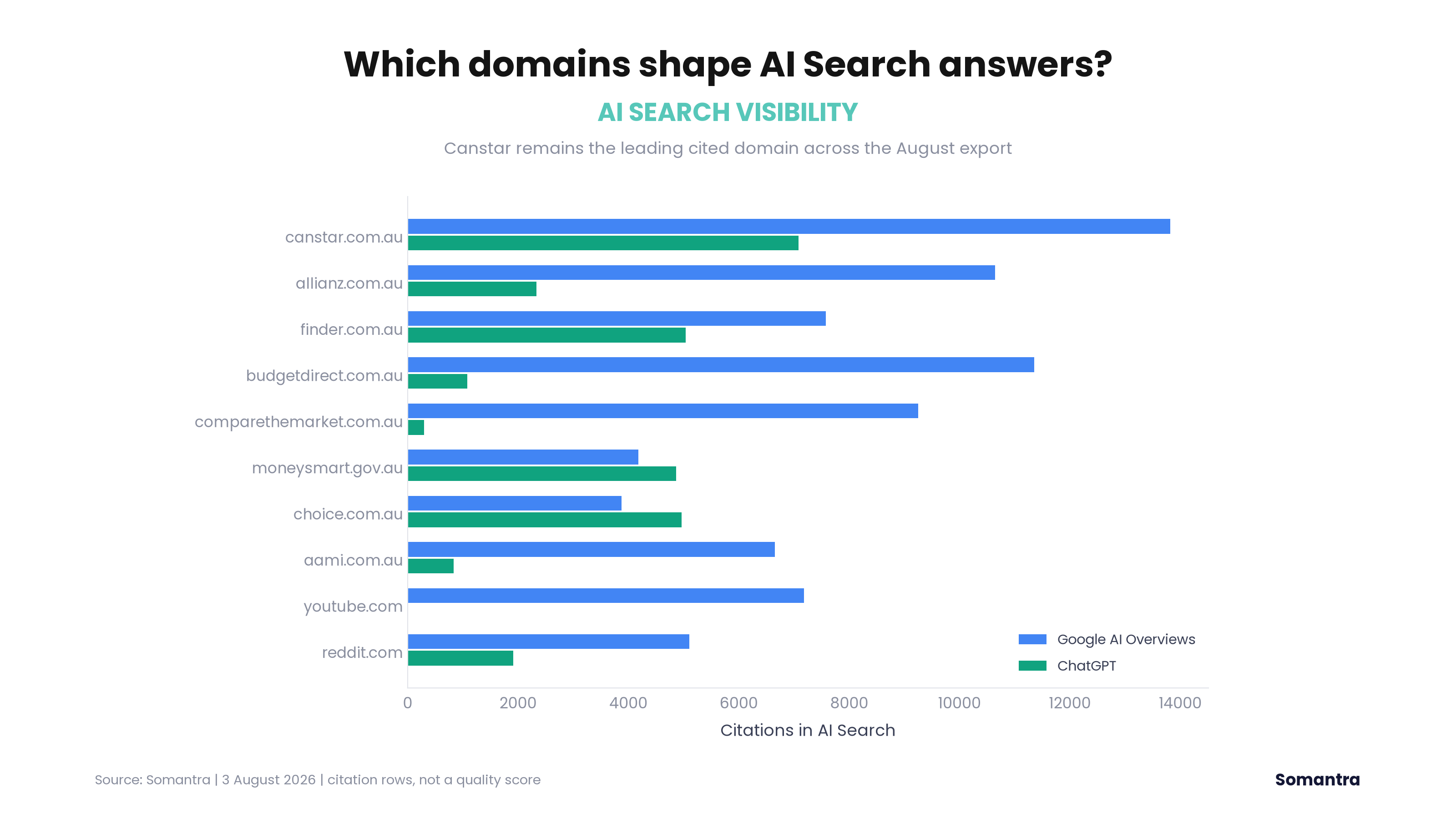
Citations in AI Search show part of the information environment surrounding an answer. A frequently cited domain may be influential, but frequency alone does not establish quality or endorsement.
Canstar remains the leading cited domain in the August export with 20,897 citation rows across both engines. ChatGPT’s top 10 cited domains account for 53.0% of its citation rows, compared with 33.6% for Google AI Overviews.
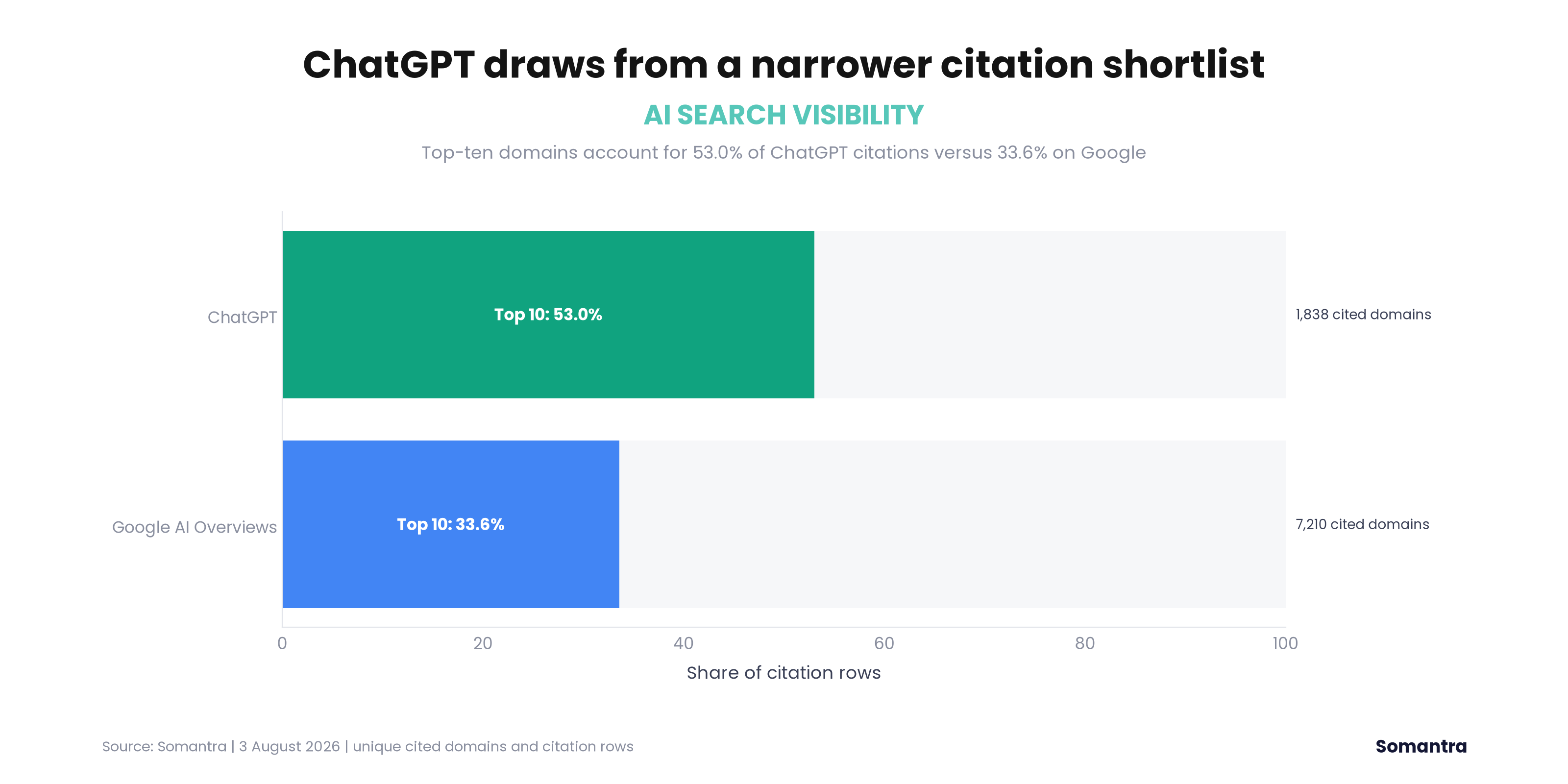
| Engine | Top 10 citation share |
|---|---|
| Google AI Overviews | 33.59% |
| ChatGPT | 53.02% |
Follow-up from May: the leading citation layer is stable
| Snapshot | Combined leading domain | ChatGPT leading domain |
|---|---|---|
| May 2026 | canstar.com.au: 16,838 | finder.com.au: 902 |
| July 2026 | canstar.com.au: 21,854 | canstar.com.au: 6,779 |
| August 2026 | canstar.com.au: 20,897 | canstar.com.au: 7,079 |
Canstar is the combined leading domain in the May, July and August exports. The more material change is inside ChatGPT: Finder narrowly led in May, then Canstar took the lead in July and remains first in August. These are observed citation counts, not a quality score or a claim that each domain caused the answer.
What changed in the citation ecosystem?
The tldr is stable core, moving edges:
- July contained 8,031 unique cited domains; August contained 7,945.
- 4,916 domains appeared in both snapshots. The raw domain-set Jaccard overlap is 44.45%.
- August contains 3,029 domains not observed in July: 1,929 were absent from the February, May and July audit snapshots, while 1,100 had appeared earlier and returned after a July absence.
- Those entrants contributed only 4,331 rows, or 1.42% of August citations. All 100 of July’s top 100 domains remained present in August.
- Only 22 entrants recorded at least 10 August citations; 18 of those were first observed in August.
This means the low domain set overlap is primarily a long tail phenomenon. It should not be interpreted as wholesale replacement of the leading citation layer.
Largest August entrants versus July
“First observed in August” means absent from the three earlier supplied snapshots, not newly created on the web or newly used by every tracked platform.
| Domain | Audit status | August citations | On July to August shared queries | Engine | Representative page |
|---|---|---|---|---|---|
| petguides.au | First observed in August | 46 | 46 | ChatGPT 46 | Pet insurance comparison · 9 AU providers · PetGuides.au |
| theplanetedit.com | First observed in August | 36 | 36 | Google 36 | Cycle Touring Insurance: 8 Best Providers For Cycle Travel |
| ngmobility.com.au | First observed in August | 35 | 32 | Google 35 | E-Bike Insurance Australia: 2026 Guide - NG Mobility |
| picki.com.au | Returned after July absence | 33 | 33 | Google 33 | How Rising Property Insurance Costs Affect Investment … - Picki |
| mindiampets.com.au | First observed in August | 27 | 25 | Google 27 | Pet Insurance Trends in South Australia: 2026 Guide |
| fair.com.au | First observed in August | 24 | 23 | Google 24 | Life insurance for single parents in Australia: What to know in 2026 |
| obrienrealestate.com.au | Returned after July absence | 21 | 21 | Google 21 | Home Insurance Costs Surge Nearly $400 a Year as … |
| insideaustraliatravel.com | First observed in August | 20 | 20 | Google 20 | Is Breakdown Cover Included With My Rental Car in Australia? |
| dhbinsurancegroup.com | First observed in August | 19 | 19 | Google 19 | The Complete Guide to Motorcycle Insurance |
| taxbne.com.au | First observed in August | 18 | 18 | Google 17, ChatGPT 1 | Is Income Protection Insurance Tax Deductible in Australia? (2025-26) |
The matched query column is important: 2,833 of 3,029 entrants appeared on queries also present in July, accounting for 4,002 of 4,331 entrant citation rows. The largest movements therefore cannot be explained only by a larger August query panel.
New does not mean better
The entrant layer also reveals retrieval fit risks. The Planet Edit page is about cycle-touring insurance but surfaced for commuter-versus-touring motorcycle questions. DHB Insurance Group discusses U.S. locations and products while appearing against Australian motorcycle questions. The audit records these as citations, but an editorial quality review should distinguish topical fit, geographic fit, authority and recency before treating any entrant as useful evidence.
4. Where is insurance visibility crowded, and where is it open?
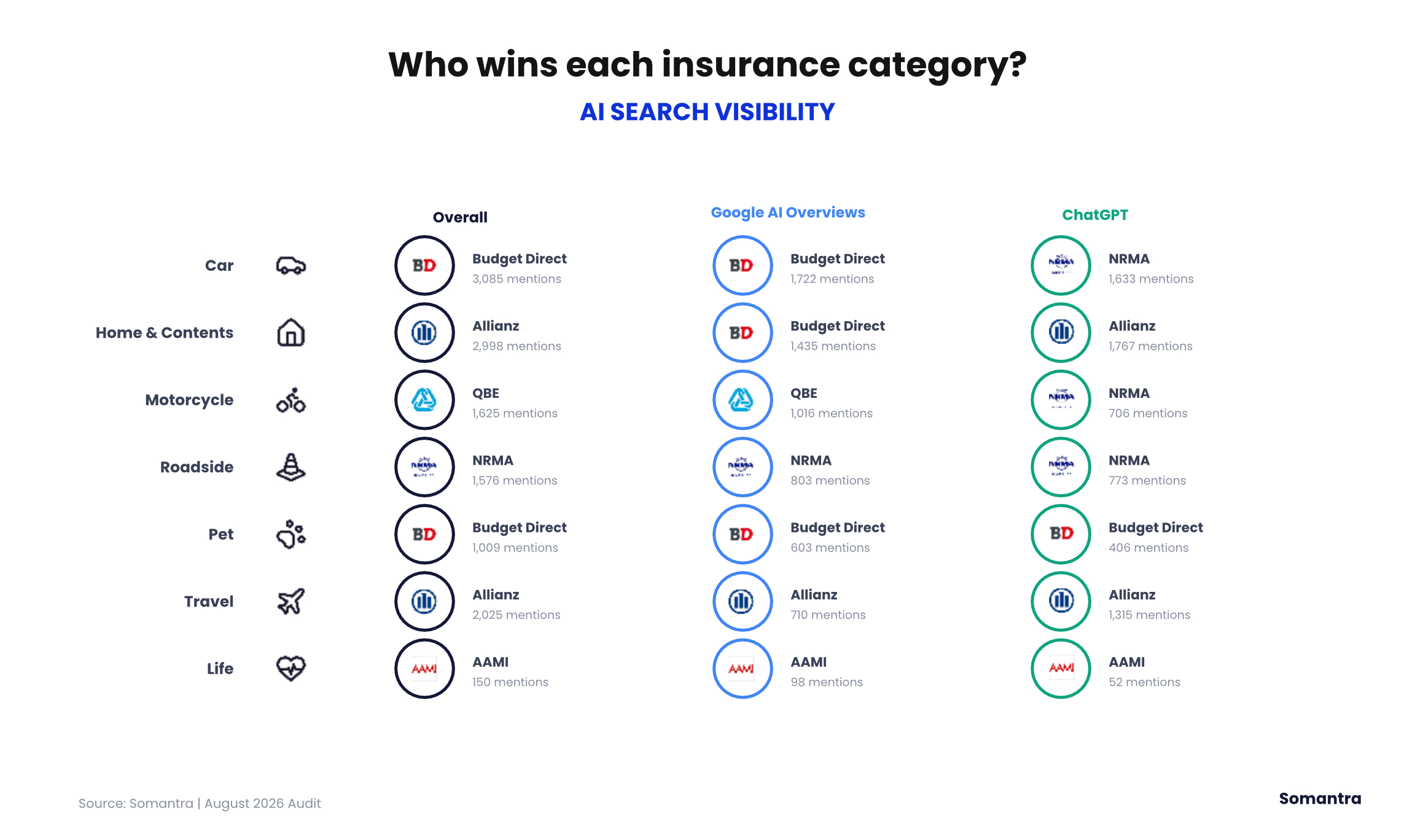
| Insurance category | Combined winner | Google AI Overviews winner | ChatGPT winner |
|---|---|---|---|
| Car | Budget Direct: 3,085 | Budget Direct: 1,722 | NRMA: 1,633 |
| Home & Contents | Allianz: 2,998 | Budget Direct: 1,435 | Allianz: 1,767 |
| Motorcycle | QBE: 1,625 | QBE: 1,016 | NRMA: 706 |
| Roadside | NRMA: 1,576 | NRMA: 803 | NRMA: 773 |
| Pet | Budget Direct: 1,009 | Budget Direct: 603 | Budget Direct: 406 |
| Travel | Allianz: 2,025 | Allianz: 710 | Allianz: 1,315 |
| Life | AAMI: 150 | AAMI: 98 | AAMI: 52 |
Follow up from May: brandless ChatGPT advice remains the norm
| Snapshot | ChatGPT Conversation denominator | Answers naming a tracked insurer |
|---|---|---|
| May 2026 | Reported as share per 100 | 18.00% |
| July 2026 | Reported as share per 100 | 18.00% |
| August 2026 | 6,874 of 32,602 | 21.08% |
The May and July reports each recorded roughly 18 in 100 ChatGPT Conversation answers naming at least one tracked insurer. August records 21.08% (6,874 of 32,602) after analysing the category level rows. The measurement granularity changes between the earlier rounded summary and the August category export, so this is directional context, not a clean trend claim.
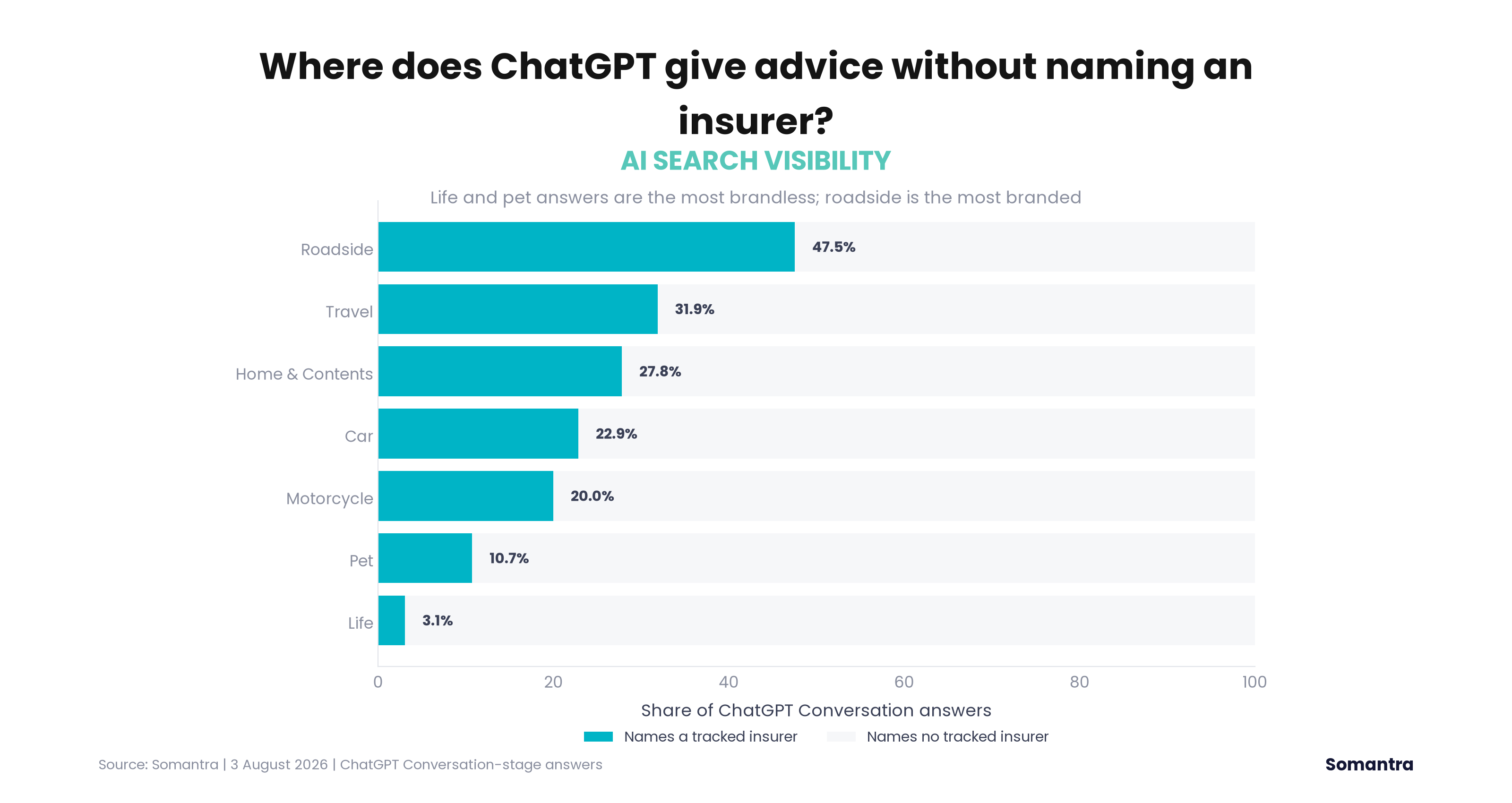
| Insurance context | Conversation answers | No tracked brand | Brandless rate |
|---|---|---|---|
| Car | 7,023 | 5,418 | 77.15% |
| Home & Contents | 5,797 | 4,185 | 72.19% |
| Pet | 4,089 | 3,651 | 89.29% |
| Motorcycle | 3,271 | 2,617 | 80.01% |
| Life | 2,472 | 2,396 | 96.93% |
| Travel | 3,458 | 2,356 | 68.13% |
| Roadside | 1,115 | 585 | 52.47% |
Category leaders: combined and by engine
| Insurance category | Combined winner | Google AI Overviews winner | ChatGPT winner |
|---|---|---|---|
| Car | Budget Direct: 3,085 | Budget Direct: 1,722 | NRMA: 1,633 |
| Home & Contents | Allianz: 2,998 | Budget Direct: 1,435 | Allianz: 1,767 |
| Motorcycle | QBE: 1,625 | QBE: 1,016 | NRMA: 706 |
| Roadside | NRMA: 1,576 | NRMA: 803 | NRMA: 773 |
| Pet | Budget Direct: 1,009 | Budget Direct: 603 | Budget Direct: 406 |
| Travel | Allianz: 2,025 | Allianz: 710 | Allianz: 1,315 |
| Life | AAMI: 150 | AAMI: 98 | AAMI: 52 |
These are August tracked brand mention leaders across Discovery, Intent and Conversation prompts. “Other” is excluded because it is not a coherent insurance category. The table measures frequency of naming, not recommendation quality, consideration or sales.
Markets are not equally branded. In detailed ChatGPT conversation queries, Roadside is the most branded category: a tracked insurer appears in 47.53% of answers. Life is the least branded at 3.07%, leaving 2,396 of 2,472 answers with no tracked insurer.
The right question is not just “who ranks highest?” It is “where does the answer currently name brands, and where does it still explain the category without naming one?”
5. Why “Brand Consideration” Matters More Than Brand Mentions
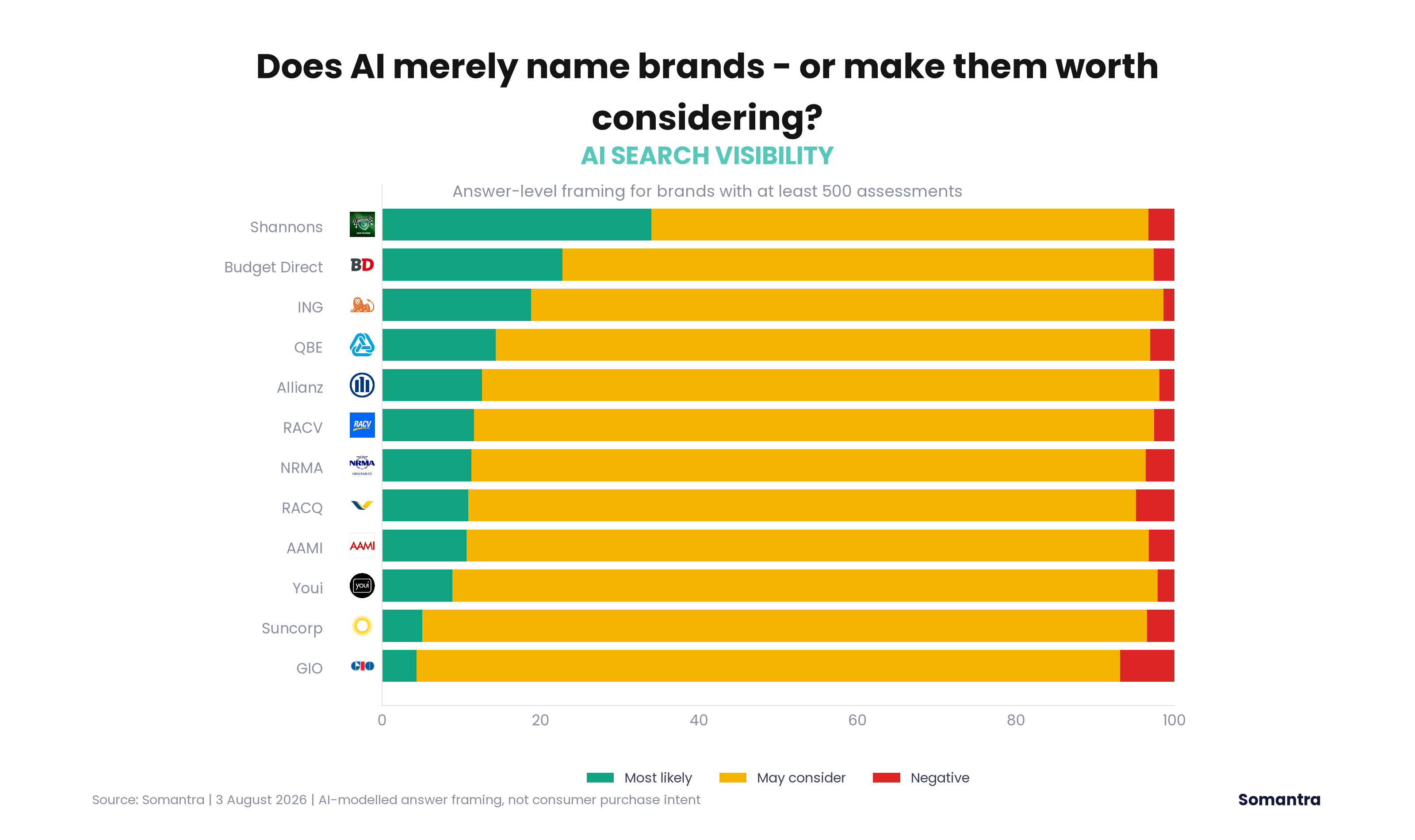
| Brand | Most-likely framing | Assessments |
|---|---|---|
| Shannons | 33.98% | 980 |
| Budget Direct | 22.74% | 7,947 |
| ING | 18.78% | 932 |
| QBE | 14.32% | 3,471 |
| Allianz | 12.60% | 7,815 |
| RACV | 11.61% | 4,021 |
| NRMA | 11.29% | 7,557 |
| RACQ | 10.86% | 2,708 |
| AAMI | 10.68% | 6,702 |
| Youi | 8.90% | 2,518 |
| Suncorp | 5.09% | 2,770 |
| GIO | 4.36% | 596 |
Brand Consideration separates visibility from the role assigned to a brand inside an answer. Among brands with at least 500 classifications, the highest August most likely rates are Shannons 34.0% (n=980); Budget Direct 22.7% (n=7,947); ING 18.8% (n=932).
This is intentionally not called “consideration rate” in the customer-research sense. The denominator is answer assessments, and the label says how the AI response frames a brand under the collected prompts. It cannot predict sales, conversion or actual consideration without an external validation study.
6. How to Shape Brand Consideration: Power of Modifiers
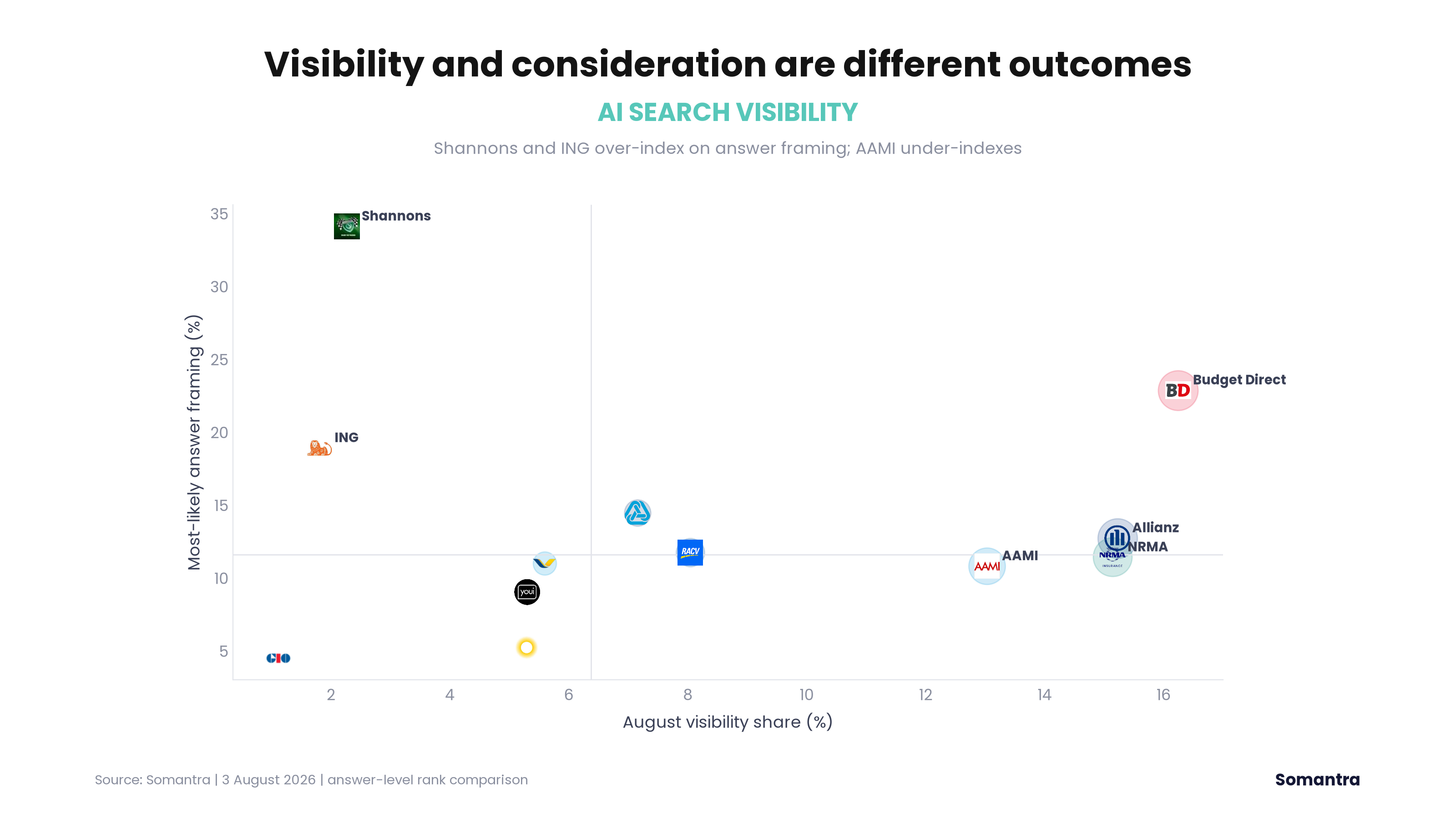
| Brand | Visibility rank | Consideration rank | Rank premium |
|---|---|---|---|
| Shannons | #10 | #1 | +9 |
| ING | #11 | #3 | +8 |
| QBE | #6 | #4 | +2 |
| Budget Direct | #1 | #2 | -1 |
| Allianz | #2 | #5 | -3 |
| NRMA | #3 | #7 | -4 |
| AAMI | #4 | #9 | -5 |
Visibility and answer framing are distinct measures; a brand mentioned frequently does not necessarily receive a positive recommendation. For instance, Shannons and ING punch above their weight, securing higher “Most-Likely” framing ranks compared to their raw visibility (Shannons is #10 in visibility but #1 in framing). Conversely, high-visibility brands like AAMI and NRMA under index on consideration, proving that simply being named in an AI output doesn’t guarantee a strong endorsement.
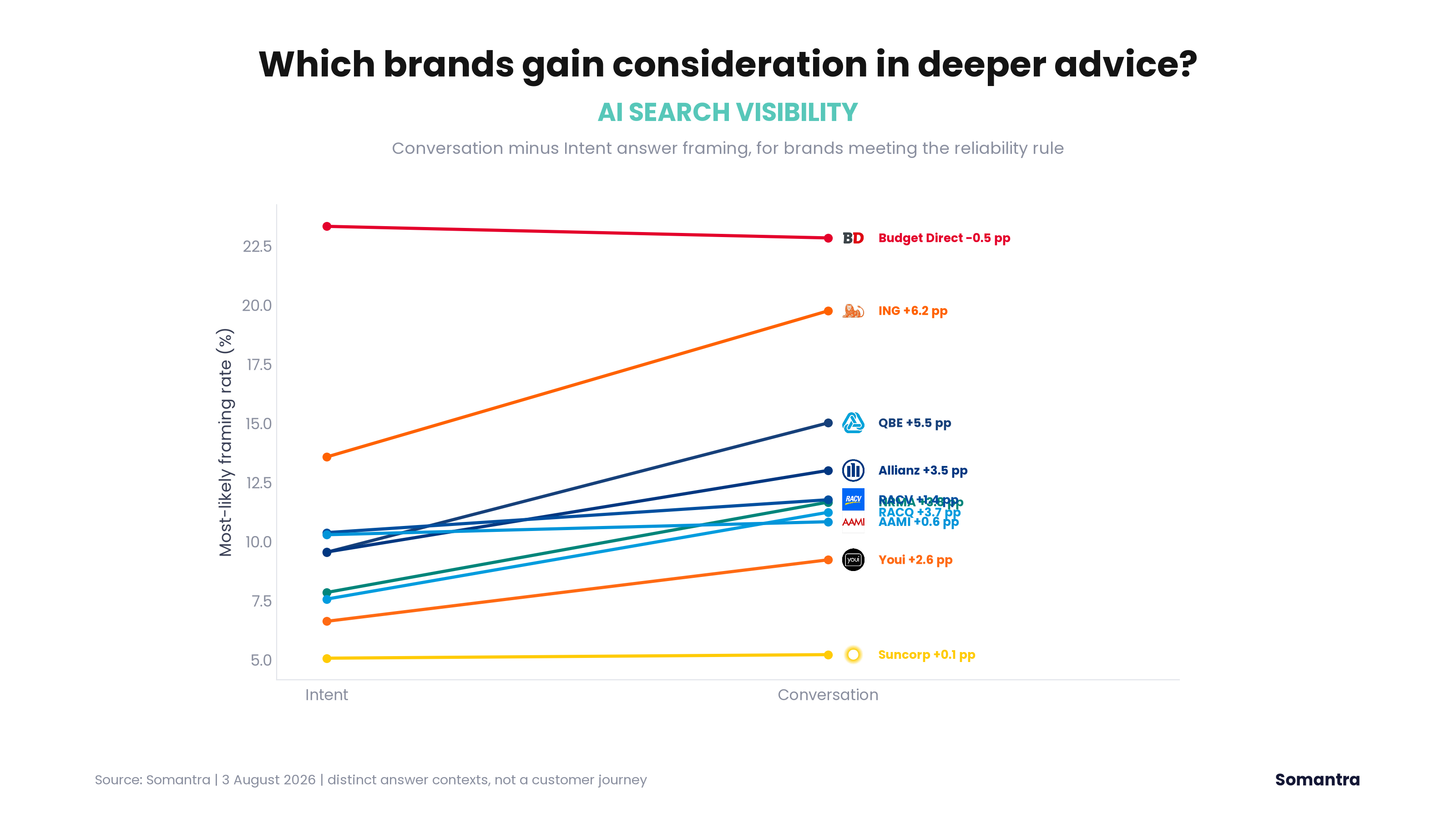
| Brand | Intent most-likely | Conversation most-likely | Conversation minus Intent |
|---|---|---|---|
| ING | 13.49% | 19.67% | +6.18 pp |
| QBE | 9.46% | 14.93% | +5.47 pp |
| NRMA | 7.76% | 11.58% | +3.82 pp |
| RACQ | 7.48% | 11.15% | +3.67 pp |
| Allianz | 9.47% | 12.92% | +3.45 pp |
| AAMI | 10.20% | 10.75% | +0.55 pp |
| Budget Direct | 23.24% | 22.75% | -0.49 pp |
As queries deepen from broad intent to detailed conversations, a brand’s likelihood of being recommended can change materially. Brands like ING, QBE, and NRMA see stronger “most-likely” consideration rates in detailed conversational queries compared to broader intent searches. This intent-to-conversation shift highlights that AI answer framing dynamically adapts to the context and depth of the user’s prompt rather than applying a static brand preference across all questions.
We have research uncovering how AI search is shifting the nature of brand positioning, see AI Search Repositions Brand.
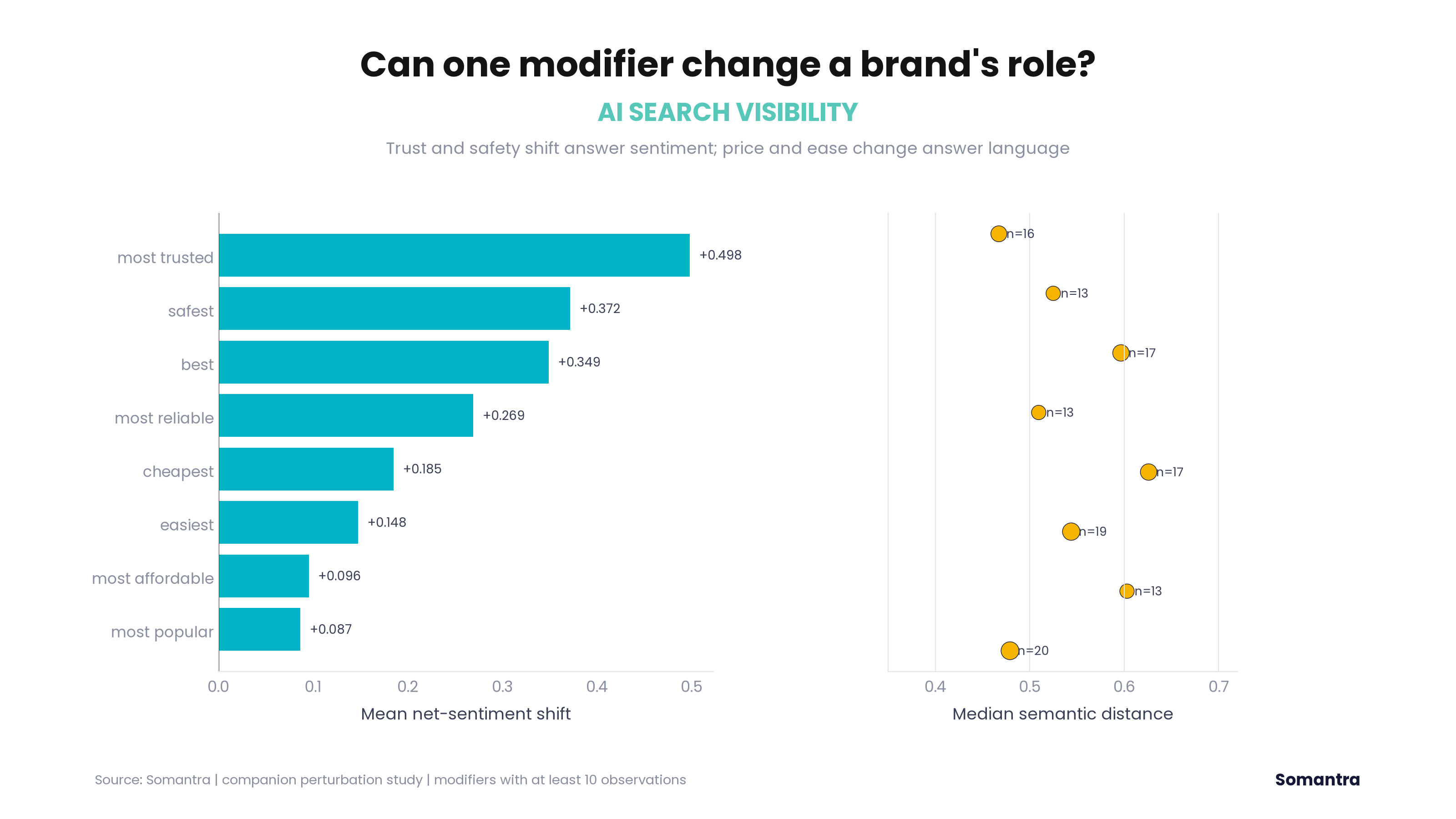
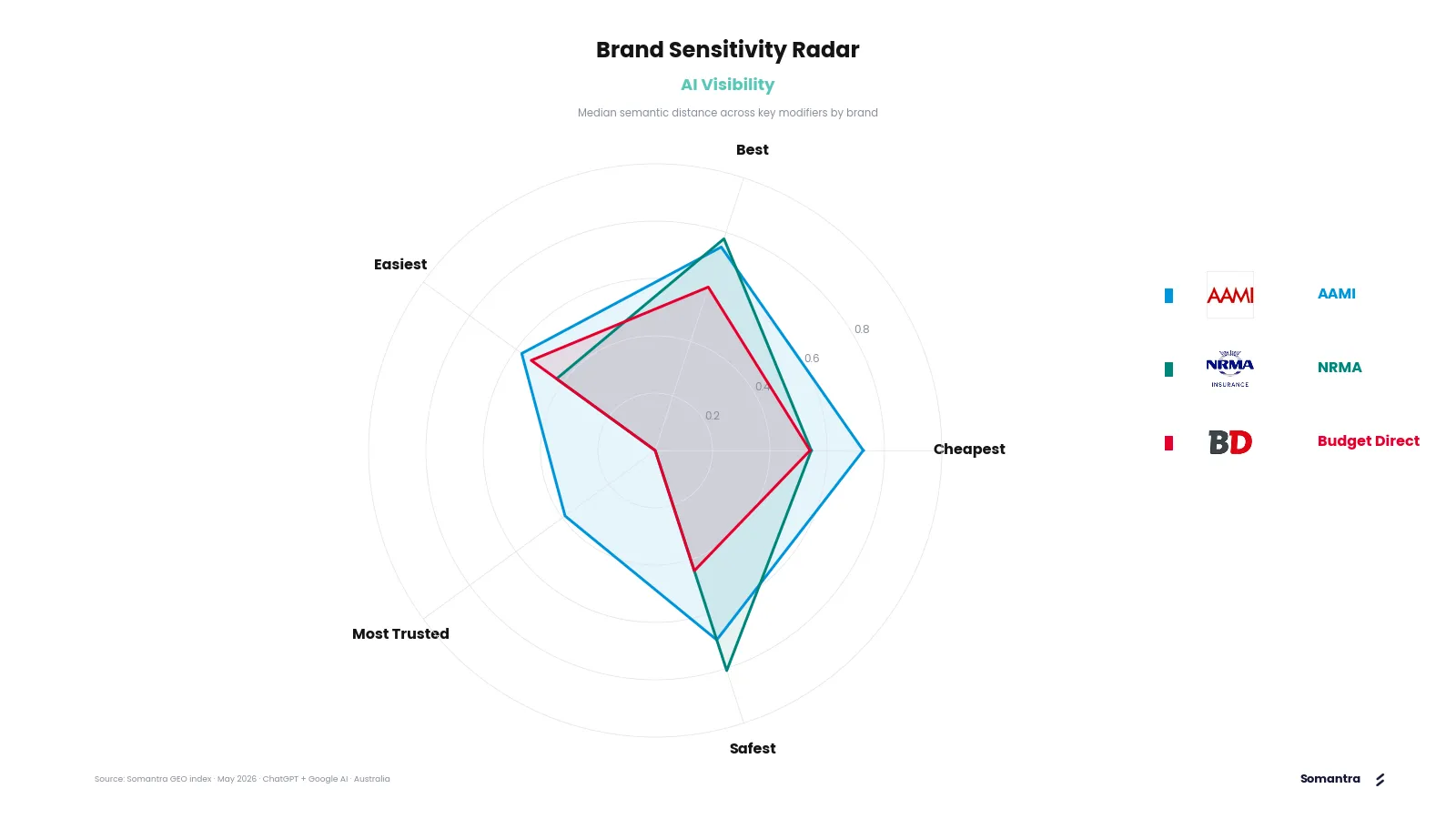
| Modifier | Observations | Median semantic distance | Mean net-sentiment shift |
|---|---|---|---|
| most popular | 20 | 0.479 | +0.087 |
| easiest | 19 | 0.544 | +0.148 |
| best | 17 | 0.597 | +0.349 |
| cheapest | 17 | 0.626 | +0.185 |
| most trusted | 16 | 0.467 | +0.498 |
| most affordable | 13 | 0.603 | +0.096 |
| most reliable | 13 | 0.509 | +0.269 |
| safest | 13 | 0.525 | +0.372 |
Furthermore, AI visibility is highly sensitive to phrasing. Adding a single modifier such as cheapest, safest, or most trusted—can substantially shift the language, rationale, and sentiment of the response. Testing reveals that modifiers like “most trusted” can drive the largest positive shifts in net sentiment, while words like “cheapest” cause significant semantic changes. This demonstrates that minor wording tweaks in the user’s prompt can entirely reframe a brand’s role in the AI’s output.
7. First Seen Audit: did the answer put the brand in view before scrolling?
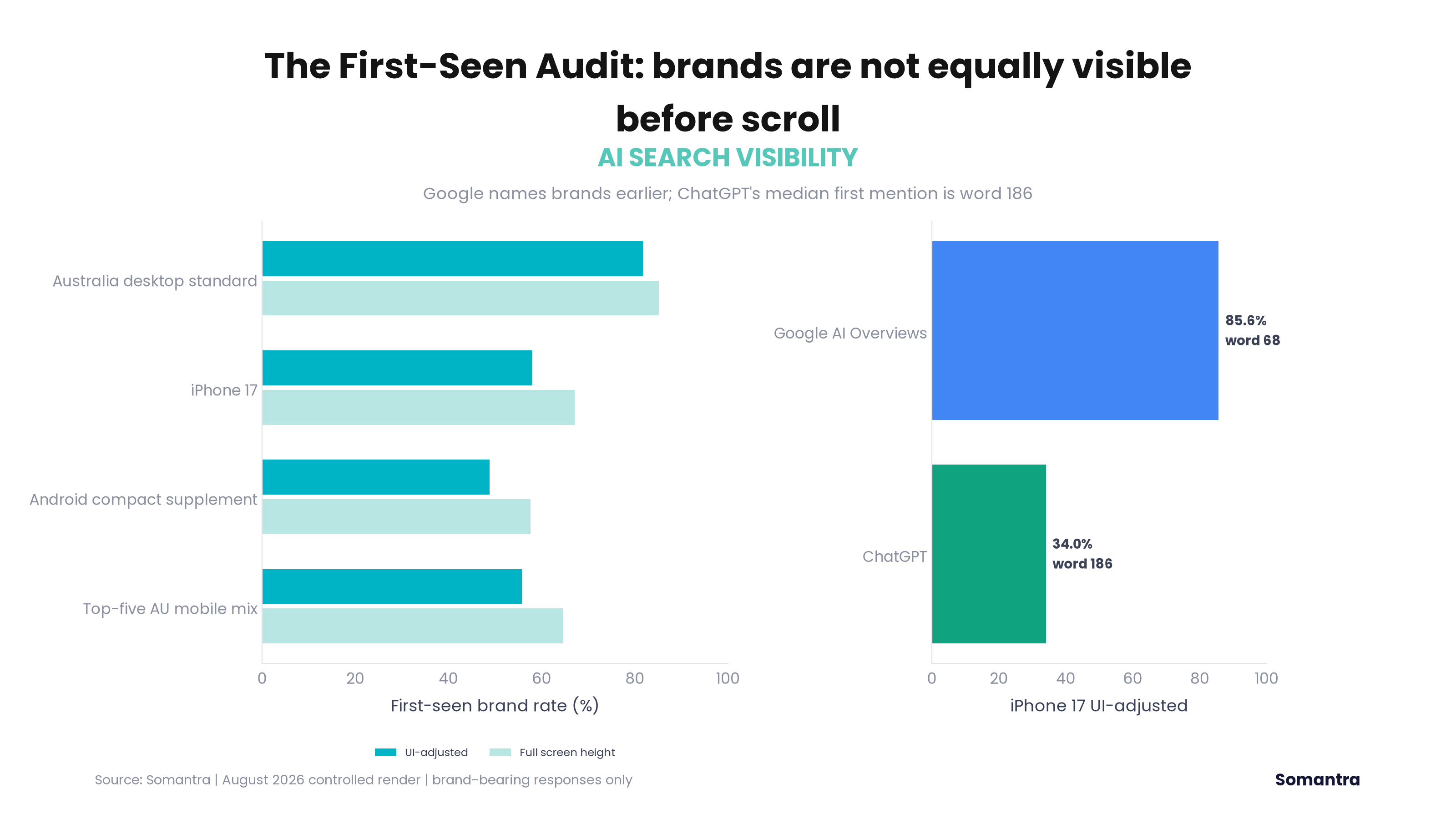
| Engine | First-seen brand rate | Median first-brand word | Median answer height |
|---|---|---|---|
| Google AI Overviews | 85.62% | 68 | 976px |
| ChatGPT | 34.04% | 186 | 1,868px |
The First-Seen Audit measures whether a brand is mentioned before a user has to scroll, revealing a stark difference in how AI engines format their advice. Google AI Overviews typically deliver concise summaries where brands appear early and remain highly visible. In contrast, ChatGPT provides extended advice, meaning the first tracked brand mention occurs much later (median word 186) and frequently requires scrolling. Importantly, early placement does not guarantee a positive recommendation; a brand’s first-seen rate and its “most-likely” framing score are distinct outcomes that do not strictly move together.
These organic visibility patterns create specific contextual opportunities for Australian insurance ads in ChatGPT. Because eligible ads enter a relevance weighted auction and appear below the organic response, advertisers can capitalize on “brandless” conversational inventory where topics like pet or life insurance are discussed without an established tracked-brand presence. By building neutral, product-specific context hints (e.g, comparing comprehensive versus third party cover) rather than broad keyword lists, insurers can efficiently reach users who are actively seeking detailed advice but haven’t yet been guided toward a specific competitor.
Once the contextual entry point is set, insurers should use organic consideration and perturbation data to determine their creative strategy. For example, highly visible but under considered brands might need to test “reliability” or “trust” messaging to reframe their position, whereas brands with strong consideration but low visibility should focus on expanding their efficient reach. By keeping campaign variables fixed and systematically testing controlled message variants based on these AI driven insights, advertisers can determine the most effective claims to drive completed quotes and acquisitions, even when ads appear below lengthy advice.
Appendix
Somantra’s Visibility Model
AI Search visibility has four separate layers. A brand can perform strongly on one layer and weakly on another, so the report measures each one directly.
| Layer | Plain-English question | Measure in this report |
|---|---|---|
| Visibility | Did the answer name the brand? | Tracked-brand mentions |
| Consideration | What role did the answer give it? | AI-modelled answer framing |
| Evidence | What information environment shaped the answer? | Citations in AI Search |
| First seen | Could the person see the brand before scrolling? | Rendered First-Seen audit |
This is an audit of observed AI answer outputs and citations. It is not a consumer survey, an attribution model, or a measure of sales. A mention means a tracked brand appeared in a collected result. Citations in AI Search are the domains cited or surfaced alongside the result.
May, July and August are audit snapshots. Their observed totals support a continuity read of who leads each snapshot, but changing query panels mean they are not a clean before/after series. Only the overlapping July to August query cohort supports a month-on-month movement claim. August only analysis, First Seen, Brand Consideration and perturbation, are new diagnostic layers, not retroactive May comparisons.
Tags:

About the author
Arun Prasad
Founder, Somantra
Arun Prasad is the founder of Somantra, an AI search visibility platform for brands, where he writes about answer engine optimisation (AEO) and AI search. His research analyses how brands surface in AI answers across ChatGPT and Google AI Overviews, including Somantra's studies of the Australian insurance market. He focuses on measuring brand visibility through systematic, large-scale conversational testing rather than one-off screenshots.

About the author
Yajat S
Yajat S is a researcher at Somantra, where he analyses how brands surface in AI search across ChatGPT and Google. He authored Somantra's Australian insurance citation study covering 2.4 million AI search citations, focused on the content formats and URL patterns that get cited by answer engines.