
AI Search Doesn’t Have a Rank. It Has Five Axes.
I ran 32 insurance queries through ChatGPT. Brands are being sorted into cells and no single number can tell you how you’re doing.
I ran a batch of ordinary Australian consumer insurance queries through ChatGPT. They are buying intent queries which consumers type when they’re about to make a decision.
These queries included seven categories (car, home, life, pet, motorcycle, travel, roadside assistance) across three intent framings each: best X, best value X, cheap X.
What surprised me was the shape of the default response from ChatGPT. ChatGPT is not responding with a list of brands and links, instead it now provides sorted comparison grid, each brand is categorised across different perspectives, followed by offer to personalise advise and, increasingly an ad in the free tier account.
This combination is a new competitive surface which forces CMO’s to shift how they think of measuring success in AI Search. The biggest shift is this: there is no rank to climb, instead there are five separate axes which move independently. The biggest challenge is that brands can improve on one while going backwards on another without noticing.
1. The format is intent-gated
If I had tested only one phrasing, I would have missed this finding.
- “Best X” and “best value X” → a table. ChatGPT responds with a comparison grid with multiple columns. The columns are almost identical every time and include , the brand, a “Best for” cell, a strengths cell, and a “Things to watch” / “Potential downside” cell.
- “Cheap X” → no table. The ChatGPT response is a flat bulleted list of four brands with price tips. It does not have “Best for” assignments or superlatives.
- One run of “best motorcycle insurance” returned a third thing entirely. ChatGPT responded with a card deck. It had each brand in its own panel with a pill label e.g. Best for enthusiasts & modified bikes, Best all-round comprehensive cover, Best for price-conscious riders.
The format is an indication that the table appears when the model has framed the task as choosing between named brands. The bullet list appears when it has framed the task as finding a low number.
Based on the job, ChatGPT adjusts both response format and brand positioning. We also see that ChatGPT understands the nuance of Value Vs Price. For Answer Engine Optimization(AEO) / Generative Engine Optimization(GEO) this makes it important for brands to disentangle value positioning from a price based positioning.
2. The single axis is gone
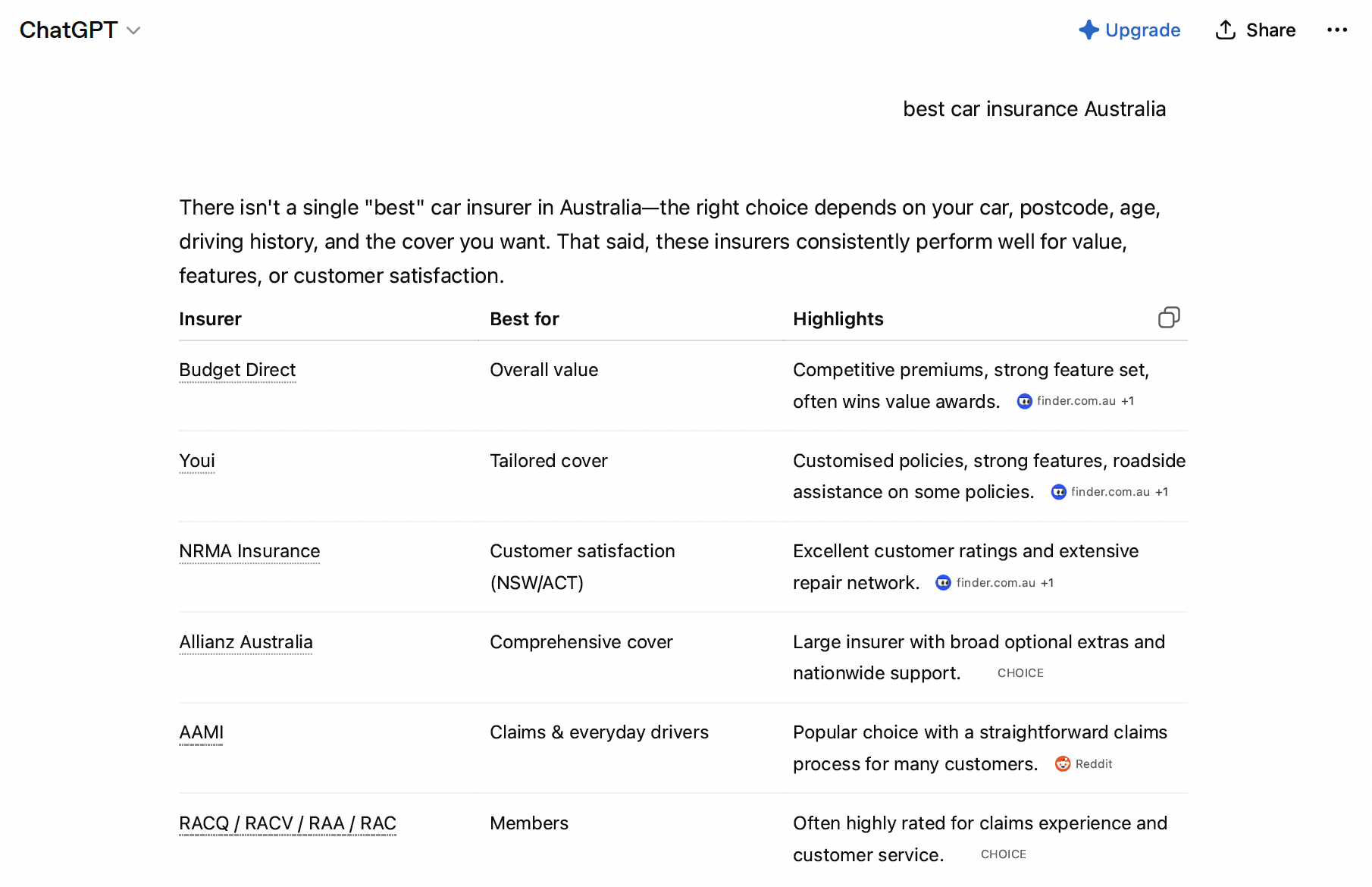
Traditional search had one axis: rank. Brands would measure their rank within ten positions; it was a a single ladder to climb and every SEO decision could be scored against a single question - did the brand’s clickable link go up?
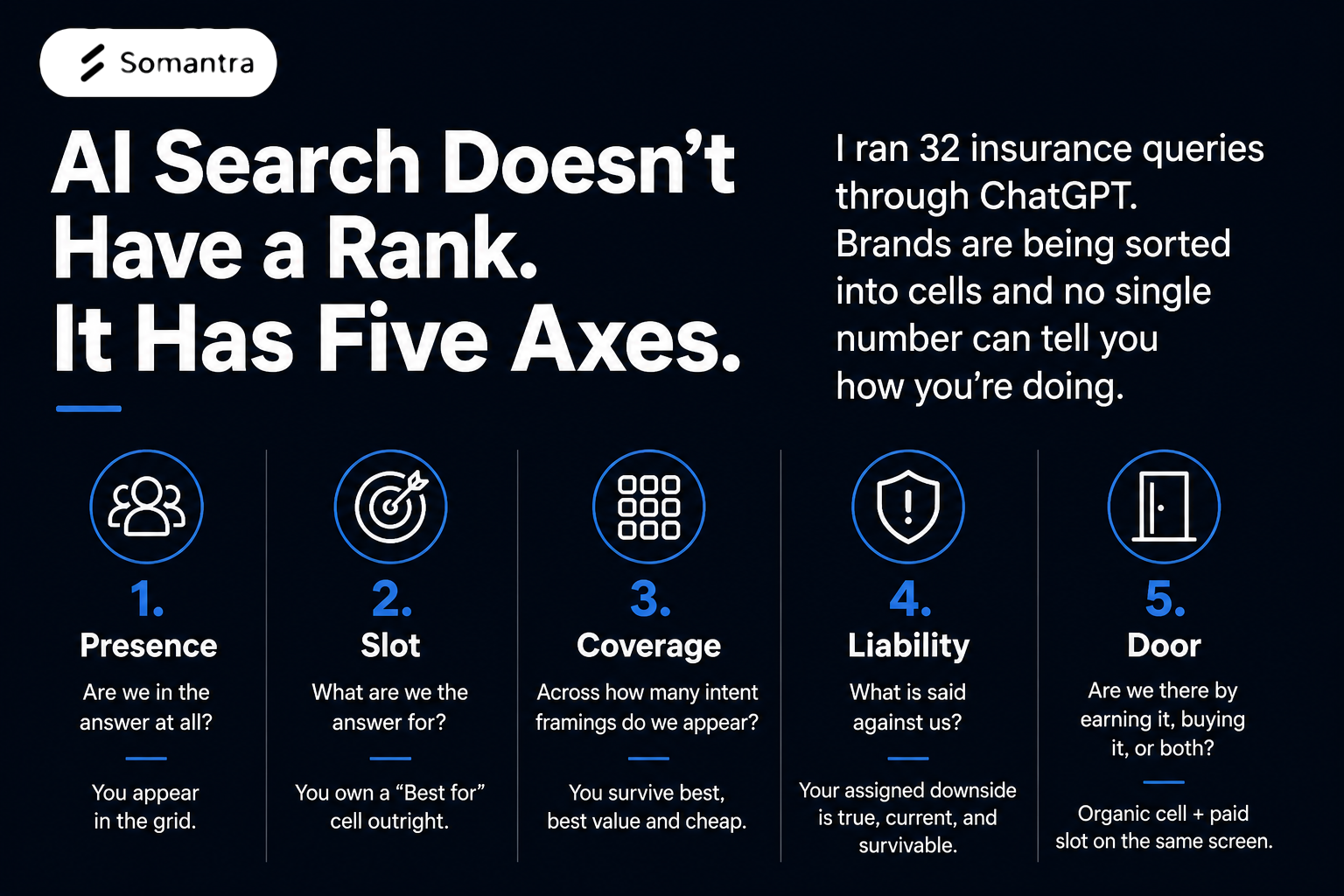
AI search has no ladder. It’s replaced with a grid with named cells, and a brand’s standing is the sum of five independent measures for Answer Engine Optimization(AEO) / Generative Engine Optimization(GEO).
| # | Axis | The question it answers | What “winning” looks like |
|---|---|---|---|
| 1 | Presence | Are we in the answer at all? | You appear in the grid |
| 2 | Slot | What are we the answer for? | You own a “Best for” cell outright |
| 3 | Coverage | Across how many intent framings do we appear? | You survive best, best value and cheap |
| 4 | Liability | What is said against us? | Your assigned downside is true, current, and survivable |
| 5 | Door | Are we there by earning it, buying it, or both? | Organic cell + paid slot on the same screen |
These are not five derived views of one metric but five different metrics, and the critical property is that they move independently.
You can hold a strong slot but have almost no coverage. You can have total presence but with a liability that quietly kills conversion. You can have zero organic standing and buy your way onto the screen through an ad.
Which means the single “AI visibility score” that most tools sell you , one number, up or down is an average across five axes that point in different directions, and averaging them destroys the only information you could have acted on.
3. Four brands, five axes, four completely different problems
Here is what the same dataset looks like when you score it properly.
| Brand | Presence | Slot held | Coverage | Liability attached | Door |
|---|---|---|---|---|---|
| Budget Direct | 7 of 7 categories | Value / lower premiums | best, best value, cheap | ”Claims experience more mixed than premium brands” | Both — organic + ad |
| Allianz | Car, home | Comprehensive cover (strong, uncontested) | best only | ”Usually costs more” | Organic only |
| Bingle | Car only | Lowest premiums (owned outright) | best value, cheap | ”Fewer extras, less personalised service” | Organic only |
| 1Cover | Zero organic travel mentions | None | None | — | Paid only |
The picture emerges when you read across the rows and compare their brand position.
Allianz has an excellent slot, comprehensive cover, which is essentially uncontested. It also has coverage of one framing out of three. It has been excluded from every price led conversation in car insurance. A single visibility score would show Allianz as “present and healthy.” The axes show a brand that is invisible two-thirds along the Coverage axes.
Bingle is the inverse: narrow presence, one category, but it owns its cell so completely that no one is competing for it. That is not a weak position but a defensible one. A dashboard optimising for mention volume would tell Bingle to broaden. That would be the wrong advice if the C-level is focused on category ownership by dominating through “lowest premiums” brand message.
1Cover scores zero on axes 1 through 4 in travel insurance but appears on screen anyway, twice, because it bought the fifth axis. Every organic travel winner is there; 1Cover is not. It purchased adjacency to an answer it could not earn.
Budget Direct is the only brand scoring on all five. I will share more on that below.
We now see four brands with four genuinely different strategies.
Traditional SEO ranking or a simple AEO mentions number would not guide any of the brands on what they should do next.
4. The axes you’re scored on vs. the levers that move them
The are worth separating, because CMOs keep being sold by AEO tools that the two as if they are the same thing.
The levers that drive the outcomes along the five axes in AEO are different.
- Attribute vocabulary : the model sorts on attributes, so it needs attributes. Brand messaging like “We’re on your side” sorts into nothing. Flood cover. Agreed value. No age-based excess. Riding gear cover., help ChatGPT sort/categorise. This is the lever that decides the outcome for Slot.
- The citation supply chain : Finder, Canstar, CHOICE, Mozo, Reddit. This is the lever that moves Presence and Liability.
- Intent-side content : whether your brand is described in price language anywhere at all. This is the lever that moves Coverage.
- Paid Ad : the lever that moves Door.
5. Changing one word changes the competitive landscape in AEO
For the same category, three different phrasings will paint three different competitive landscapes.
| Query | Brands named |
|---|---|
| cheap car insurance | Budget Direct, Bingle, Youi, ING, Coles |
| best value car insurance | Budget Direct, Bingle, AAMI, ROLLiN’, Youi |
| best car insurance | Budget Direct, Youi, NRMA, Allianz, AAMI, RACQ/RACV/RAA/RAC |
ING and Coles exist only in the cheap universe. Allianz and the motoring clubs only in best. ROLLiN’ surfaces only under best value.
In this case we are considering the Axes 3, Coverage. Brands also have to measure the how they stack up in Axes 4, Liability , to assess whether it is decreasing their probability of getting chosen by the consumer.
6. Every AI recommendation ships with a pre-loaded objection
Axis 4. Every brand in every table gets a liability assigned to it, unprompted:
- Bingle — fewer extras, less personalised service
- Youi — often more expensive for average drivers; quotes require a phone call
- Allianz — usually costs more
- Budget Direct — check annual benefit limits and excess options
- Pet Insurance Australia — premiums vary significantly by breed and age
- QBE (motorcycle) — no roadside assistance option
The table format in ChatGPT delivers symmetry to the consumer; a strengths column implies a weaknesses and it is filled in the ChatGPT response either in an adjacent column or further down in the response.
Brands now have to face the challenge of monitoring and measuring the impact of a machine generated objection sitting beside their brand name, delivered to a purchase-intent consumer, before they have visited a single brand website page.
Objection handling which used to live on a brands landing page now surfaces in a comparison grid cell which brands don’t control, sourced from material they may have not read.
Brands have spent three years learning to manage zero-click. This is now an additional challenge since perception is being shaped before the consumer meets the brands message. If left unaudited and unmanaged, this stale liability compounds to get re-cited, re-summarised, and hardens into what the model simply knows about the brand.
7. The ads have arrived and now there are two doors
Axis 5 is the newest.
In the second batch, fourteen of nineteen answers carried a sponsored unit below the response. Budget Direct in most. TAL under life insurance. 1Cover under travel.
A brand bought its way into a category it had lost. The organic travel table lists ReadySet, Zoom, Insure4Less, Tick, Fast Cover, Southern Cross and InsureandGo. 1Cover appears in none of them but appears twice in the ad slot.
One brand holds both doors. Budget Direct sits in the organic table and in the ad unit underneath it. Its now in the same screen through both earned and paid position.
The targeting is currently loose. Budget Direct’s car insurance creative ran beneath a pet insurance answer and a motorcycle answer. This is less precision placement than buying category wide presence and letting relevance sort itself out. It could also mean that Budget Direct has identified an arbitrage window in ad costs across Google and ChatGPT for the target audience. At Somantra we anticipate that this arbitrage will close as more brands find the surface and bid the slots up.
One caveat worth stating plainly: the ad-bearing batch was run on a free-tier account. This has a sharp implication for ICP (Ideal Customer Profile) modelling: whether your customer is on a free or paid plan determines whether they see a commercial layer at all.
8. In AEO, Third Party Topic Authorities can be the kingmakers
In travel insurance it isn’t subtle. Nearly every organic winner is justified with the same credential: “Winner of Finder’s 2026 Best Comprehensive Travel Insurance award.” “Awarded Best Value International Travel Insurance by Finder.” “Winner of Finder’s 2026 Best Domestic Travel Insurance award.”
In that category, a third party topic authority, the Finder awards list is not evidence for the ranking. It effectively is the ranking.
Across both batches, the citations were overwhelmingly Finder, Canstar, CHOICE, Mozo, Reddit , not insurer websites. In AEO, your comparison-site profile and your awards submissions are now distribution infrastructure, not just marketing hygiene.
9. The case study: Budget Direct scores on all five in AEO
One brand appeared in every category tested and across all three intent framings.
It’s recurring slot is some variant of value or lower premiums and carries a consistent liability (claims experience more mixed than premium brands).
It is not the strongest brand in any of these categories but it is the most legible brand with clear brand positioning for AI Search. It has been so consistently described as the value option across the entire third-party corpus that the model reaches for it by reflex in every category, at every price framing. Budget Direct then reinforces this by buying the ad slot underneath.
That is not a keyword strategy but a positioning strategy, executed with enough persistence that a machine learned it and it is now compounding across seven product lines the brand never had to win individually.
What CMOs should actually do to win in AI Search.
1. Stop asking “how visible are we?” Start asking five questions. Presence, slot, coverage, liability, door. One number averages them into meaninglessness.
2. Pick your cell and make it undeniable. Not “best.” Decide which Best for you intend to own, and make sure the vocabulary of that cell attaches to your name, repeatedly, in the corpus the model reads.
3. Test every intent framing. Best, best value, cheap, cheapest, comparison, quotes, discount. AI Search is a conversational experience for consumers allowing them to express a richer and varied set of intents. You cannot measure your brand position accurately unless you model the diverse intents of your customers.
4. Audit your liability line. What do the models say is wrong with you, and where did they get it? Some will be true and fixable. Some will be a stale artefact from a 2023 review. The second is worth correcting at source.
5. Work the citation supply chain. Finder, Canstar, CHOICE, Mozo and the awards. In some categories the award list is the ranking. Awards are now a distribution channel. Identify third party publishers who are topic authorities for your customers.
6. Price the second door. The ad slot is live in AU insurance, targeting is loose, and at least one brand is using it to buy presence it could not earn. It is currently cheap and it is currently working. [ We are not paid by ChatGPT to promote their platform ]
One honest caveat
Model outputs are probabilistic. I ran “best motorcycle insurance Australia” twice and got two different layouts- a table one time, a card deck the other.
A brand that appears in five of ten runs is in a genuinely different position from one that appears in ten of ten, and you cannot tell those apart from a single screenshot. Every axis above is a distribution, not a fact.
If you’re not sampling systematically, you are not measuring but simply collecting anecdotes.
This is why Somantra models a minimum of 15,000 conversational paths across at least five Ideal Customer Profiles per brand and reports on the axes separately, because the average of five axes is not a strategy.
Frequently asked questions
What are the five axes of AI search visibility in AEO? +
AI search replaces the single 'rank' with five independent measures: Presence (are you in the answer at all), Slot (which 'Best for' cell you own), Coverage (how many intent framings you appear across — best, best value, cheap), Liability (what the model says against you), and Door (whether you are there organically, via a paid ad, or both). Because they move independently, no single number can describe how a brand is doing.
Why is a single 'AI visibility score' misleading in AEO? +
A brand's standing is the sum of five metrics that often point in different directions. You can hold a strong slot but have almost no coverage, or total presence alongside a liability that quietly kills conversion. Averaging the five axes into one number destroys the only information you could have acted on.
Does the format of a ChatGPT answer change with the query? +
Yes — the format is intent-gated. 'Best X' and 'best value X' return a comparison table with 'Best for' cells, 'cheap X' returns a flat bulleted list of brands with price tips, and some queries return a card deck. The format signals whether the model framed the task as choosing between named brands or simply finding a low price.
What is the 'liability' axis in AEO and why does it matter? +
Every brand in a ChatGPT comparison gets an unprompted downside attached to its name — for example Allianz 'usually costs more' or Bingle 'fewer extras, less personalised service.' This objection is delivered to a purchase-intent consumer before they visit any brand page, and if left unaudited a stale liability gets re-cited and hardens into what the model simply 'knows' about the brand.
Have ads arrived in ChatGPT insurance answers? +
Yes. In one test batch, 14 of 19 answers carried a sponsored unit. One brand, 1Cover, bought its way into a travel category it had lost organically, while Budget Direct held both doors — the organic table and the ad beneath it. The ad-bearing batch ran on a free-tier account, so whether a customer is on a free or paid plan can determine whether they see a commercial layer at all.
How can insurance brands actually improve their AI search position? +
Pick a specific 'Best for' cell and attach attribute vocabulary to it (flood cover, agreed value, riding gear cover), test every intent framing, audit the liability the model assigns you and correct it at source, and work the citation supply chain — Finder, Canstar, CHOICE, Mozo and industry awards, which in some categories effectively are the ranking. The paid 'second door' is also live and currently cheap. Stop optimising one averaged number.
Why does systematic sampling matter in AEO when measuring AI search visibility? +
Model outputs are probabilistic — the same query 'best motorcycle insurance Australia' returned a table one run and a card deck the next. Every axis is a distribution, not a fact, so a brand appearing in five of ten runs is in a very different position from one appearing in ten of ten. Somantra models a minimum of 15,000 conversational paths across at least five Ideal Customer Profiles per brand and reports on the axes separately.

About the author
Arun Prasad
Founder, Somantra
Arun Prasad is the founder of Somantra, an AI search visibility platform for brands, where he writes about answer engine optimisation (AEO) and AI search. His research analyses how brands surface in AI answers across ChatGPT and Google AI Overviews, including Somantra's studies of the Australian insurance market. He focuses on measuring brand visibility through systematic, large-scale conversational testing rather than one-off screenshots.