
At a glance
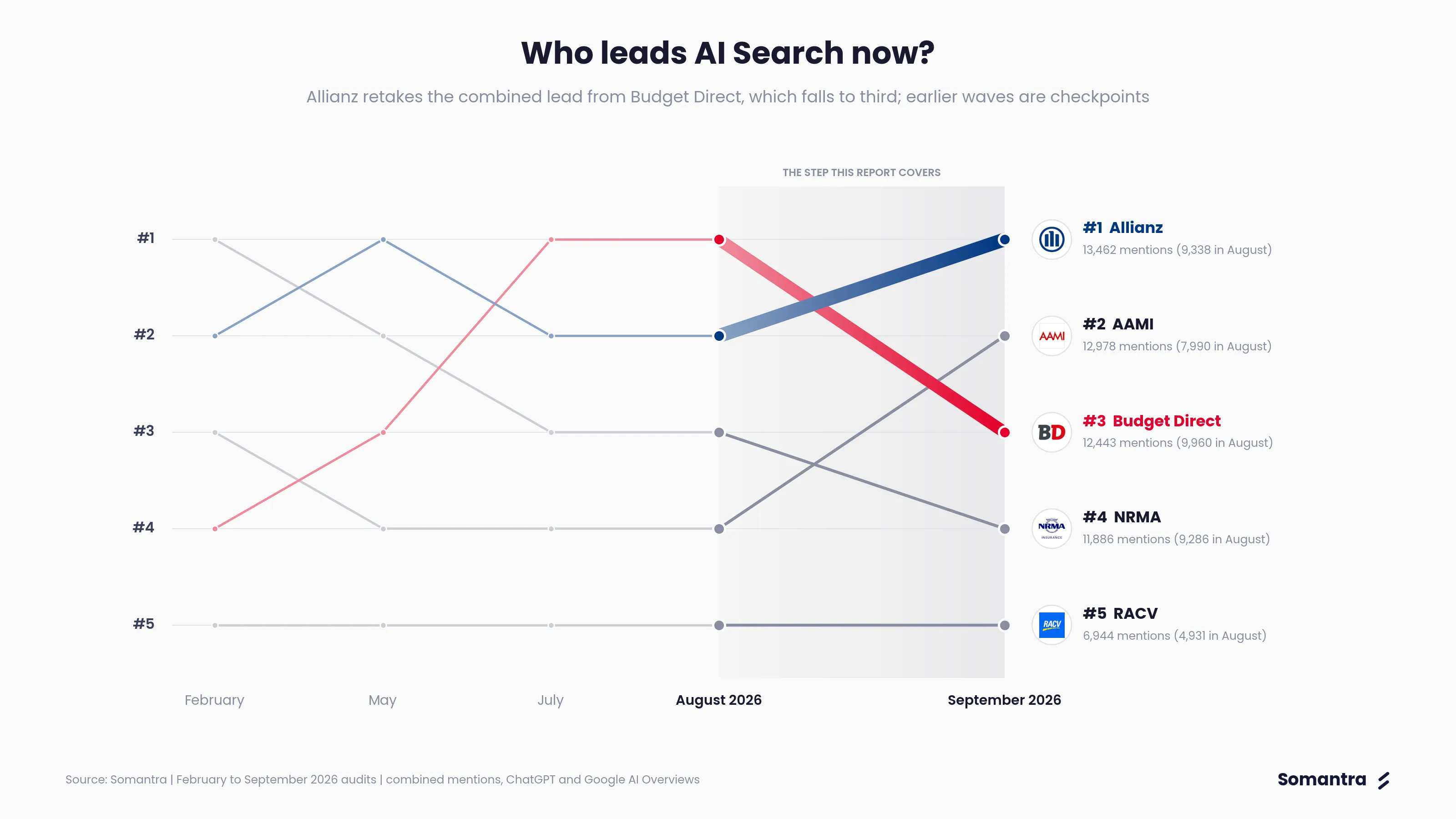
- Allianz is the new leader. Budget Direct, first in July and August, is now third. Allianz has 15.9 percent of all mentions of the 20 tracked insurers, AAMI 15.3 percent, Budget Direct 14.7 percent and NRMA 14.0 percent. The two engines disagree: Budget Direct still leads on Google, while Allianz and AAMI are level on ChatGPT. Only 18.6 percent of queries get an insurer mentioned by both engines.
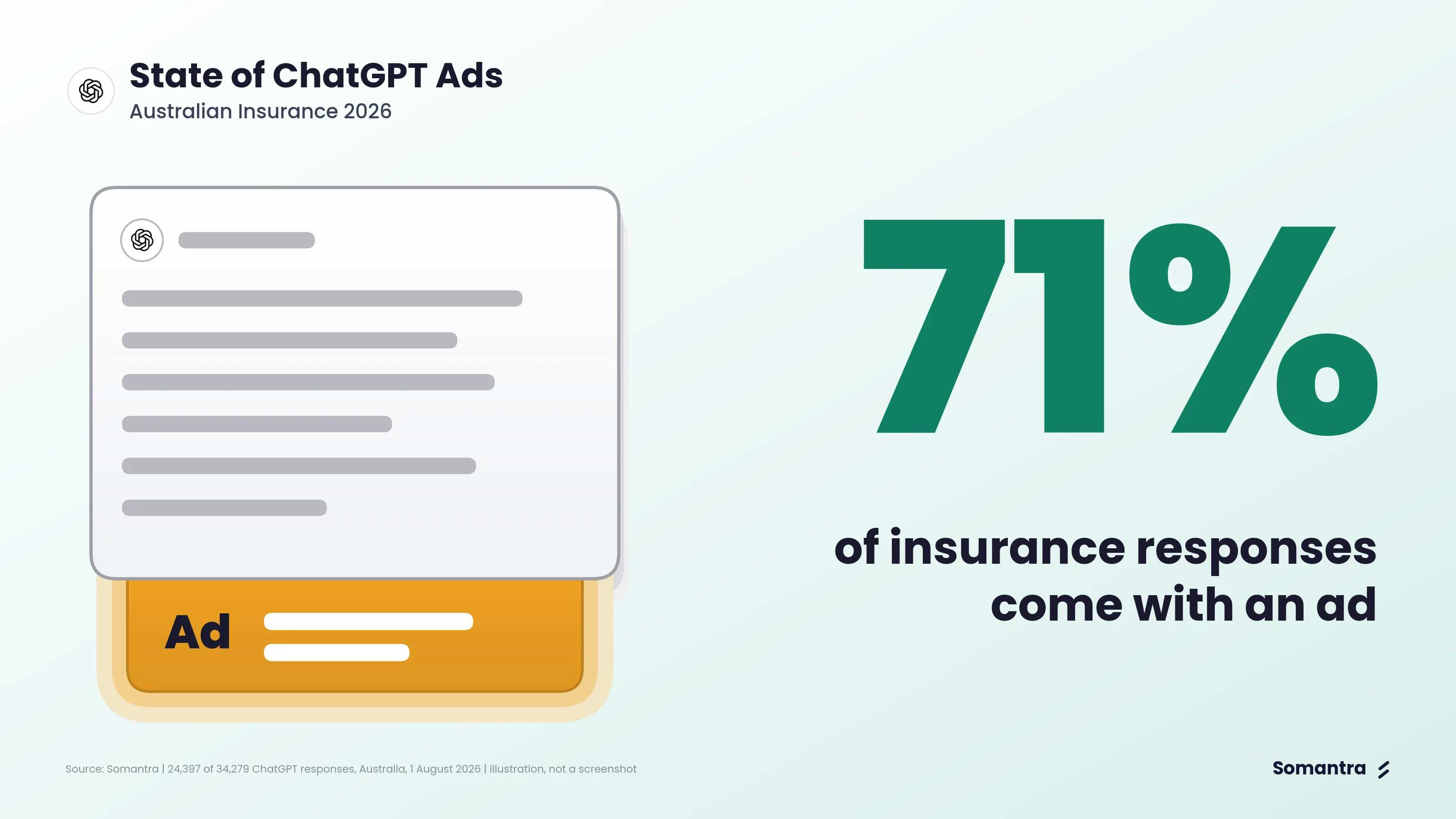
- Most of the September gain is ChatGPT mentioning more insurers, not brands winning share. ChatGPT mentioned an insurer in 35.2 percent of its answers, up from 21.1 percent in August. Its insurer mentions rose 67 percent, against 13 percent on Google. AAMI gained the most, from 14.1 percent to 17.6 percent of all the times ChatGPT mentioned an insurer. Allianz, NRMA and Budget Direct were mentioned in more answers but lost share.
- Moneysmart replaced Canstar as the most-cited website. It is the first change of leader in the series. Government sites now supply 34.0 percent of ChatGPT’s citations, up from 17.8 percent in August. Comparison sites fell from 22.1 percent to 8.0 percent.
- ChatGPT stopped linking to insurer homepages and started indexing the source documents. Homepages fell from 29.9 percent of ChatGPT’s insurer citations to 2.5 percent. PDS (Product Disclosure Statement) and policy documents rose from 2.8 percent to 12.7 percent. The homepage fall is mostly a change in link format: in August the brand name itself was linked to the homepage. The move to policy documents is real.
- The same question, asked twice, brings up different insurers. Asked twice, minutes apart, ChatGPT’s two answers share only 30 percent of the insurers they mention and start with a different insurer 60 percent of the time. Google’s two answers share 29 percent and start with a different insurer 43 percent of the time. Adding a word such as “cheapest” now changes the list no more than simply asking again.
- Test and staging websites are being cited as sources. 302 September citations point to test, staging and development sites that were not built for the public, across 58 sites. That is 0.07 percent of all citations, but double the previous peak and ten times the three waves before it. Nothing private or password-protected was reached.
- The insurers mentioned most are the ones whose own websites are cited most. The match is close: a correlation of 0.97 on ChatGPT and 0.93 on Google. Fresh dates, matching URLs and the number of pages do not explain who leads. The kind of question, the kind of page and the same sources coming back do.
How to read this report
This is the follow-up to the August 2026 report. The comparison that matters is August to September. February, May and July appear as labelled checkpoints behind it.
The panel includes 32,602 detailed insurance questions, 1,596 intent questions and 81 discovery topics, asked of Google AI Overviews and ChatGPT in every wave. 32,599 of the detailed questions were answered by ChatGPT in all five waves, and 25,549 by Google. No question mentions an insurer, so every brand mention is unprompted. August answers were collected on 1 August 2026, September answers on 26 September 2026.
One thing changed between the waves and shapes everything that follows: ChatGPT’s behaviour. Every August ChatGPT answer records the model as GPT-5.5. The September answers that record a model say GPT-5.6, and public reporting places the change of default model in the week of 6 August. The September ChatGPT answers are shorter, cite far more sources, and mention far more insurers.
Part A. Follow-up from August: who leads now
1. The combined leader changed hands again
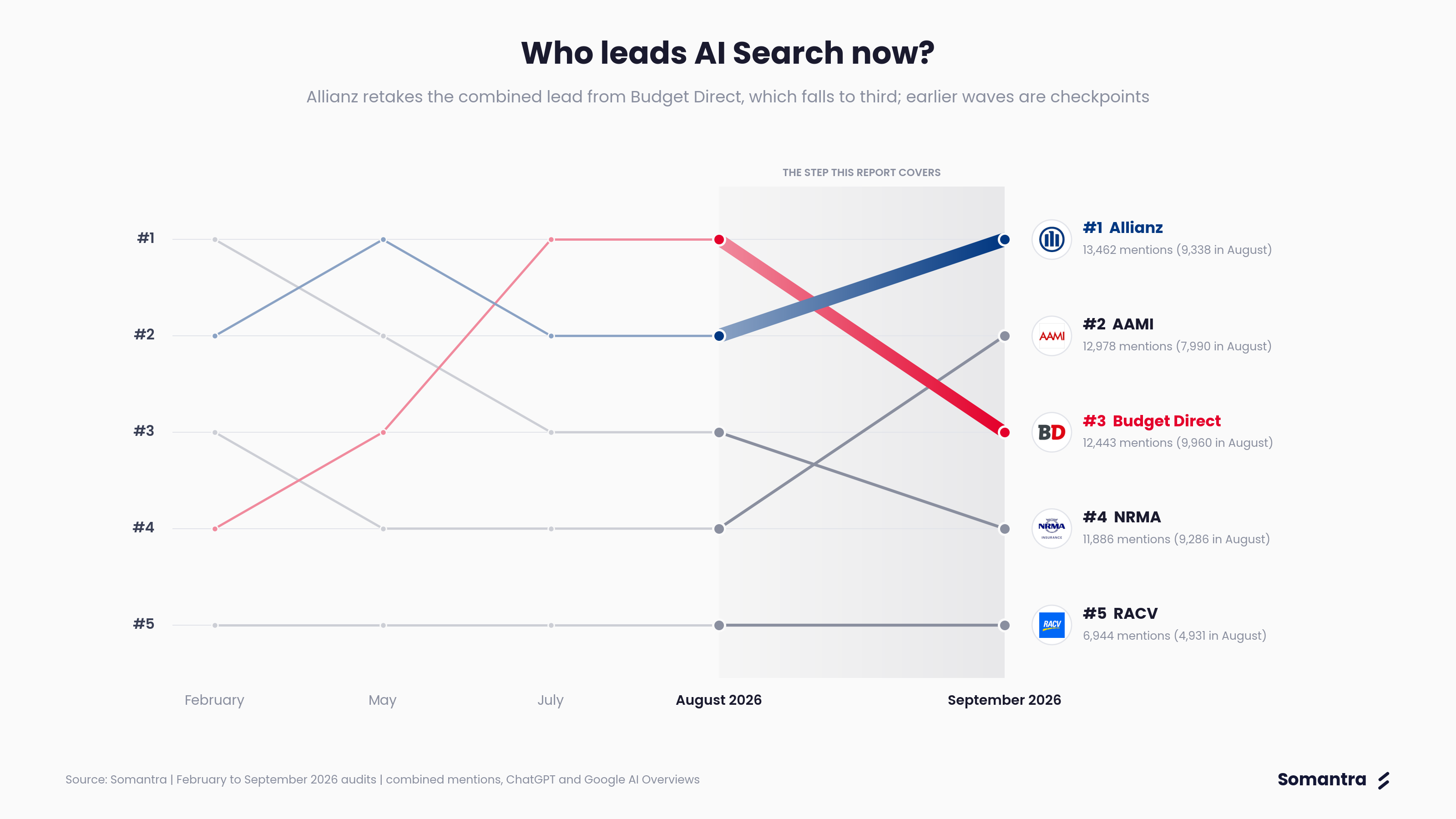
Combined rank by wave, February to September 2026. Base: tracked brand mentions across Discovery, Intent and Conversation.
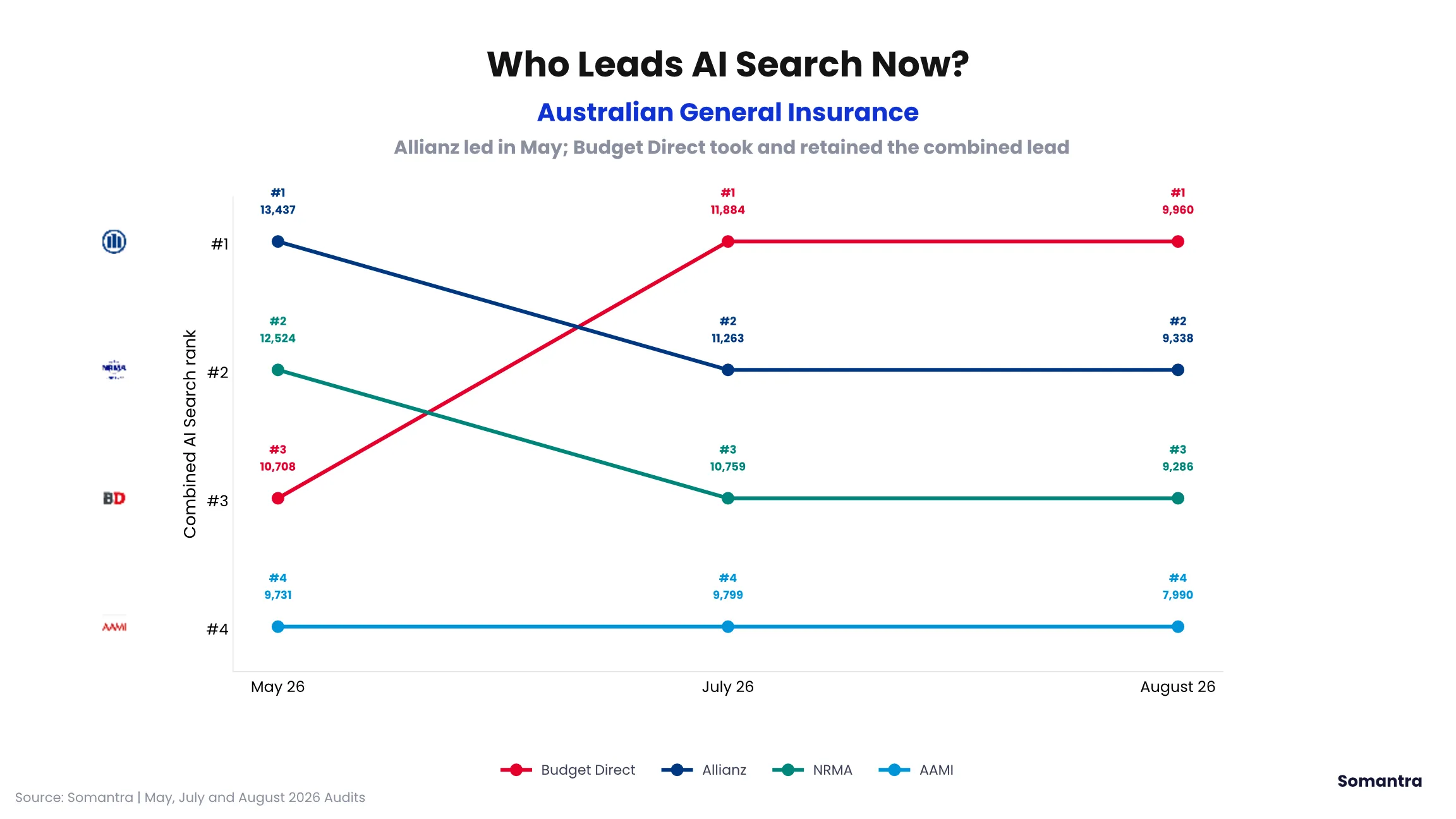
Budget Direct held the combined lead in July and August. In September Allianz is first, AAMI second, Budget Direct third and NRMA fourth. The gaps between neighbours are 3.7 to 4.7 percent, outside the 2.1 percent margin of error (see Method and limits). The top four together hold 60.0 percent of tracked mentions, the same concentration as August (59.6 percent).
September totals are higher than August’s, and that is ChatGPT. On detailed questions its mentions rose 67 percent (29,637 to 49,387), against 13 percent on Google (25,904 to 29,198). ChatGPT’s answers mention insurers more often and repeat each name more, so mention counts overstate any one brand’s change. That is why the next section uses answers and share of slots.
What sits behind this. The order of the leaders follows whose website the engine reads. Across the 15 insurers with their own sites, the number of September answers mentioning an insurer tracks the number citing its site almost exactly (rank correlation 0.97 on ChatGPT and 0.93 on Google). ChatGPT cited Allianz’s site in 3,522 answers, AAMI’s in 3,254, NRMA’s in 3,037 and Budget Direct’s in 1,908. This is an association. An engine may choose the brand first and look up its page after.
2. The leader depends on the Platform
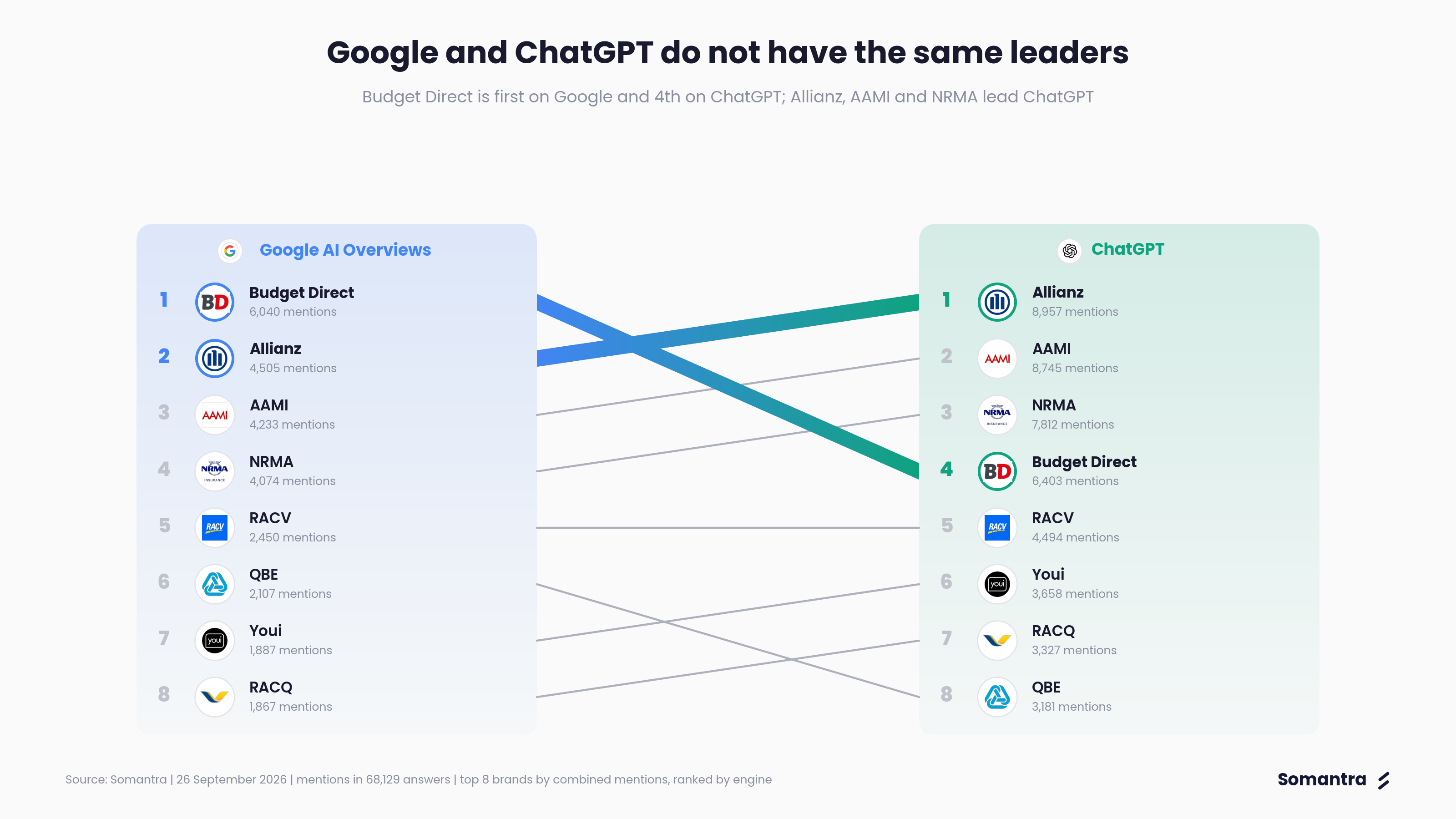
September rank by engine for the eight brands with the most combined mentions. Base: 34,276 ChatGPT answers and 33,853 Google AI Overview answers across all stages.
Budget Direct leads Google AI Overviews for the fourth wave in a row. On ChatGPT it is fourth. Allianz leads ChatGPT on mentions (8,957 to AAMI’s 8,745) and AAMI is 13 answers ahead (5,646 to 5,633), so the two are level. NRMA, the July and August ChatGPT leader, is third. RACV is fifth on both engines.
Same question, both engines. Would someone asking the same question on Google and on ChatGPT meet the same insurers? Usually not. In September, 32,200 detailed questions were answered by both engines.
Only 18.6 percent of questions get a tracked insurer mentioned by both engines. Even then the lists differ. Of the 5,974 questions where both mention insurers, the two lists are identical 9.2 percent of the time, and 20.1 percent of the time they have no insurer in common. On average the two lists share 37 percent of their insurers, down from 42 percent in August. No brand is mentioned by both engines on much more than 25 percent of the questions that mention it: Bingle 25.3 percent, Budget Direct 24.6, NRMA 21.5, AAMI 18.7, Allianz 18.0.
What sits behind this. Each engine’s leader leans on one kind of question.
Allianz’s ChatGPT lead is driven by travel insurance. Allianz is mentioned in 1,065 ChatGPT travel answers and AAMI in 13. Without travel questions AAMI leads ChatGPT with 5,305 answers, NRMA has 4,806 and Allianz 4,263.
Budget Direct’s Google lead leans on discount questions. 4,434 questions, 14 percent of the panel, ask about discounts. Budget Direct is mentioned in 1,907 of them on Google, 43 percent of all its Google answers. Without them Allianz leads Google with 3,207 answers, against 2,530 for Budget Direct and 2,506 for AAMI.
The engines also read different sites. Budget Direct’s main car insurance page is cited in 755 Google answers and 35 ChatGPT answers. Its home and contents page is cited in 573 and 65.
3. Did Brands Gain Visibility, or did ChatGPT start mentioning more insurers?
Every major brand gained ChatGPT answers between August and September. The fair test is whether a brand gained more than the field. Exhibit 3 gives each brand’s share of brand slots (every time an insurer is mentioned counts once) with category weights held at their September values, so a shift in question mix cannot move the number.
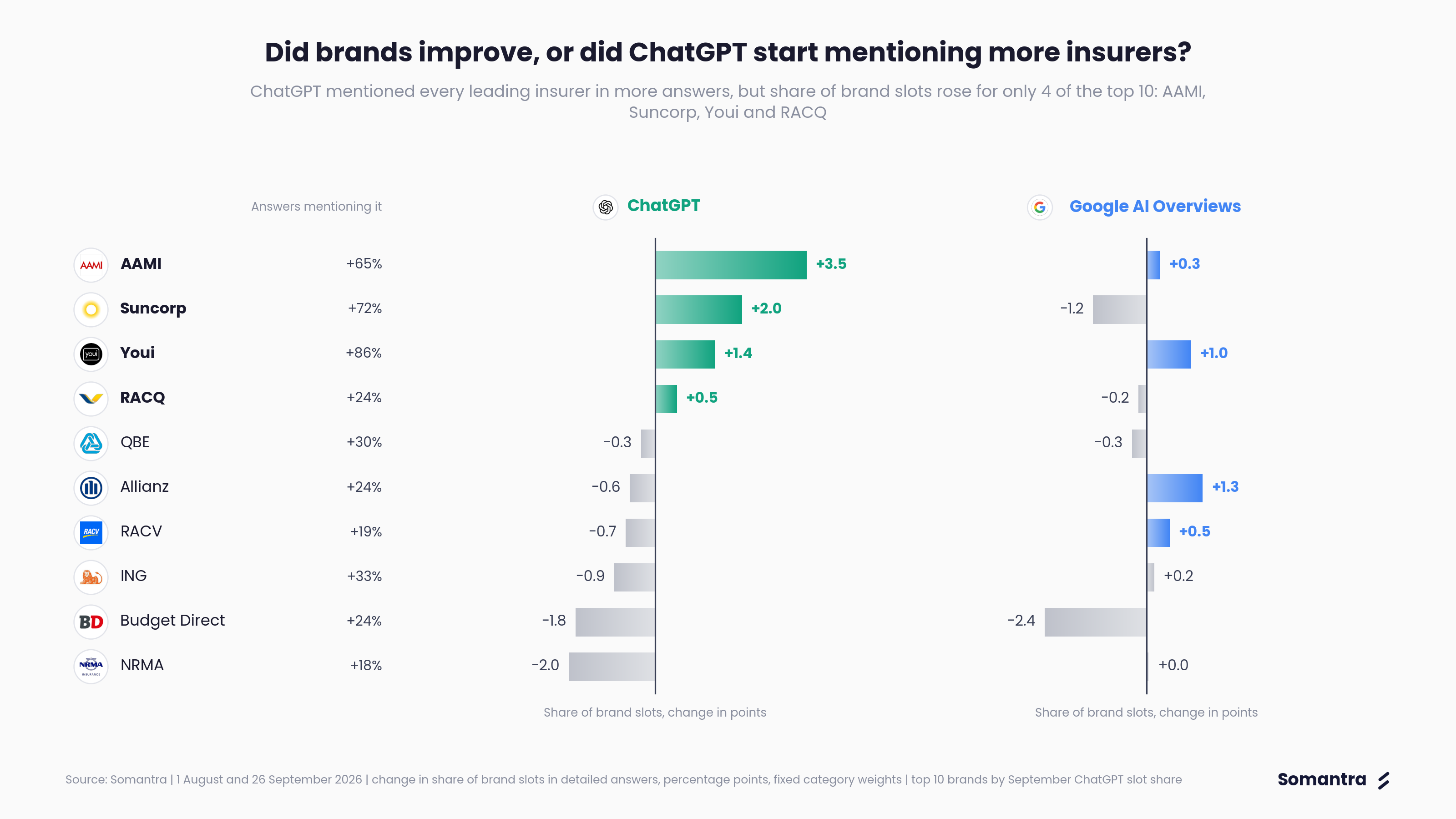
Base: shared detailed questions, 32,599 on ChatGPT and 31,722 on Google.
On ChatGPT, AAMI is the September winner: 3.5 points of slot share and 4.8 points of first-mentioned share. Suncorp, Youi and RACQ also gained ground. Allianz gained 1,025 answers and lost 0.6 points of share. NRMA gained 784 answers and lost 2.0 points, and its share of first-mentioned positions fell from 21.5 percent to 11.8 percent. Budget Direct lost 1.8 points on ChatGPT and 2.4 on Google, where it still holds 24.6 percent of all brand slots.
What sits behind this. Three things go with these moves.
NRMA lost its place at the head of the list, not answers. In August, when ChatGPT mentioned both NRMA and RACV, NRMA came first 81.7 percent of the time (1,955 answers). In September it is 53.8 percent (1,650 answers). Set against a random order, ChatGPT put NRMA first 1.52 times as often as chance in August and 1.02 times in September.
AAMI gained as ChatGPT began reading its guides, policy documents and motorcycle pages. Citations of AAMI’s own site rose from 707 rows to 5,189, the largest rise among the leaders.
For Budget Direct, part of the lost ChatGPT share sits in the questions where a comparison site was cited in August and dropped in September.
4. Category winners: two changed hands
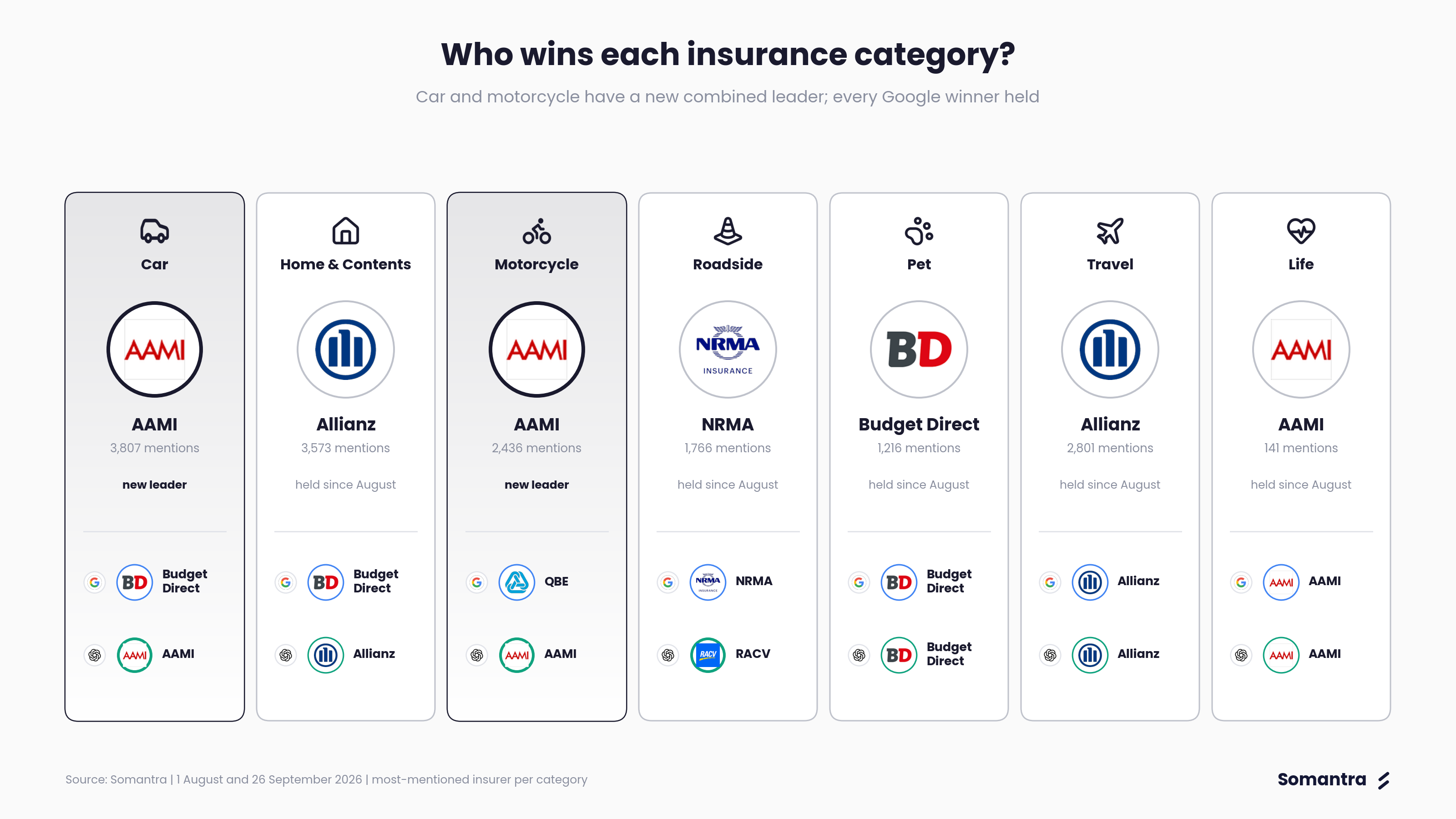
September combined, Google and ChatGPT winners, detailed questions, with the share of answers mentioning no tracked insurer. Categories use the same rules as the August report.
In August the combined winners were Budget Direct in car and QBE in motorcycle. In September AAMI leads both. Roadside, home, pet, travel and life kept their combined winners. Inside ChatGPT three leads moved: AAMI took car and motorcycle from NRMA, and RACV took roadside from NRMA. Google’s winners did not change in any category, though life on Google is now a tie (AAMI and Budget Direct, 70 mentions each, on about 100 answers). The share of answers that mention no insurer shows where ChatGPT’s new habit landed: motorcycle answers mentioning an insurer went from 20.0 percent to 58.5 percent, roadside from 47.5 to 68.7 and car from 22.8 to 43.1.
What sits behind this. AAMI’s gains go with ChatGPT reading its pages. ChatGPT cited AAMI’s motorcycle pages in 104 answers in August and 931 in September.
The rise in answers that mention an insurer goes with ChatGPT searching the web on almost every question. Motorcycle answers carrying any citation went from 39.7 percent to 92.0 percent (3,271 answers), and those citing an insurer’s site from 21.2 percent to 69.1 percent. ChatGPT also began assuming a place the question did not give (“Since you’re in Western Australia”). It did so in 17.9 percent of September car answers, 29.6 percent of motorcycle answers and 21.6 percent of roadside answers, against 1.4, 1.7 and 5.6 percent in August. Google does it in under 0.2 percent of answers in both waves.
Life and pet look mostly brandless in this chart because the 20 tracked brands include no life or pet specialist. That is a gap in the tracking. It is not an absence of brands in the answers. September’s tracking added 29 specialists.
The expanded list can also be applied to the August answers, so the specialist series does have a starting point.
The original 20 understated pet and life visibility in August as well as in September. In August a pet answer mentioned a specialist and none of the original brands 18.5 percent of the time on ChatGPT and 21.8 percent on Google. In September 51.0 percent of ChatGPT’s pet answers mention a tracked insurer once specialists are counted, against 20.4 percent on the original list. The specialists mentioned most in September are Pet Insurance Australia, RSPCA Pet Insurance, Medibank and Bow Wow Meow in pet; InsureandGo, 1Cover, Fast Cover and Medibank in travel; and TAL, AIA, Zurich and NobleOak in life.
5. Citations in AI Search: Moneysmart replaces Canstar
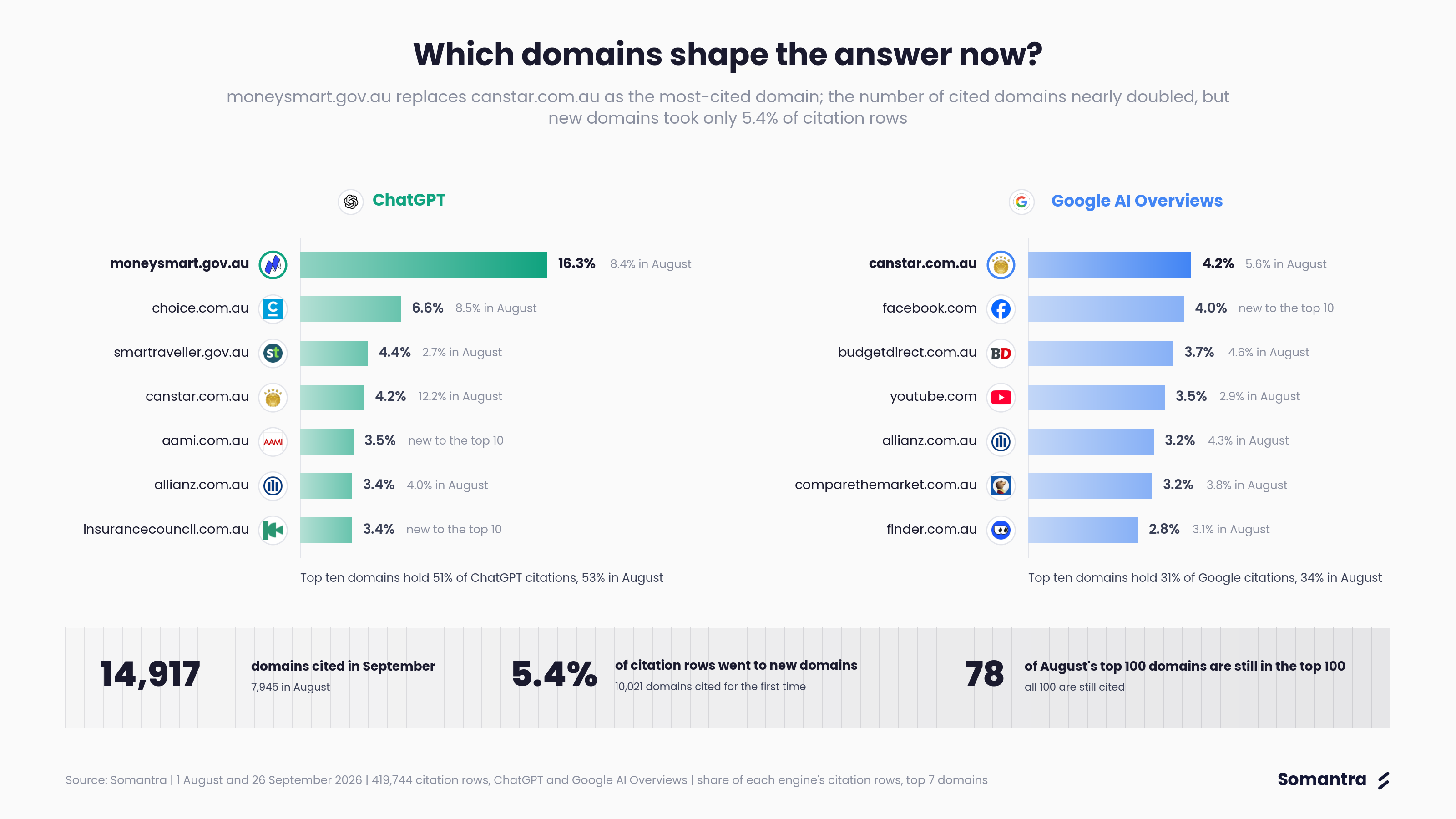
Leading domains and top-ten share by engine, August and September, all stages, with the citation ecosystem panel. Base: 156,268 ChatGPT and 263,476 Google citation rows in September.
Canstar led the combined ranking in May, July and August. In September Moneysmart leads by 11,000 rows, almost all of them from ChatGPT, which cites in 88 percent of its answers against 45 percent in August. ChatGPT remains the more concentrated engine, with its top ten domains holding 51.3 percent of its citations, against 30.9 percent for Google’s top ten.
The second panel answers a question the growth invites: did new domains take share? Cited domains rose 88 percent, from 7,945 to 14,917. Domains new since August (10,021 of them) received 5.4 percent of September rows. Every one of August’s top 100 domains is still cited and 78 remain in the top 100. More domains, little redistribution.
One departure stands out. nationalcover.com.au, a guide site, fell from 12,745 Google citation rows in February to 5,401 in August and four in September. The 15 domains named individually in Somantra’s July piece on contaminated insurance advice are at or near zero in this panel: 38 ChatGPT rows and 3 Google rows between them in September.
What sits behind this. Moneysmart’s rise is broad, not a few new pages. It is cited in 33.0 percent of ChatGPT answers, up from 11.3 percent, across every question type and category, and 87 percent of its September rows are on pages it was already cited for in August. What changed is where ChatGPT cites at all. It began citing on kinds of question it used to answer from memory: “why” questions went from 1.4 percent citing to 68.5 percent (3,246 questions) and “what is” questions from 27.7 to 82.4 percent, while “best” questions stayed at 94 percent. Government and insurer pages fill the new citations.
nationalcover.com.au did not only leave the AI Overview. It left Google’s ordinary results: it appeared on 11.1 percent of result pages in August and 0.1 percent in September. The site is still live.
Non-production pages in the sources, and other hosts worth checking
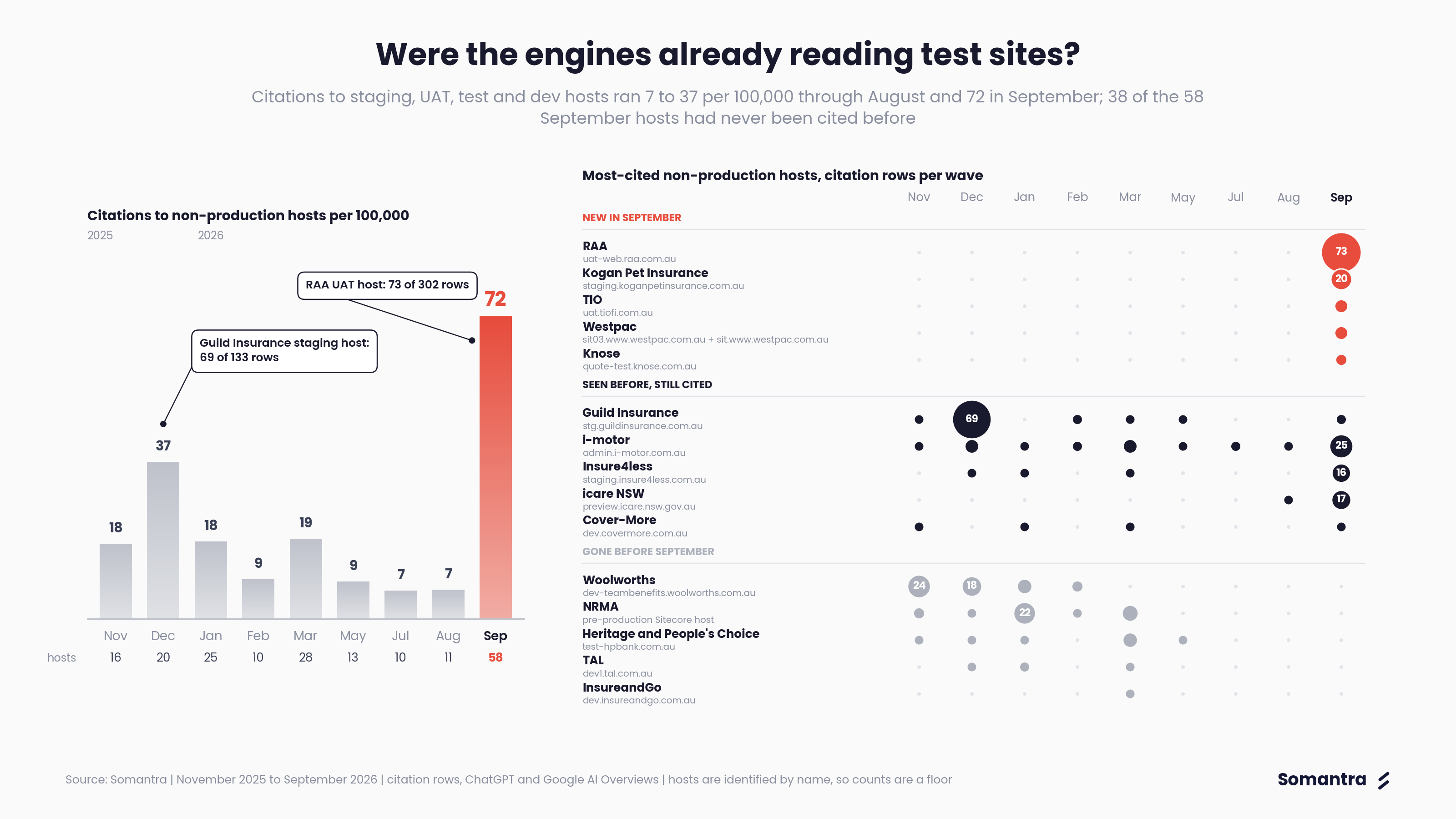
Citations to staging, UAT, test, development and similar hosts by wave, November 2025 to September 2026, per 100,000 citation rows, with the hosts behind them. Base: citation rows in the history file (November 2025 to July 2026) and the August and September snapshots; both engines.
In September, 2,444 citations (0.58 percent of all citation rows, in 2,161 answers) pointed at a host other than an organisation’s main public site. They fall into two groups, and the difference matters.
The first group is 2,142 citations to content-management and origin servers, asset and document stores, and quote funnels. Hosts like these can be public on purpose. A citation to one is a warning sign, not a confirmed problem.
The second group is 302 citations to staging, test, development, QA, preview, sandbox and admin environments. These are non-production hosts: working copies of a site that are not built for the public. That they are being cited is a confirmed problem.
ChatGPT accounts for 1,900 of the 2,444 rows and Google for 544. In August the equivalent count was 396.
The first group is mostly a question of which address the engine treats as the official one for a page. The engine learned the page from a CDN, an origin server or a quote funnel instead of the main public address. The organisation may be content with that or may not; only it can say. The second group is where the confirmed problems are.
Four things stand out.
For 986 of the 2,444 citations (40 percent), the same path is also cited on the organisation’s public host in September. Matching any of the organisation’s main hosts, not only the bare domain, gives 1,098 (45 percent). The engine holds two copies of one page and sometimes sends the reader to the copy that is not on the main site. All 73 RAA citations are test-host copies of pages that are also cited on raa.com.au, and the same is true of TIO’s eight. For the other 60 percent the infrastructure copy is the only copy cited: the i-motor PDS on an admin host, the Insure4less staging homepage, the Marsh claim form, the Assurant document API, and Cover-More’s 2022 business travel PDS, whose public copy was cited in six earlier waves and in September appears only on the development host. On a non-production host the reader can land on a draft or a superseded version, and the page can disappear without notice. Three cases are confirmed. The RAA test host returned 403 on 7 October, so it was reachable when the engine read it and has since been closed. getquote.fastcover.com.au, cited 516 times in September, no longer resolves. And Cover-More’s 2022 document is cited in September only on a development host.
This was not already happening at this scale. The citation record, the same 2.4 million rows behind our citation report, runs back to November 2025, nine waves in all. Non-production hosts appear in every wave, but September’s 302 citations, 72 per 100,000, are about double the previous peak (December 2025, 37 per 100,000) and ten times the level of the three waves before it (7 to 9 per 100,000).
Thirty-eight of September’s 58 hosts had never been cited before; they carry 193 of the 302 citations. The other 20 have a history. admin.i-motor.com.au has been cited in all nine waves. Guild Insurance’s staging host drew 83 citations between November and March, 69 of them in December 2025, and is still cited. Insure4less, Cover-More, VicRoads, Marsh and Fast Cover hosts recur. The record also shows what fixing it looks like. NRMA’s pre-production Sitecore host was cited 46 times between November 2025 and March 2026, 22 of them in January, by both engines, for pages such as roadside assistance for electric vehicles. It has not appeared since May, and those pages are now cited on mynrma.com.au. A Woolworths team-benefits development host (58 citations from November to February), TAL’s development host (December to March), InsureandGo’s development host (March) and a Heritage and People’s Choice test domain (November to May) have gone the same way. Two moved the other way: icare’s preview host rose from three citations in August to 17 in September, and NRMA’s production CMS origin host, which is not a test host but is not the public site either, rose from six to 183. Under this host rule, none of the 20 tracked insurers other than NRMA, RAA and ING (an acceptance-test host, two citations in December and January) has had a non-production host cited in any of the nine waves.
What sits behind this. The two engines got here differently.
On Google the rise begins in the ordinary search results, not in the AI Overview. Organic results on non-production hosts went from 22 (8 hosts) in August to 248 (41 hosts) in September, out of about 290,000 organic results in each wave. The AI Overview cites these hosts at the same rate it cites anything else that ranks.
ChatGPT was already being handed these hosts in August and did not cite them. They were 106 per 100,000 of the search results it retrieved and left uncited (164 of 155,227). In September it cited them. One host carries much of each engine’s count. Without uat-web.raa.com.au, ChatGPT’s September rate is 54 per 100,000, inside its earlier range of 13 to 62. Without admin.i-motor.com.au, Google’s is 46 per 100,000, still above its earlier peak of 36.
Two checks bear on a fix. Three production copies that carry a correct canonical tag pointing at the main site (a CDN and two origin servers) were still cited by ChatGPT 334 times. And of six non-production pages that could be reached, none carries a canonical tag pointing at the main site and none carries a noindex instruction. Both samples are small.
A second live check on 7 October found the Westpac, icare and VicRoads test hosts closed or gone, and the TIO, carsfinance, Cover-More development and Guild staging hosts still answering.
The question it leaves for each insurer named above is whether the document on that host is the one in force, and whether the host should be reachable at all.
Part B. Conversation Journey in Insurance
6. What shapes visibility for a brand?
Before asking who wins, it is worth asking which questions ever produce a brand. Five waves give each question five observations per engine.
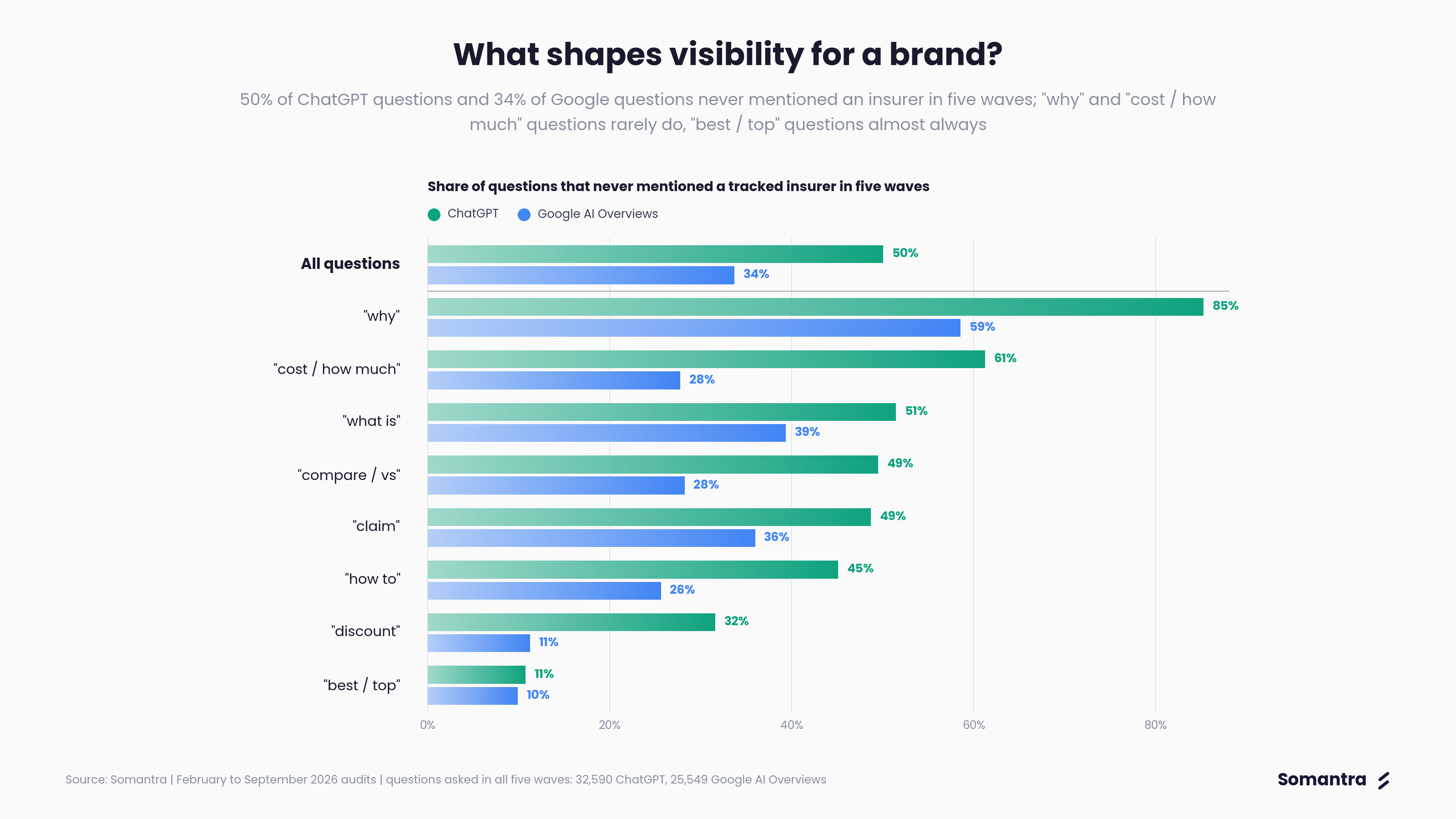
Base: 32,590 ChatGPT questions and 25,549 Google questions present in every wave.
50.0 percent of ChatGPT’s questions never mentioned a tracked insurer in five tries. Across the five waves, “why” questions are the most brandless on both engines. “Best” questions are the opposite: Google mentioned a brand every time on 51.6 percent of them. Cost questions split the engines: Google mentions an insurer in 40 percent of its observations, ChatGPT in 15 percent, because ChatGPT’s cost answers lean on Moneysmart and Canstar rather than insurers.
Pet and life carry the caveat from section 4: the five-wave series tracks 20 brands and misses specialists.
What sits behind this. “Why” questions were brandless on ChatGPT because it did not search for them. In August 1.8 percent of its “why” answers carried any citation. In September 68.7 percent do. On Google the reason is different: 60 percent of “why” answers cite an insurer’s page and only 17 percent of those mention the insurer.
Beyond the wording of the question, two things go with a brand being mentioned every time a question is asked. One is a place: questions that say “Australia”, or a state or city, get a brand every time more often on ChatGPT. The other is an insurer’s page among the sources. Of the questions where no insurer page was cited in any of the five waves, 77.5 percent never mentioned a brand.
Three common explanations, tested. Fresh content, a URL that matches the question and the number of pages are the usual explanations for who gets mentioned. None of them separates the leaders in this panel.
7. Insurer Pages That Are Being Cited?
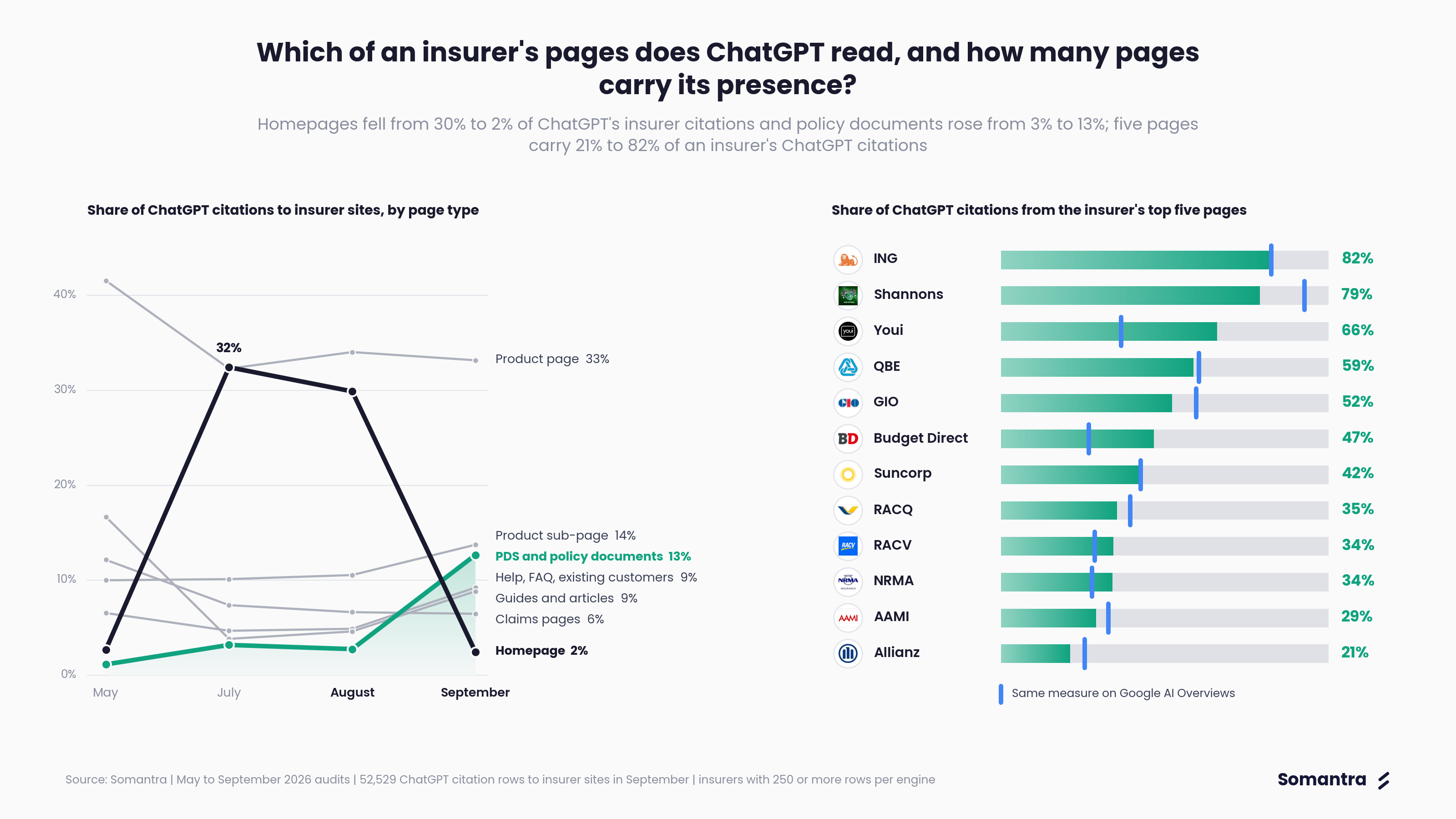
Base: ChatGPT citations to insurer domains in detailed answers, 3,070 in May, 12,648 in July, 14,983 in August, 52,529 in September.
The homepage was a July and August habit. In those waves about 30 percent of ChatGPT’s insurer citations were links on the brand name pointing to the front page. In September that habit is gone and the engine reads deep pages: 4,150 distinct insurer pages, against 1,694 in August, and 12.7 percent of citations are a PDS or policy booklet. Google did not move: product pages were 47 percent of its insurer citations in August and 44 percent in September, PDS documents 1 percent in both.
The second panel shows how narrow an insurer’s presence can be. Budget Direct’s ChatGPT citations come from 127 pages and the top five carry 46.5 percent of them. Youi’s top five carry 65.9 percent, QBE’s 58.7 percent. Allianz is the exception at 21.1 percent across 160 pages. This describes concentration, not what would happen if a page disappeared.
What sits behind this. The homepage fall is a change of format. Of 4,479 August homepage citations, 4,165 (93 percent) were the brand name itself linked to the front page, in a list of insurers. Looking only at source links, homepages were 3.1 percent of insurer citations in August and 2.5 percent in September. The move to policy documents is real: 4.1 percent to 12.7 percent on the same basis.
The rise in distinct pages is partly volume. September has three and a half times as many insurer citations as August. A random draw of 14,983 September citations, August’s count, contains about 2,516 distinct pages, against 1,682 in August on the same URL rule. ChatGPT does read more widely, by about 50 percent and not by 145 percent.
Top-five concentration is mostly a motorcycle effect. Motorcycle questions draw many insurer citations, and one product page answers most of them. Without motorcycle questions the top five pages carry 38.3 percent of Youi’s citations, 38.4 percent of QBE’s and 32.0 percent of GIO’s.
8. Does ranking on Google earn a citation, a mention, or neither?
This section asks one question: How does an Insurer’s Organic Performance Translate to ChatGPT?
Three terms are used the same way throughout.
- Rank on Google is where the insurer’s website appears in Google’s regular search results, the list of blue links below the AI Overview. Top 3 means it is one of the first three links. The groups build on each other: the top 5 includes the top 3, and the top 10 includes the top 5. If several of an insurer’s pages appear, we take the highest one.
- Cited means the AI answer lists the insurer’s website as one of its sources.
- Mentioned means the insurer appears in the wording of the answer.
We checked each of 15 insurers on each of the 32,200 queries that both Google and ChatGPT answered. Each check is one case: one insurer on one query. That makes 483,000 cases.
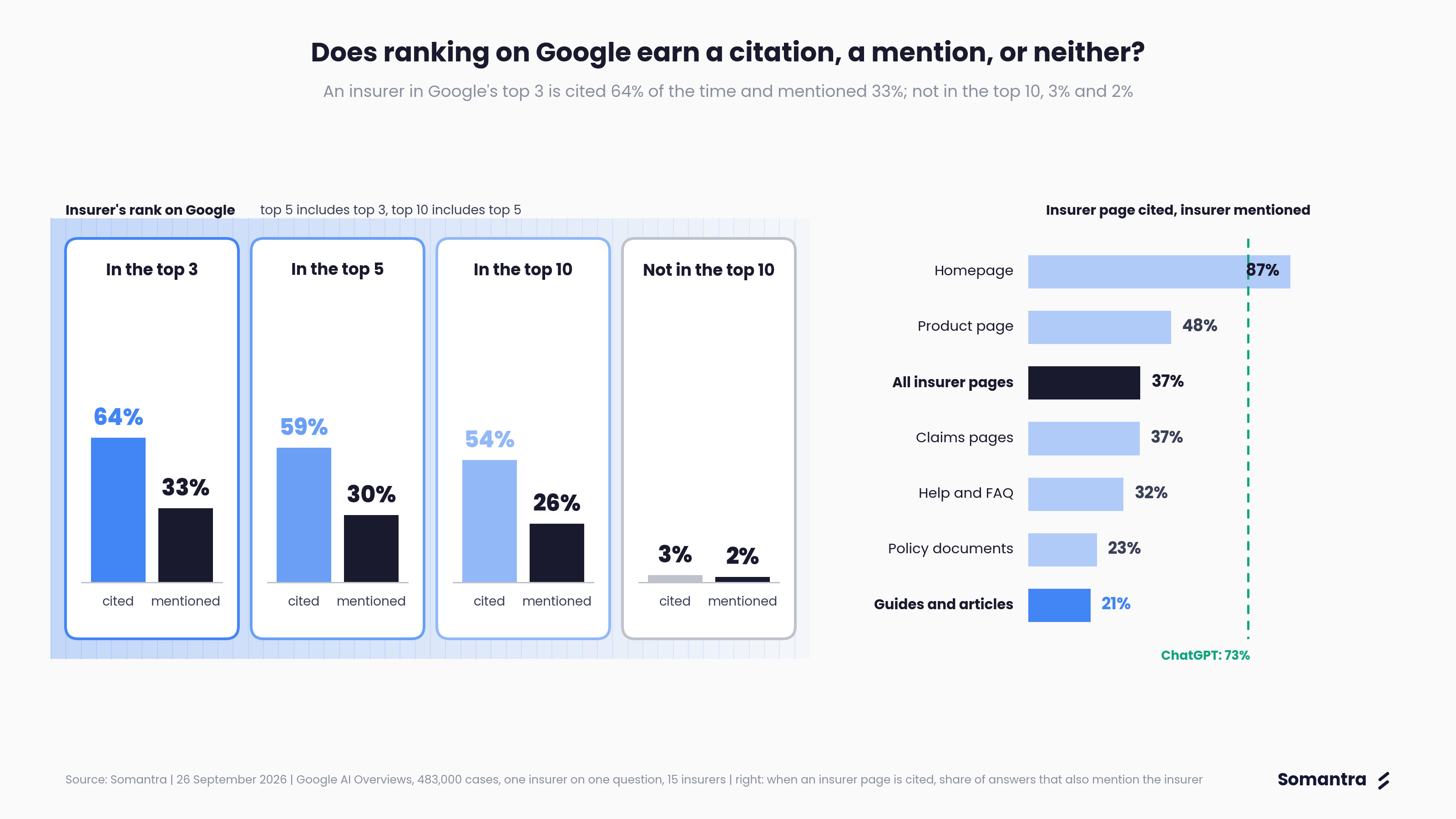
September. Base: 15 insurers on 32,200 detailed questions.
An insurer in Google’s top 3 is cited about twice as often as it is mentioned. An insurer in Google’s top 3 is cited by the AI Overview 63.7 percent of the time and mentioned 32.6 percent of the time. In the top 10 it is cited 53.9 percent of the time and mentioned 25.7 percent. An insurer outside the top 10 is almost never cited (3.2 percent) or mentioned (2.4 percent).
It differs by insurer. In the top 3, Budget Direct is mentioned 45.5 percent of the time, AAMI 36.4 percent, Allianz 32.9 percent and Youi 16.2 percent. GIO is the extreme case: cited 74.2 percent of the time and mentioned 8.9 percent.
Is ranking on Google linked to being cited and mentioned by ChatGPT? The same insurers and the same questions, this time looking at ChatGPT’s answer. Base: the 32,200 questions both engines answered in September.
Yes, the two are correlated. An insurer in Google’s top 3 is cited by ChatGPT 19.5 percent of the time and mentioned 25.0 percent of the time. In the top 5 it is 17.4 percent and 23.2 percent, and in the top 10 it is 14.9 percent and 20.7 percent. Outside Google’s top 10 it is 2.9 percent and 4.7 percent.
That comparison flatters the ranking, because insurers rank on Google mostly for questions about their own products. So we compared each insurer with itself: the questions where it ranks on Google against similar questions where it does not rank. Similar means the same type of insurance and the same kind of question.
An insurer in Google’s top 3 is cited by ChatGPT 8.8 points more often, and mentioned 8.6 points more often, than the same insurer on similar questions where it does not rank. Put another way, ChatGPT cites an insurer nearly twice as often when it is in Google’s top 3 (19.5 percent against 10.7 percent). The difference gets smaller as the group widens: 7.4 points for citations and 7.6 for mentions in the top 5, and 5.9 and 6.3 points in the top 10.
Two more things to know. The correlation has strengthened for citations since August: for the top 3 the difference was 4.2 points then and is 8.8 points now. For mentions it is about the same (7.9 points in August, 8.6 now). And a correlation is not a cause. These figures do not prove that ranking on Google makes ChatGPT cite an insurer. A page that ranks well on Google for a question is likely to be a page ChatGPT finds for it too.
By insurer, when it is in Google’s top 3, ChatGPT cites AAMI 27.8 percent of the time and mentions it 36.9 percent; Allianz 22.8 and 29.0; Budget Direct 19.5 and 27.2; NRMA 15.8 and 30.2; Youi 14.8 and 15.5; QBE 11.5 and 17.9.
When an AI answer cites an insurer’s page, does it also mention the insurer? In September, Google’s AI Overview did so for 37.3 percent of the insurer pages it cited, and ChatGPT for 73.2 percent.
Google uses insurer pages as reference material. When it cites an insurer’s guide article, it leaves the insurer out of the answer 79.3 percent of the time. ChatGPT mentions the insurer for 73.2 percent of the insurer pages it cites (79.7 percent in August). That is about twice Google’s rate.
What sits behind this. The kind of question and the kind of page explain most of the gap between being cited and being mentioned.
- Budget Direct is mentioned most because of discount questions. 44 percent of the cases where Budget Direct is in Google’s top 3 are discount questions. Without them it is mentioned 32.4 percent of the time, close to the 30.5 percent for all insurers.
- GIO is cited but rarely mentioned because its top pages are guides. 87 percent of the GIO pages in Google’s top 3 are guide articles, against 24 percent for all insurers. In the top 3, a guide gets its owner mentioned 14.1 percent of the time. A product page gets 38.7 percent.
- A web address that matches the question makes no difference. What counts is the kind of question and the kind of page. “Best” questions make a mention much more likely, and guide pages make it less likely.
9. Does the answer lead to your site?
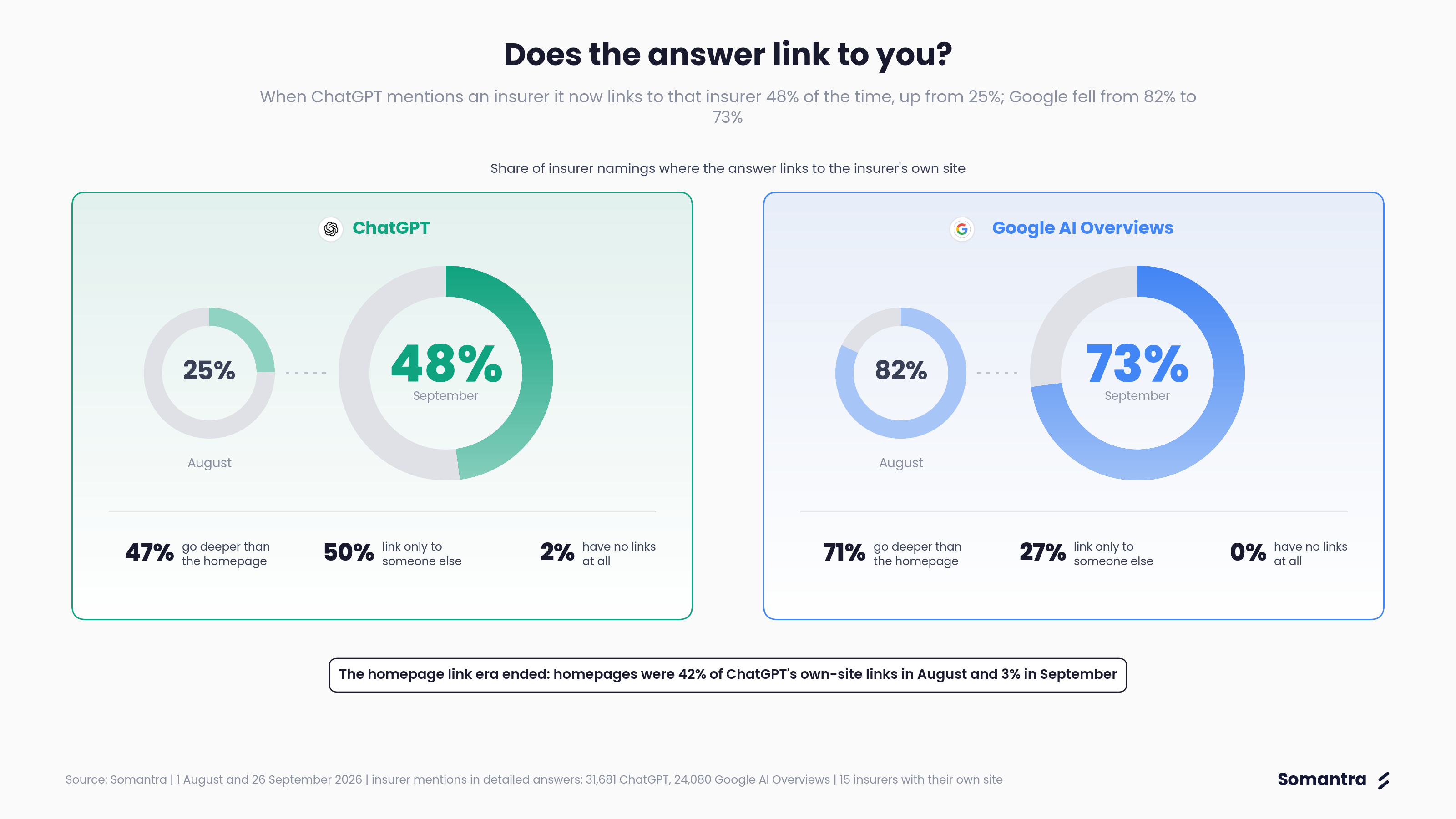
Pooled across the 15 insurers with their own domains, detailed questions. Base: insurer mentions counted once per answer, 23,766 on ChatGPT in August and 31,681 in September; 20,760 and 24,080 on Google.
The engines are converging from opposite directions. ChatGPT nearly doubled the share of mentioned insurers that get a link to their own site, from 24.7 percent to 47.9 percent, and almost all of those links now go to a specific page: homepages fell from 42.0 percent of ChatGPT’s own-site links to 3.0 percent, product pages rose to 42.4 percent, guides to 10.1 percent and PDS documents to 6.9 percent. Google slipped nine points, and the share of mentions where the only links go elsewhere rose from 18 percent to 27 percent.
Google does something ChatGPT does not: it hyperlinks the insurer’s name inside the sentence, separately from its numbered references, in 56 percent of mentions. ChatGPT’s insurer links are citation chips after the sentence.
By insurer, September: on ChatGPT, ING (72.6 percent), RACV (64.8) and RACQ (64.5) are linked most often when mentioned; QBE (27.5), Youi (37.8) and Budget Direct (42.8) least. On Google, ING (86.6), Allianz (83.4) and Budget Direct (82.3) lead; NRMA (51.5) trails, with 48 percent of its mentions linking only to other sites. NRMA’s figure depends on a rule: mynrma.com.au, the motoring club’s site, is not counted as NRMA’s own. Counted, NRMA is linked 66.8 percent of the time and the share linking only to other sites falls to 32.7 percent.
What sits behind this. On ChatGPT the link depends on how many insurers the answer mentions. In answers mentioning one or two insurers, a mentioned insurer gets a link to its own site 78.0 percent of the time (8,258 mentions). With three or four it is 52.3 percent, with five to seven 27.1 percent (13,141 mentions) and with eight or more 15.2 percent.
That accounts for much of the gap between brands. 1,153 of QBE’s 2,041 mentions, 56 percent, are in answers mentioning five or more insurers, where it is linked 11.2 percent of the time. RACV, RACQ and ING are mentioned mainly when their own page was read.
10. Change in Citations
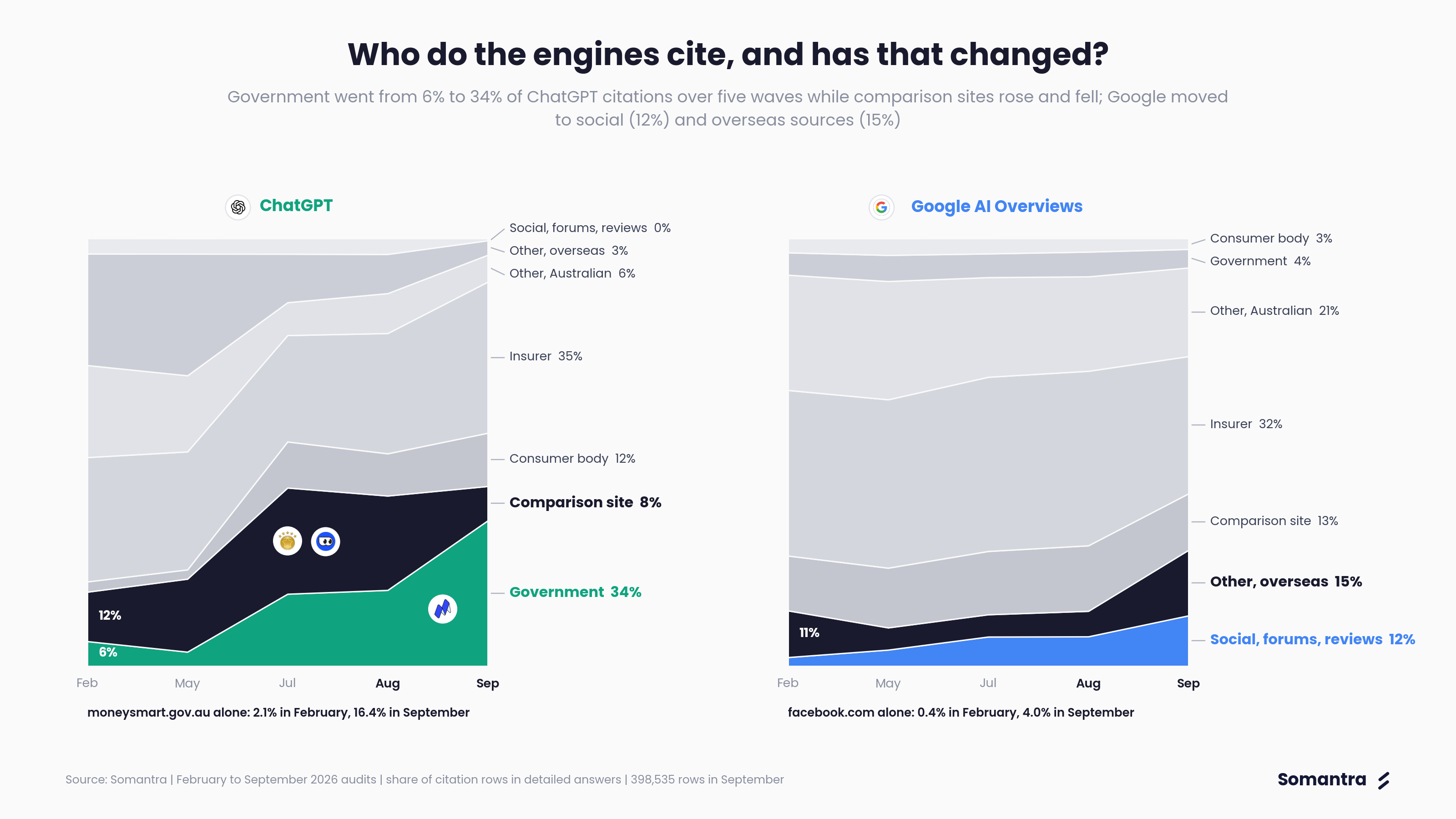
Base: detailed-question citation rows; ChatGPT 4,252 in February, 11,130 in May, 50,830 in July, 53,288 in August, 148,689 in September.
Google AI Overviews, August to September: insurers 40.8 percent to 32.1 percent; social, forum and review sites 6.9 percent to 11.8 percent; overseas sites 6.0 percent to 15.3 percent; comparison sites 15.3 percent to 13.2 percent; government 5.8 percent to 4.3 percent. Facebook alone went from 3,400 rows to 10,085.
Two stories in one chart. ChatGPT became Australian and official: overseas sources fell from 26.1 percent of its citations in February to 3.4 percent, government rose from 5.8 percent to 34.0 percent, Reddit went from 1,761 rows in August to 41. Comparison sites rose to 24.8 percent of ChatGPT’s citations in July and are now below their February share, with their row count flat (11,755 to 11,940) while ChatGPT’s total citations tripled. Google moved the other way, toward Facebook, Quora and overseas insurers and comparison sites.
What sits behind this. Comparison sites were replaced, not only diluted. Among the 13,997 ChatGPT answers that cited sources in both waves, those citing a comparison site fell from 7,076 to 3,892. An answer that cited a comparison site in August cited one again in September 39 percent of the time, against 72 to 74 percent for government and insurer sources. The flat row count hides this, because comparison sites gained 3,657 rows in answers that cited nothing in August.
Reddit did not fall alone. It was cited in 1,522 ChatGPT answers in August and 26 in September, and ten news and reference domains went from 2,441 rows to 46.
Google’s two moves have different origins. The move to Facebook follows its ordinary search results, where Facebook appeared on 27.0 percent of result pages in August and 37.2 percent in September. The move to overseas insurers does not. progressive.com fell in the ordinary results (511 rows to 237) and rose in the AI Overview (63 to 1,017).
Part C. Does the answer help someone choose?
12. Next actions for the user
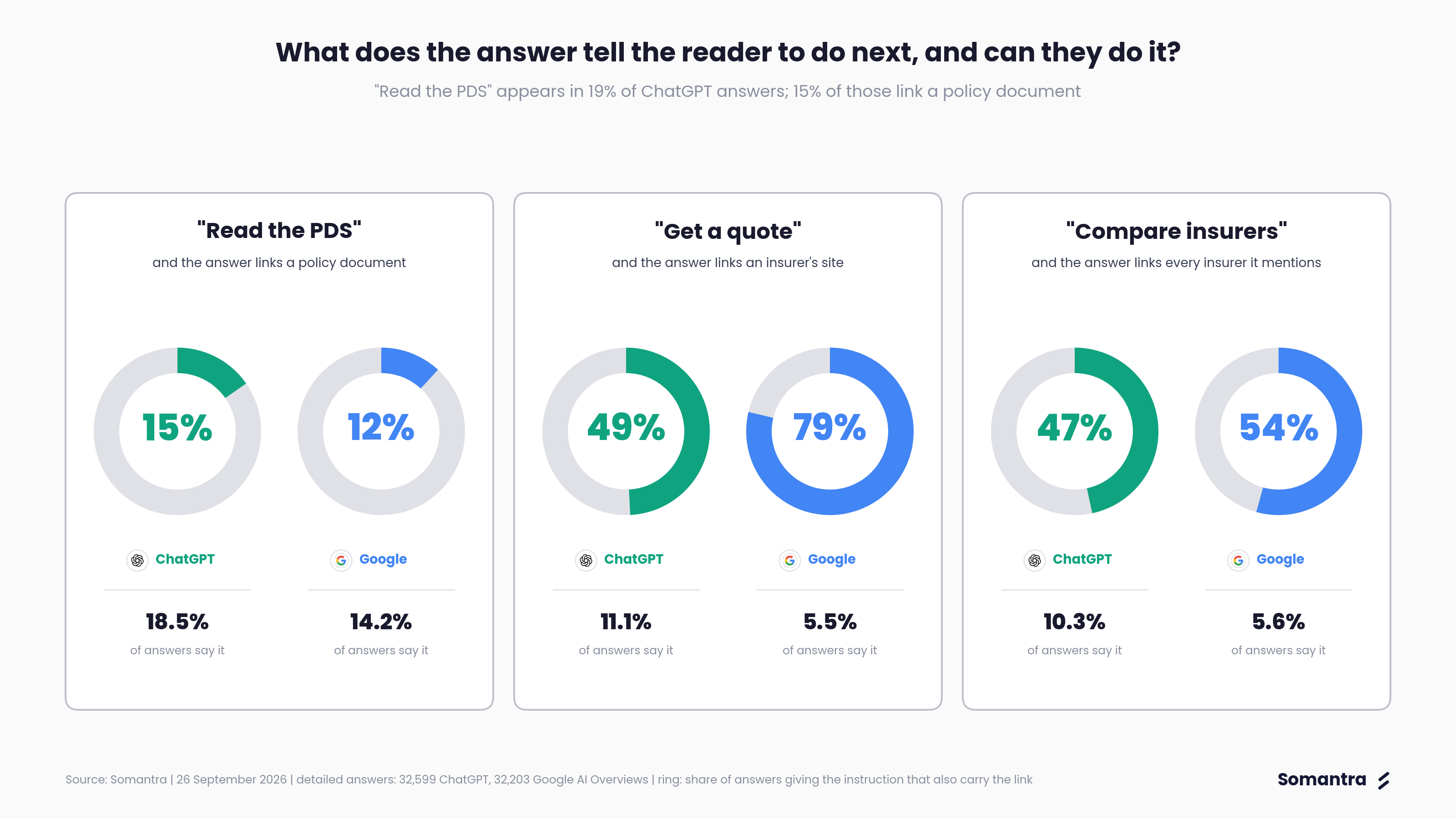
Base: 32,599 ChatGPT and 32,203 Google detailed answers in September; 32,602 and 32,067 in August.
“Read the PDS” is the most common instruction and the one least often backed by a link. In September, 18.5 percent of ChatGPT answers say it and 15.3 percent of those link any policy document. ChatGPT’s “compare these insurers” answers became usable in a month: the share with none of the mentioned insurers linked fell from 56 percent to 23 percent. Google’s went the other way, from 5 percent to 15 percent. ChatGPT now points to Moneysmart or ASIC in the text of 26.7 percent of its answers, against 1.3 percent in August. Both engines end most answers by offering to continue the conversation rather than sending the reader anywhere.
What sits behind this. Whether an instruction comes with a link depends on what the answer was built from. On ChatGPT in September, “read the PDS” comes with a policy document link in 29.3 percent of the 2,937 answers that also cite an insurer’s site, and in 2.0 percent of the 3,102 that do not. 51 percent of ChatGPT’s “read the PDS” answers cite no insurer site at all. The “compare” answers improved for the same reason: an insurer’s site is linked in 80.6 percent of them in September (3,349 answers), against 48.0 percent in August (2,527). Google’s got worse where Facebook, Reddit, Quora and Instagram took the place of insurer pages.
13. Perturbation: change one word, or change nothing, and see what moves
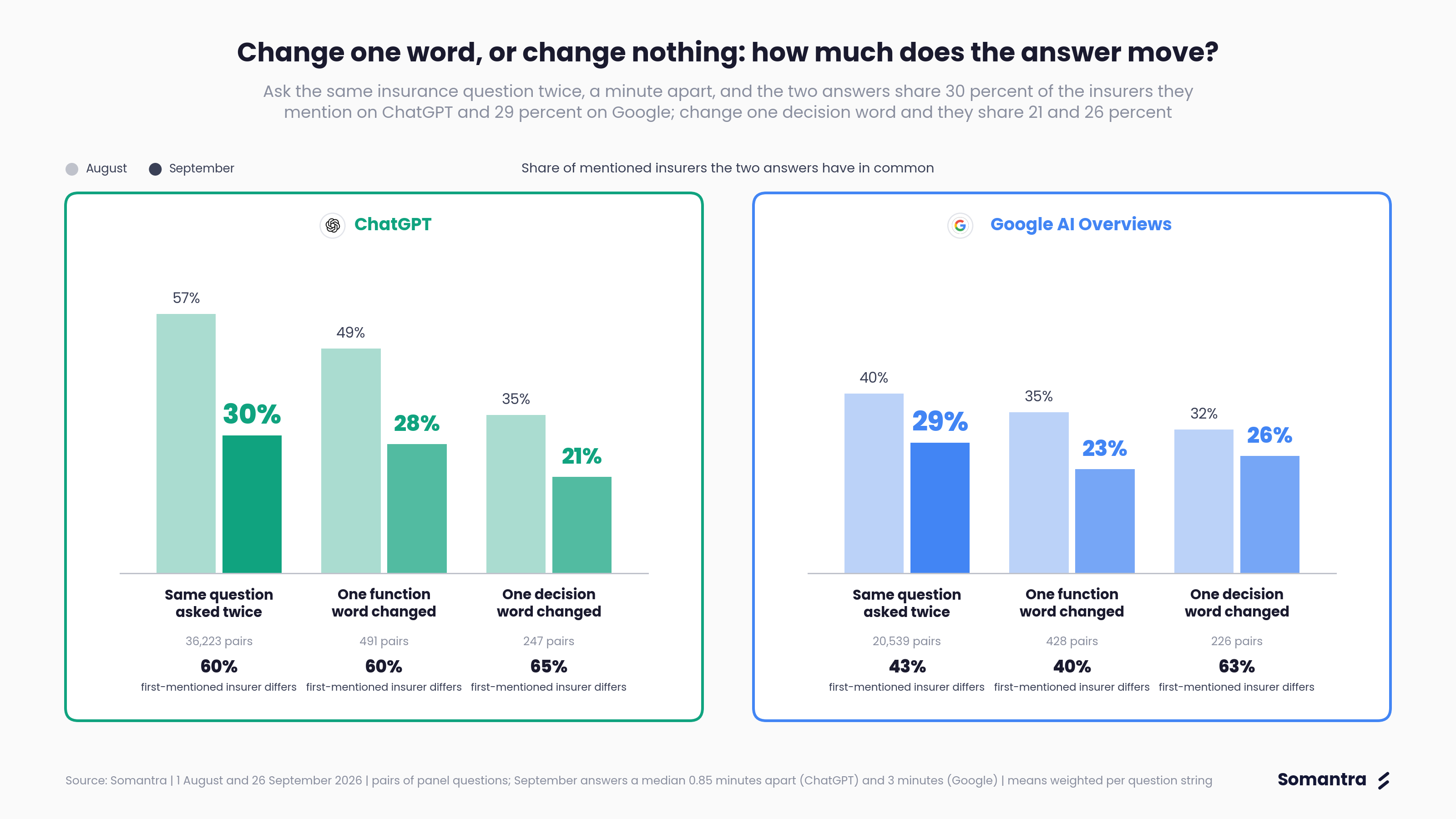
Base: pairs of panel questions with the same wording (same words; only case, punctuation or word order differ), pairs that differ by one function word, and pairs that differ by one decision word (best, comprehensive, rated, cheap, value, cheapest, top, affordable, premium, recommended). Answers mentioning a tracked insurer on at least one side; August and September; means weighted per question string.
A perturbation test is simple. Take a question, change one thing about it, keep everything else the same, and see how much the answer changes. Marketers use it to ask which words move their brand: does adding “cheapest” bring Budget Direct into the answer, does adding “most trusted” bring in NRMA. The August companion study did this with 135 pairs of questions and found that one word can rewrite how a brand is described.
There is a catch. To know what one word does, you first need to know how much the answer changes when you change nothing. If the same question asked twice gives two different answers, then a word that seems to move a brand may have moved nothing at all. The August study said this itself: it had no pairs of identical questions to compare against.
The September panel has them. The panel asks many questions more than once, under different parent topics, so 750 question strings appear two or more times. Counting the pairs in which at least one answer mentions an insurer, that gives 36,223 pairs of identical questions on ChatGPT, from 657 question strings, and 20,539 on Google, from 699. Almost all of them are exact repeats of the same text: 35,815 of the ChatGPT pairs, from 515 strings. The rest differ only in capitalisation (208 pairs), punctuation (116) or word order (84).
The section uses three measures, and they are not the same thing.
- Insurers shared is the overlap between the two lists: the insurers mentioned in both answers, as a share of the insurers mentioned in either.
- First insurer changed is how often the two answers lead with a different insurer.
- Mentioned again is how often a brand mentioned in one answer is also mentioned in the other.
One question string alone supplies 18,840 of the 36,223 ChatGPT pairs. For that reason every figure is an average per question string, not per pair. So a question repeated 200 times counts once.
Four readings, in plain terms.
The same question gives a different list. Take the strictest case, exact repeats of the same text. ChatGPT’s two answers share 31.0 percent of the insurers they mention, and the first insurer mentioned differs 60 percent of the time. Google’s two answers share 29.3 percent and lead with a different insurer 43 percent of the time. Adding the pairs that differ only in capitals, punctuation or word order does not change the result: 30 percent on ChatGPT and 29 percent on Google.
The lists agreed more in August. The fair comparison uses only the question strings repeated in both waves, 289 on ChatGPT and 470 on Google.
On the same questions, ChatGPT’s two answers shared 59 percent of their insurers in August and 39 percent in September. Google went from 46 to 36 percent. On both engines the first insurer now changes far more often. The ChatGPT drop coincides with the model change. The September figure here is 39 percent, not the 30 percent above, because this group leaves out questions that mentioned no insurer in August.
In September, one word moves the list no more than asking again. The headline figures seem to show a decision word doing something: 21 percent shared against 30 on ChatGPT. That comparison is not a fair one. Decision-word pairs come from shopping questions, and those answers vary more to begin with. The fair test sets each decision-word pair beside repeats of its own base question.
In August, changing one decision word moved the list clearly more than asking the same question again: on ChatGPT the two lists shared 41 percent of their insurers after a word change, against 64 percent for a plain repeat. In September, asking again moves the list as much as changing the word: 30 percent against 29 percent. The effect of the word can no longer be told apart from ordinary variation. The sample is small: 45 to 54 decision-word pairs with a matched repeat, from 18 to 24 base questions in each row. Read it as a first result, not a settled one. A function word adds little on ChatGPT (28 percent shared against 30). On Google the figure is lower (23 against 29), with ranges that overlap.
A brand mentioned once is mentioned again less than 50 percent of the time. Take the pairs of identical questions in which a brand is mentioned at least once. On ChatGPT the brand is mentioned in both answers 45 percent of the time for Budget Direct, 43 percent for NRMA, 42 percent for AAMI, 41 percent for Allianz, 27 percent for Youi and for QBE, and 23 percent for RACV. On Google it is 40 percent for Budget Direct, 38 percent for NRMA, 32 percent for QBE, 31 percent for AAMI, 24 percent for Youi and 20 percent for Suncorp.
For the four largest brands on ChatGPT, a brand mentioned in one answer is mentioned in the repeat answer 42 to 47 percent of the time. On the same questions, a brand mentioned in August was mentioned again in September 56 to 62 percent of the time. These are two different measures, one within a run and one across waves, but both are “mentioned again” rates on the same questions. Set side by side, they show that the change between two answers minutes apart is at least as large as the change across a month.
What the words seem to do, for what it is worth: on ChatGPT in September, “best” brings in AAMI, Allianz, QBE and Budget Direct most often, and drops Allianz most often; “comprehensive” brings in AAMI, Budget Direct, Youi and RACV; “rated” brings in NRMA, RACV, GIO and Allianz and drops Bingle and Youi; “cheap” drops RACQ. Each rests on 20 to 100 pairs, and the matched test above shows that asking again moves the list as much, so none of these is a claim.
What sits behind this. A brand is mentioned again when the same sources come back, and they rarely do. On Google, one of the four largest brands mentioned in one answer is mentioned in the repeat 21 percent of the time when the two answers share no source, and 50 percent when they share more than 50 percent of their sources. ChatGPT shows the same pattern. Two answers to the same question share only 19 percent of their sources on ChatGPT and 30 percent on Google.
The insurer’s own page is the clearest case. When its page is cited in the repeat answer, ChatGPT mentions the brand 79 percent of the time. When it is not cited, 29 percent. But a page cited in the first answer is cited again in the repeat only 31 percent of the time.
Position in the list matters too. In Google’s lists of five to seven insurers, a brand mentioned first is mentioned again 73 percent of the time, and a brand mentioned fourth or later 45 percent. ChatGPT shows the same pattern.
Why it matters. A leaderboard built from one answer per question is one draw from a range of possible answers, so small moves between waves should not be read as brands rising or falling. The retention figures in the next section carry this variation inside them. The August finding, that one word rewrites how a brand is described, now needs the same test: how much does the description change when the question is not changed at all? The panel can supply that. And it is one more reason to keep the layers separate rather than roll them into one visibility score, the approach set out in How to monitor brand performance in the era of AEO and GEO.
14. Is visibility a position or a draw?
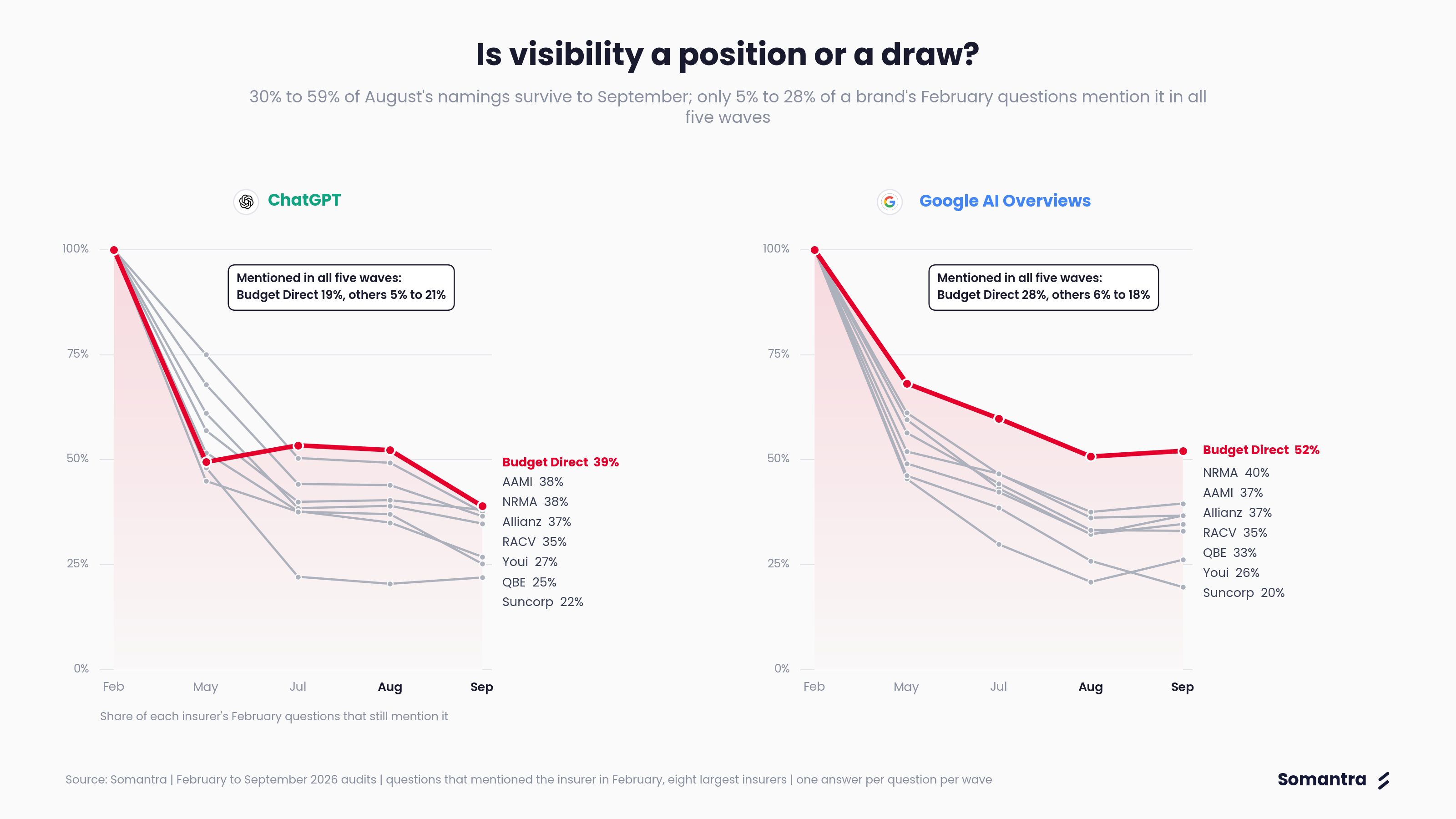
Base: detailed questions present in all five waves; February cohort per brand.
One wave on, a brand keeps between 45 and 75 percent of its February questions. By July the four largest brands hold between 40 and 60 percent, and the curve then flattens. Each brand keeps a core and churns the rest: Budget Direct on Google keeps 28 percent of its February questions through all five waves, Suncorp on ChatGPT 5 percent. Between August and September alone, the eight largest insurers kept between 30 and 59 percent of their mentions, about 50 percent for the largest four (AAMI 52.0 percent, Allianz 49.1, NRMA 48.5, Budget Direct 45.5 on ChatGPT; Budget Direct 58.8 on Google).
With one answer per question per wave, some of this churn is run-to-run variation rather than lasting change, and these figures cannot separate the two. Section 13 measures the variation on the questions the panel asks more than once. On those questions, a brand mentioned in one answer is mentioned again in a repeat answer less often than it is mentioned again a month later. Somantra’s Brand Engagement view asks a related question: where a brand drops out of the journey, stage by stage.
What sits behind this. The core that survives is mostly “best” and “top” questions. On Google they make up 26 percent of the five-wave core and 8 percent of the questions that dropped out. A month later, a brand mentioned on a “best” or “top” question is mentioned again 74 percent of the time on Google, against 45 percent on “how to” questions. ChatGPT shows the same pattern.
16. Who gets mentioned when a publisher is cited?
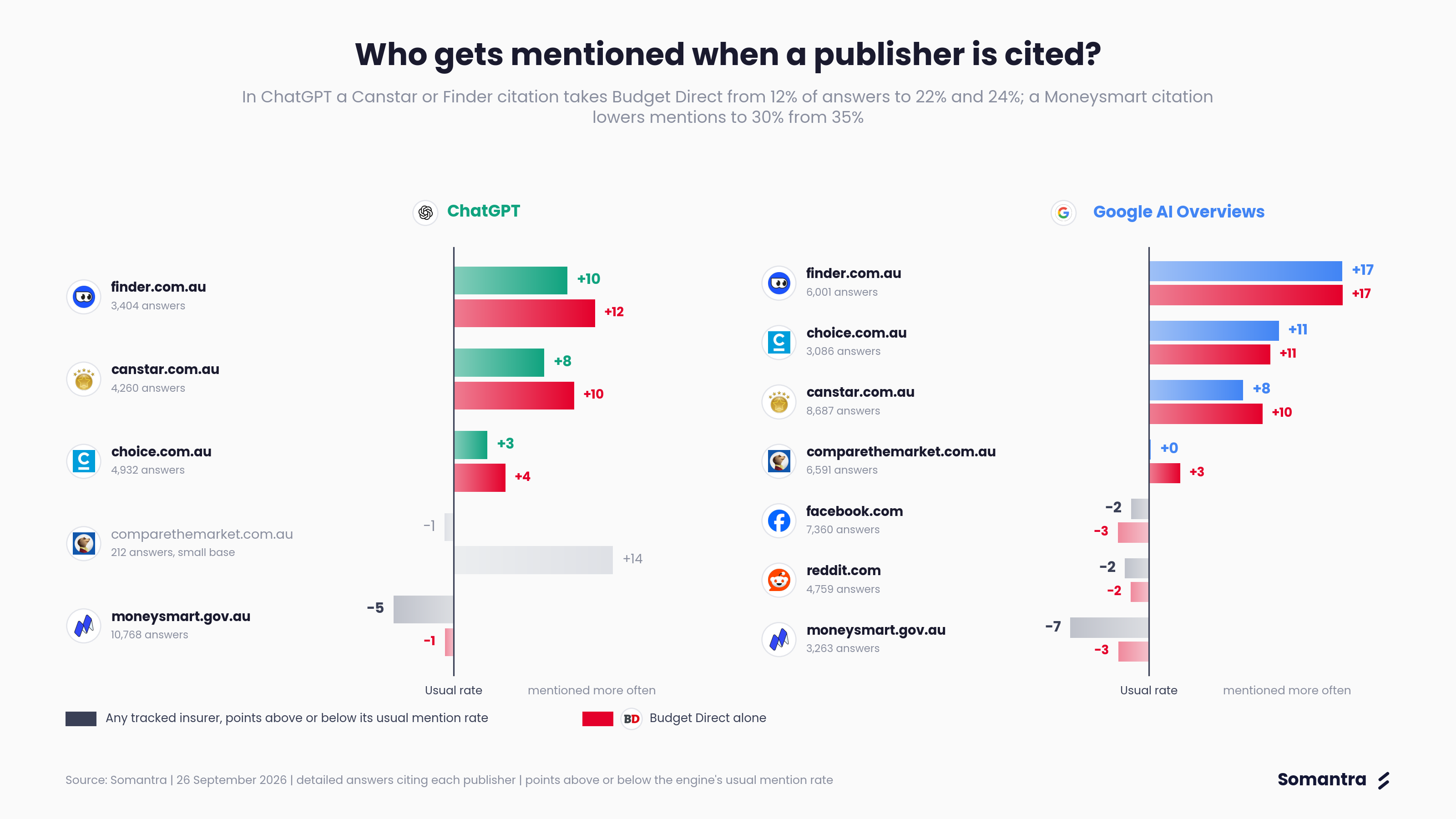
Base: September detailed answers; answers citing each publisher as shown.
When Canstar or Finder is cited, the answer mentions Budget Direct about twice as often as usual, on either engine. It also mentions Youi and QBE more often. Allianz and NRMA get no such lift, and an answer citing Compare the Market mentions NRMA less often. Which insurers sit on each site’s panel has not been confirmed, so that is an observation and not an explanation.
There is an obvious objection. Canstar and Finder may simply be cited on shopping questions, and shopping questions tend to mention insurers whoever is cited. So the comparison was run again inside each insurance category and question type, which compares like with like.
The association survives the check. Between 66 and 83 percent of the Canstar and Finder gap remains once the question is held constant. By brand, Budget Direct’s lift with Canstar goes from 12 points to 8 on ChatGPT and from 13 to 10 on Google. With Finder it goes from 14 to 9 on ChatGPT and from 21 to 14 on Google. Youi and QBE keep 81 to 93 percent of their Canstar and Finder lift on ChatGPT. Across all answers, Allianz and NRMA show no association before or after. Among ChatGPT answers that mention at least one insurer the picture differs: Allianz is mentioned 14.7 points less often when Canstar is cited, and NRMA 11.1 points less often. Answers citing those sites mention more insurers, and Allianz and NRMA take a smaller part of them. The lower rate of NRMA mentions beside Compare the Market also remains: 6 points lower before the check and 8 after on ChatGPT, where only 212 answers cite it, and 5 and 2 on Google.
One result does not survive. A Moneysmart citation looked as if it lowered brand mentions, by 8 points on each engine. Within category and question type the gap is 2 points on ChatGPT and 1 point on Google. That was mostly question mix: Moneysmart is cited on cost and explanation questions, which rarely mention insurers.
These are associations inside the same answer, after allowing for what was asked. They do not show that the citation causes the mention.
What sits behind this. The Canstar link to Budget Direct sits on particular kinds of page, not on the whole site. Budget Direct is mentioned in 51.7 percent of ChatGPT answers citing a Canstar discounts page (611 answers), 50.4 percent of those citing an awards or star-ratings page (532) and 45.0 percent of those citing a “best”, “cheapest” or “compare” page (484), against a base rate of 11.7 percent. On Canstar cost pages it is mentioned 11.6 percent of the time (804 answers). Google shows the same pattern: 57.6 percent on discounts pages (1,263 answers) and 16.6 percent on cost pages (829), against a base rate of 13.9 percent.
It is not Budget Direct’s own site being cited alongside. Leaving out answers that cite budgetdirect.com.au, Budget Direct is mentioned in 16.5 percent of ChatGPT answers citing Canstar and 5.7 percent of those that do not. The pages checked list these insurers by name, and both Canstar and Finder say on the page that they earn referral fees and mark some rows “Promoted”. That check covers 11 pages fetched 11 days after the wave, so it is a small sample.
17. Sources worth a second look
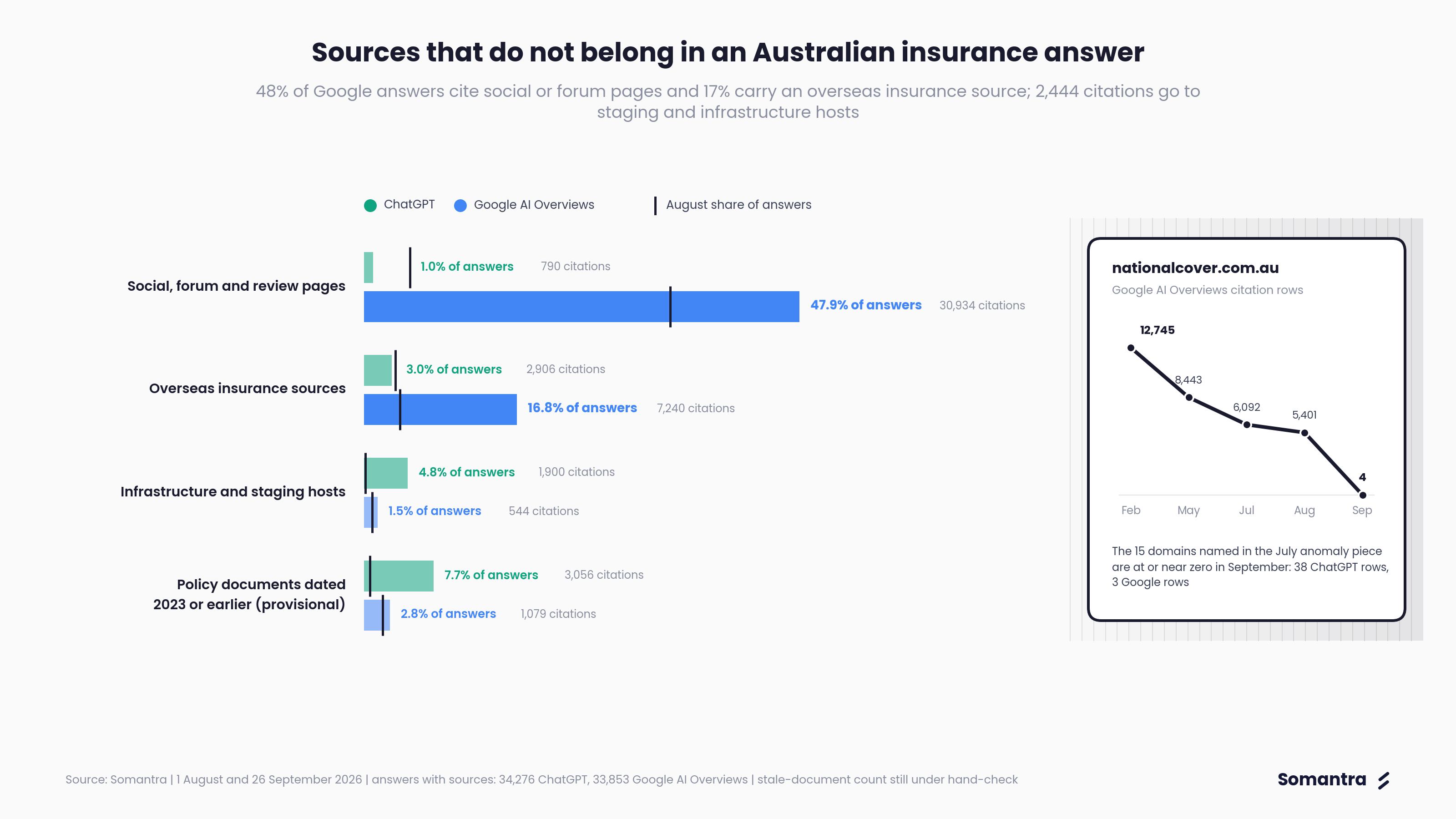
Base: all September citation rows, 156,268 ChatGPT and 263,476 Google; answers, 34,276 and 33,853.
Four kinds of source are worth a second look, each for a different reason. Most of what follows is a warning sign, not a confirmed problem. Overseas insurers and comparison sites usually describe products that cannot be bought here, though an overseas source can be relevant to a travel question. Infrastructure hosts are not an organisation’s main public site. Some are public on purpose; the staging and test hosts among them are the one confirmed problem in this section. A policy document dated 2023 or earlier may have been replaced, or may still be the one in force. Social, forum and review pages are unchecked, which is not the same as wrong.
Overseas sources. 16.8 percent of Google answers carry a source from a US, UK or Indian insurer or comparison site. On motorcycle questions it is 27.3 percent, led by a US motorcycle insurer’s pages. The count includes 690 rows that are Australian editions on an overseas domain, almost all Forbes Advisor Australia. Without them it is 15.0 percent of Google answers and 23.3 percent on motorcycle questions. This is the AI Overview’s choice, not a change in ranking: overseas domains held 1.45 percent of Google’s ordinary results in August and 1.29 percent in September, while answers citing them went from 3.9 percent to 16.8 percent. It goes with questions that mention no place. 21.0 percent of Google answers to questions that do not say Australia carry an overseas source, against 11.2 percent of those that do. ChatGPT went the other way: it dropped US finance media (on detailed questions, WSJ from 848 rows to 9 and Investopedia from 225 to 0) and picked up the US insurance regulators’ body, content.naic.org, at 1,493 rows.
Infrastructure hosts. Most of these rows are quote funnels, CDN, CMS and origin servers, which can be public on purpose. The confirmed problem is the 302 citations to staging, test, development, QA, preview, sandbox and admin environments across 58 hosts. The section before Part B sets them out host by host, with their history since November 2025. The rest of the infrastructure count is mostly a ChatGPT change: 53 citations in August and 1,743 in September, against 322 and 399 on Google. 40 percent of these citations duplicate a page that is also cited on the organisation’s main site; the rest exist only on the infrastructure host. A check of all September URLs found no sign of private or credential-protected content.
Old documents. The count reads the year from the URL or title, so it is provisional until the most-cited documents are checked by hand. An old date does not prove a document is out of force. ChatGPT’s share rose about five times from August, from 0.40 percent of its citation rows to 1.96 percent, as it began citing PDS files directly. It cites more documents, not older ones: documents went from 1.6 percent of its citations to 8.2 percent, and the share of them dated 2023 or earlier held at about a quarter (25.0 and 23.9 percent).
Social pages. These are unchecked, not wrong. 47.9 percent of Google’s answers cite a social, forum or review page: 10,525 Facebook rows, 38 percent of them from groups, 5,559 Reddit threads and 1,928 Quora rows. ChatGPT cites almost none. Facebook rose in Google’s ordinary results as well, by 61 percent (9,363 results to 15,076), while answers citing Facebook rose 143 percent (3,161 to 7,692).
Sections to follow
Brand Consideration by engine. The AI-modelled Brand Consideration labels can be tied to an engine for about 80 percent of rows. On the rows available, ChatGPT’s share of “most likely” framings rose from 7.6 percent in August to 13.6 percent in September while Google’s eased from 16.0 to 14.3 percent, and Budget Direct’s share fell for the fourth wave in a row (30.5, 24.1, 22.7, 19.9 percent). This section, with the visibility-to-framing rank gap and the Intent-to-Conversation shift from August, waits on the platform re-run of the September labels.
First-Seen Audit. The August audit found a brand in view before the scroll in 85.6 percent of Google answers and 34.0 percent of ChatGPT answers on an iPhone 17 render, with ChatGPT’s median first brand at word 186. The September raw answers put that word at 80. The rendered audit will be rerun on the September answers.
Modifier study. The August companion study on modifiers measured how a brand’s description changes when a decision word is added. Section 13 now shows how much the insurers mentioned change when the question is not changed at all; the framing rerun on the September answers will use the same pairs of identical questions as its comparison.
Method and limits
Panel and collection. 32,602 detailed questions, 1,596 intent questions and 81 discovery topics, Australian location, desktop. One answer per question per engine per wave. February answers were exported on 22 February 2026, May on 5 May, July on 12 July, August collected on 1 August, September collected on 26 September.
Brands. 20 tracked insurers in every wave: AAMI, Allianz, APIA, Bingle, Budget Direct, CGU, Coles Insurance, GIO, ING, NRMA, Ozicare, Qantas Insurance, QBE, RAA Insurance, RAC Insurance, RACQ, RACV, Shannons, Suncorp and Youi. September tracking added 29 specialists; they appear in this report only where stated.
Brand counts. Brand mentions are counted from the answer text for the 20 tracked insurers, using whole-word matches. Mention counts include every repetition of a name in an answer; answer counts count each answer once. A brand name that appears only as the label on a source link is not counted as a mention.
Citations. A citation row is a domain or URL attached to an answer. Rows are not a quality score or an endorsement. Source types, page types and next-step instructions are classified by written pattern rules
History. Host comparisons before August use the citation-only history file behind the July citation report (November 2025 to July 2026, 2.44 million citation rows), which records citations by month but not by question. That section therefore counts citation rows and normalises them per 100,000, because ChatGPT’s citation volume differs between waves. The host rule matches naming tokens (uat, staging, stg, sit, test, dev, qa, preview, sandbox, admin and similar) as separate labels in the subdomain; hosts named differently are not caught, so the counts are a floor.
Comparisons. Movement between waves uses questions present in both waves. Observed totals describe one wave. Five-wave measures use questions present in every wave. Category rules are those of the August report.
Variation. With one answer per question per wave, persistence figures include both run-to-run variation and lasting change. Section 13 measures the first on the 750 question strings the panel asks more than once. Its averages are weighted per question string, and its ranges come from resampling question strings.
The model change. The August ChatGPT answers record GPT-5.5; the September answers that record a model say GPT-5.6. The changes in ChatGPT’s behaviour coincide with the change. Which of them it caused is not established here. Only 694 of the 32,599 September ChatGPT answers record a model, where every August answer does, so the two collections differ in at least that respect.
Independence. The data account under which the panel was collected is labelled with an insurer’s name; that label is not a client relationship.
See your own brand on these measures
Every measure in this report, visibility, consideration, citations and next step, can be run on any brand and any question panel. Request a free brand audit to see where your brand stands in Google AI Overviews and ChatGPT, or book a demo of the platform.
Tags:

About the author
Arun Prasad
Founder, Somantra
Arun Prasad is the founder of Somantra, an AI search visibility platform for brands, where he writes about answer engine optimisation (AEO) and AI search. His research analyses how brands surface in AI answers across ChatGPT and Google AI Overviews, including Somantra's studies of the Australian insurance market. He focuses on measuring brand visibility through systematic, large-scale conversational testing rather than one-off screenshots.

About the author
Yajat S
Yajat S is a researcher at Somantra, where he analyses how brands surface in AI search across ChatGPT and Google. He authored Somantra's Australian insurance citation study covering 2.4 million AI search citations, focused on the content formats and URL patterns that get cited by answer engines.