
For CMOs, an interesting pattern is appearing in their reports. Organic traffic is trending down. Rankings look stable. Spend has not changed. Nothing obvious is broken, yet performance feels harder to explain.
The instinctive response is concern. Declining organic traffic has long been treated as a leading indicator of weakening demand or reduced relevance. In an AI-led search environment, that assumption is not true. What looks like loss on a dashboard may actually be a sign that discovery is happening elsewhere.
This is not a story about search dying. It is a story about search shifting to zero-click discovery.
Traffic Decline Does Not Equal Discovery Decline
Customers are still researching products, comparing options, and forming preferences. What has shifted is how much of that activity results in a website visit. AI search engines increasingly resolve questions directly, synthesising information and guiding users forward without requiring them to click through multiple sources.
As a result, discovery is being redistributed rather than reduced. Interactions that once produced sessions, page views, and bounce rates now end inside AI-generated answers. From the customer’s perspective, the need has been met. From the brand’s perspective, the interaction becomes invisible.
This is why traffic decline can coexist with steady or even improving demand. The discovery journey still happens, but it no longer surfaces in traditional analytics.
How AI Search Engines Reshape Discovery – Understanding the Operating Layer of AEO and GEO
In traditional search, brand discovery usually occurs when a user clicks on a brand’s website or gets redirected through review platforms, comparison sites, backlinks, and referring domains. Each step generates traffic and visible signals that marketing teams could observe and optimise.
Across AI search, when a user asks “what is the best credit card for cashback,” the AI search engine frames what “best” means and introduces a limited set of relevant brands. This reflects discovery, where early-stage queries define the category and surface options worth considering. Follow-up questions that compare fees, earn rates, or card features signal intent, as the user narrows their choice and shows purchasing consideration. Later questions about eligibility, caps, exclusions, or usage scenarios move into conversation, where users seek detailed clarity on a specific product or service before deciding.
In AI search environments, user behaviour can now be observed as three distinct stages: discovery, intent, and conversation. These stages now unfold inside AI-generated answers, with much of the decision-making occurring before a website is ever visited. Together, these stages form the practical operating layer of AEO and GEO inside AI search environments.
As a result, the search journey no longer reveals itself through pages, sessions, and incremental clicks. Much of the evaluation happens inside the reasoning layer of AI search, leaving fewer visible signals for traditional analytics to capture, even as customers continue to move toward a decision.
This is why organic traffic can decline even when brand relevance remains strong. The journey has not disappeared. It has shifted upstream, into AI-mediated interpretation, where traditional metrics struggle to reflect how decisions are actually being shaped.
For marketing teams, the challenge is not declining influence. It is reduced visibility into where and how that influence is exercised.
Why SEO Metrics Are No Longer Enough
SEO metrics were designed to measure exposure in a link-based environment. They assume that visibility produces clicks and that clicks produce insight. In AI search, visibility often produces understanding instead. This is the core measurement challenge of AEO and GEO.
A brand can be consistently mentioned, explained, and recommended inside AI-generated answers while seeing declining organic traffic. Conversely, a brand can maintain traffic while being absent from critical AI-mediated discovery moments.
This mismatch creates a strategic risk. When marketing teams optimize for traffic alone, they may overcorrect in response to declines that are not harmful, while missing gaps that genuinely matter.
Leverage Somantra to See What Traffic No Longer Shows
As discovery moves inside AI search engines, traditional analytics lose sight of the questions shaping customer decisions. When AI assistants absorb large parts of the journey, marketing teams can no longer see how awareness forms, how options are narrowed, or where confidence is gained or lost.
This is where structuring prompts by stage becomes useful.
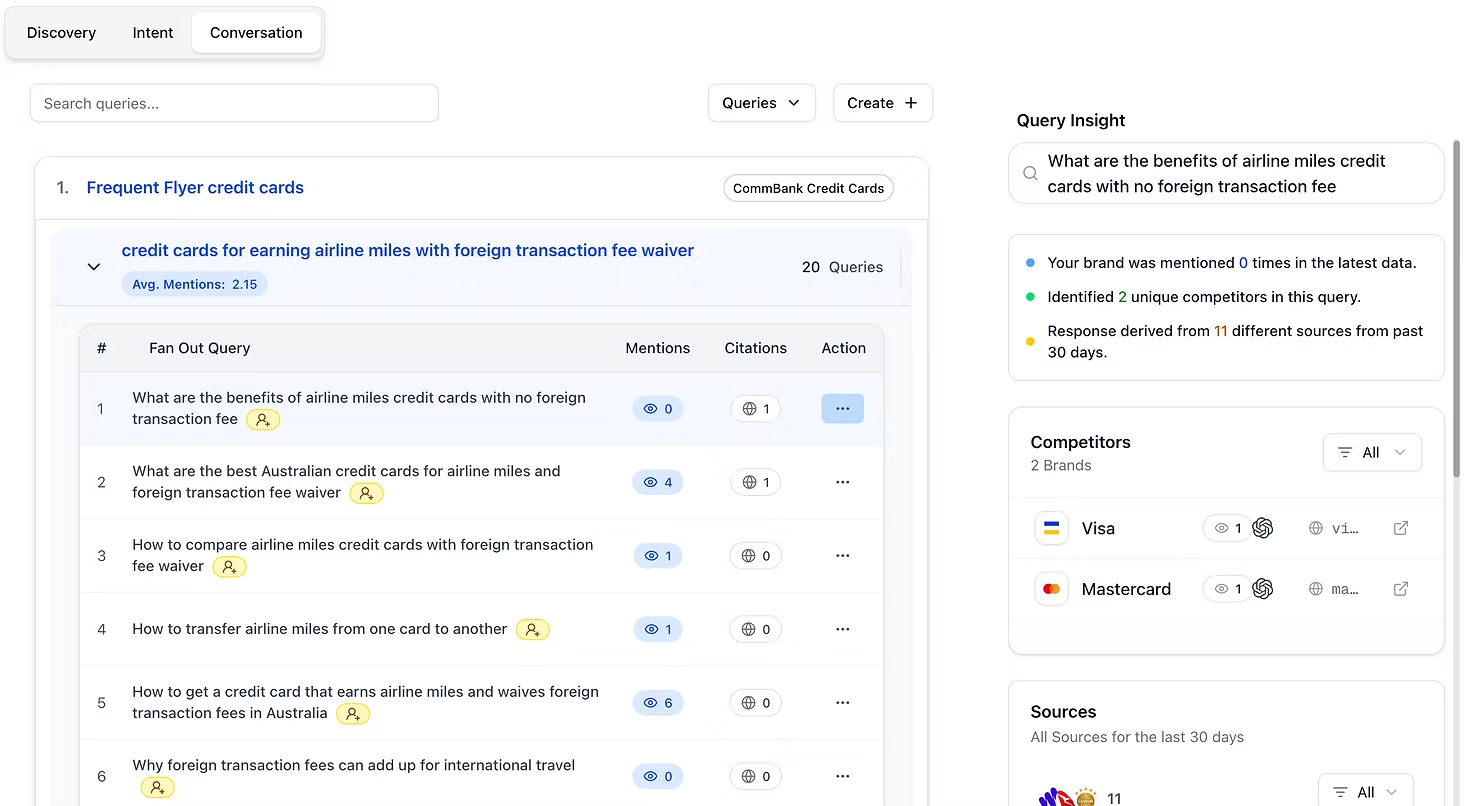
Somantra AI maps AI search behaviour across three connected prompt layers:
- Discovery prompts capture early, exploratory questions where users first articulate a need and brands may enter the conversation.
- Intent prompts reflect the comparison phase, when users narrow choices and signal readiness to act.
- Conversation prompts surface later-stage, detailed questions where users validate specifics before deciding.
For each prompt, brands can see how often they are mentioned and how often they are cited as a source. Mentions influence recall and consideration. Citations signal trust and authority inside AI-generated answers.
Together, these layers reveal what traffic cannot: where a brand is introduced, where it stays under consideration, and where it earns credibility at the moment decisions are finalised. They also expose where journeys break down, such as appearing during discovery but disappearing at intent, or being discussed without ever being cited.
This perspective does not replace SEO metrics. It completes them. As AI search engines take on more of the discovery journey, the brands that understand how they appear across discovery, intent, and conversation prompts will be better positioned to interpret falling traffic for what it often is: redistribution, not decline.
The KPIs Marketing Teams Need to Rethink
As brand discovery is shifting, CMOs need new indicators that reflect how brands perform inside AI search engines. This includes understanding whether the brand is mentioned when categories are explained, whether it is cited as a trusted source, and how often it appears across high-intent conversational prompts.
These signals do not replace traditional metrics, but they contextualise them. They help leaders distinguish between real demand erosion and structural changes in how discovery is delivered.
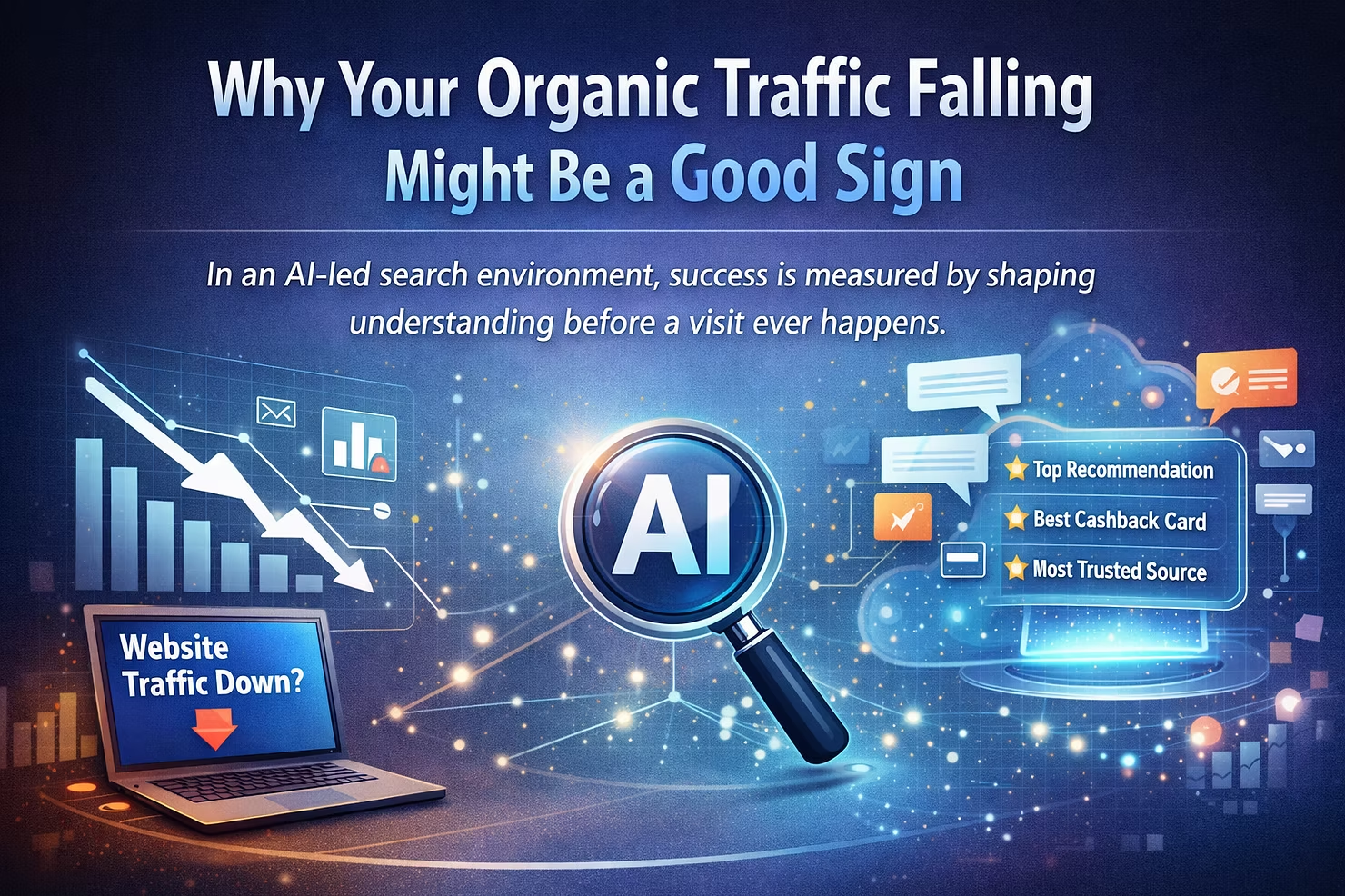
Organic traffic falling is not automatically a warning sign. In many cases, it is evidence that AI search engines are absorbing more of the discovery journey. The real question is not how much traffic you are losing, but whether your brand remains present and influential where those discovery journeys now occur.
In an AI-led search environment, success is no longer measured solely by who visits your site. It is measured by whether your brand shapes understanding before a visit ever happens.
Somantra AI helps brands measure their mindshare across AI search engines and identifies statistically significant prompts for your brand by analyzing millions of search queries across AI search engines. Receive a 14-day complimentary trial with detailed insights into your brand’s AI visibility by clicking here today.
Author: Meher Gulpavan
Tags: