
AI Search Engines are rapidly shaping how brands are discovered online. This shift is driving the rise of Answer Engine Optimisation (AEO) and Generative Engine Optimisation (GEO), where visibility depends on how effectively brands are interpreted and reused inside AI-generated answers to assist and advise.
Customers no longer scan multiple pages of traditional search results to read and process information in order to choose brands. Instead, they ask AI Search Engines a question to receive advice on brands aligned with their intent. This shift to “zero click” carries significant implications for brands and their mindshare.
At the core of every AI Search Engine response is an underlying decision structure that drives how the answer is framed—defined by the prompt pathway.
Understanding how this pathway moves from broad discovery prompts to detailed conversation prompts, and ultimately to a final recommendation, is becoming critical for effective AEO and GEO in an AI-first environment. It defines how AI Search interprets customer intent, prioritises topic authorities, and drives brand visibility at each stage.
The Three Types of Prompts That Determine Brand Visibility on AI Search
“AI systems prioritise brands that demonstrate clear expertise through expert authorship, original data, and transparent methodology.”
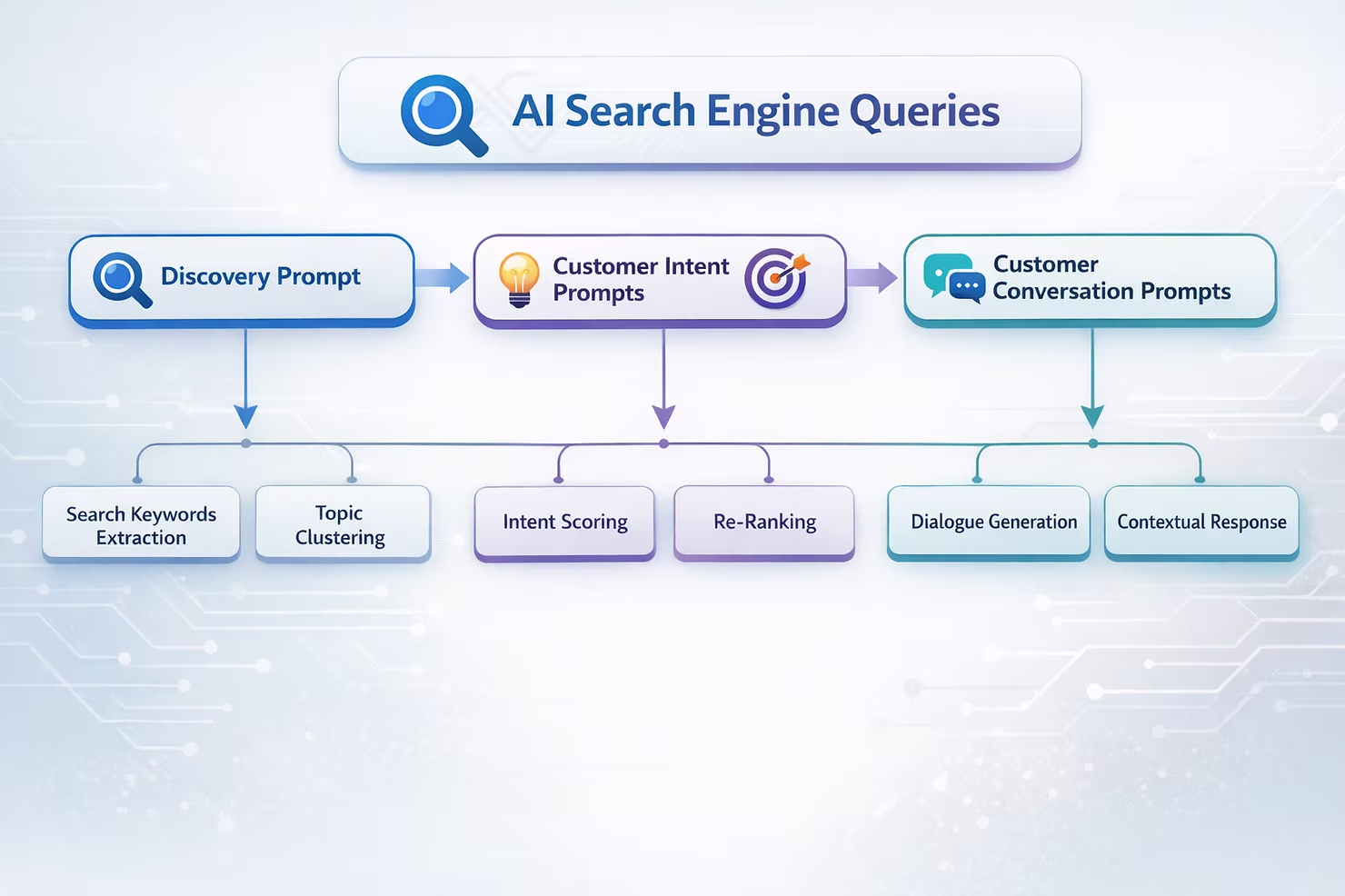
AI Search Engines interpret every question through three prompt types: Discovery, Intent, and Conversation. Together, these prompts determine how a brand is introduced, evaluated, and positioned in customer-facing answers.
To illustrate how this pathway works, consider an example:
A user begins a health journey and asks an AI search engine:
“What are the best supplements for improving energy levels?“
1. Discovery Prompt: Establishing the Landscape
A Discovery Prompt signals early exploration. The user is curious but not yet committed to any product category or brand. The AI expands the query, examining related searches, expert reviews, authoritative articles, and scientific summaries to map the broader topic of energy-boosting supplements. A typical early exploration query might look like: “Supplements to boost energy”
Brands that consistently appear in trusted citations and expert sources earn early visibility. Those that lack topic authority at this stage rarely show up later in the journey. This is where brand mindshare begins to take shape, because the brands surfaced here set the boundaries of what the AI considers credible.
2. Intent Prompt: Refining the Decision Criteria
As the user develops clarity, they shift to an Intent Prompt. A typical follow-up might be:
“Which supplement is safest and most effective for improving energy without caffeine?”
Here, the AI narrows the field based on explicit customer intent. It evaluates safety data, ingredient profiles, clinical evidence, sentiment signals, and the reliability of third-party validations. Brands that cannot demonstrate consistency between claims and external verification lose visibility quickly. Brands that provide clear, evidence-backed information rise to the top, because they align with the user’s expressed needs around safety and non-stimulant energy support.
3. Conversation Prompt: Comparing and Deciding
Once the user has a short list, they often progress to a Conversation Prompt. A natural next question might be:
“How does Brand A’s minerals-based blend compare to Brand B’s vitamin complex for long-term energy?”
At this stage, the AI synthesises structured content, expert comparisons, and product use cases. Brands that articulate their positioning with clarity and depth make it easier for the AI to generate an accurate evaluation. This directly influences brand affinity, because the comparison forms the narrative the customer will rely on when making a final choice.
How the Three Prompts Work Together
- Discovery introduces the category and determines which brands are even considered.
- Intent validates which of those brands align with the customer’s specific needs.
- Conversation provides the detailed comparison that guides the final recommendation.
Each prompt strengthens or weakens brand visibility at the next stage. Brands with deep topic authority benefit in Discovery; those with credible product data excel in Intent; and those with consistent structured content succeed in Conversation. When all three signals align, the brand secures stronger mindshare, earns trust earlier, and remains present throughout the AI-driven decision path.
How Fan Out Reveals Your Brand’s Reach on AI Search
Fan Out is the process by which AI expands each user prompt to understand a brand’s presence more completely.
A single Discovery Prompt branches out to reveal associated Intent Prompts, and each Intent Prompt further unfolds into Conversation Prompts. This cascading approach allows the AI to see where a brand is consistently mentioned, where it is validated by citations or topic authorities, and where opportunities exist for growth.
By visualising this network of prompts, marketers can appreciate how a brand is perceived across the broader AI-driven ecosystem. Strong signals across related prompts help the AI understand a brand more confidently, influencing whether it surfaces during discovery, gains trust during intent, and is described accurately in conversation. In this way, Fan Out highlights both a brand’s current visibility and the areas where additional clarity or coverage could strengthen brand mindshare.
Conclusion
In this AI-led environment, AEO and GEO are no longer optional tactics. They define how brand knowledge is constructed inside AI search engines.
As AI becomes the primary gateway for brand discovery, companies must ensure their presence is interpretable not only by human audiences but also by the AI systems shaping customer decisions. Establishing clear category alignment is the first step, allowing the brand to be positioned accurately for users navigating AI search engines. Success then depends on consistent, structured content that enables the AI to communicate the brand’s strengths with confidence. Strong external validation from topic authorities further reinforces credibility, as AI models prioritise brands recognised across trusted third-party sources.
Equally important is understanding how AI currently perceives the brand. Identifying gaps, outdated information, or inconsistencies allows teams to correct the narrative before it becomes embedded in AI-driven answers. Brands that actively strengthen their information ecosystem—across owned content, trusted mentions, expert voices, and customer feedback—position themselves to appear reliably throughout the full prompt pathway.
The rise of AI-mediated discovery marks a fundamental shift where visibility is no longer determined by how a website ranks, but by how clearly and confidently an AI system can understand and explain a brand.
The prompt pathway and the Fan Out process together form the new architecture of brand visibility.
Start your complimentary trial at somantra.ai to understand how AI currently perceives your brand across Discovery, Intent & Conversation Prompts.
Author: Arun Prasad

About the author
Arun Prasad
Founder, Somantra
Arun Prasad is the founder of Somantra, an AI search visibility platform for brands, where he writes about answer engine optimisation (AEO) and AI search. His research analyses how brands surface in AI answers across ChatGPT and Google AI Overviews, including Somantra's studies of the Australian insurance market. He focuses on measuring brand visibility through systematic, large-scale conversational testing rather than one-off screenshots.