
Customers are forming opinions about brands without ever encountering the brand itself. They are not reading landing pages, scanning product descriptions, or navigating comparison tables.
They are receiving explanations.
AI search engines now act as interpreters between brands and buyers. When a customer asks a question, AI search engines decide which brands are mentioned, what information is relevant, and how those brands should be described. By the time a customer reaches a brand’s website, brand perception and core understanding of the product has already been shaped.
This changes the role of digital visibility in a fundamental way. Visibility is no longer about attracting attention; it is about influencing interpretation. A brand does not compete to be clicked—it competes to be included in the explanation that defines the category, the problem, or the solution in the customer’s mind.
For senior leaders, this introduces a new form of exposure. Brands can be excluded, simplified, or inaccurately framed inside AI search engines without any direct interaction taking place. There is no bounce rate to analyse and no funnel to diagnose—the decision simply never advances because the brand never entered the conversation in the first place.
Why Traditional SEO Audits No Longer Capture the Real Risk
For years, SEO audits have been the standard mechanism for evaluating digital visibility. They assess content quality, crawlability, and rankings. These audits remain valuable, but they were designed for a search model that prioritised retrieval over interpretation.
AI search engines operate differently. They do not reward pages for ranking well; they ingest content from across the web and generate answers that reflect what they interpret as authoritative and current. In this environment, a technically sound website does not guarantee accurate representation.
This introduces a critical blind spot for leadership teams. A brand can pass every conventional SEO checklist and still lose visibility at the moment brand discovery occurs. Outdated documentation, or inconsistencies between product, marketing, and support materials, can surface in AI-generated answers long after they have disappeared from a brand’s website.
The risk here is not reduced traffic—it is distorted understanding. Customers tend to trust AI search engines to be accurate. When those answers have incomplete information, purchasing intent erodes quietly. Nothing breaks. No alert is triggered. The brand simply fails to progress from discovery to consideration.
Prompt Landscape Monitoring Through an AEO and GEO Lens
Prompt Landscape Monitoring addresses this gap by shifting the unit of analysis from pages and keywords to prompts and answers. Instead of auditing how a website performs, it evaluates how a brand appears across the landscape of real user prompts that AI search engines respond to every day.
Customers do not interact with AI search engines through isolated keywords. They ask questions, seek explanations, and explore options through natural language prompts. While individual phrasings vary, these interactions cluster around common discovery, intent, and conversation patterns. What matters is understanding how a brand surfaces across these prompt landscapes.
From an AEO and GEO perspective, this shift is decisive. The objective is no longer to drive a click, but to ensure that a brand is mentioned, accurately described, and supported by credible citations when AI search engines generate answers. Prompts replace rankings as the primary competitive surface.
Prompt Landscape Monitoring reveals whether a brand is mentioned in AI-generated explanations, how it is positioned relative to competitors, and whether third-party or outdated sources are shaping the narrative. It exposes visibility gaps that traditional SEO tools cannot detect, including situations where legacy content or external topic authorities exert more influence than a brand’s current materials.
Most importantly, it reframes visibility as a governance issue rather than a tactical optimisation exercise. AI search engines reflect the structure, consistency, and freshness of the content they can access. By monitoring prompt landscapes, brands gain a clear view of how they are being interpreted at scale, before customers internalise those interpretations and act on them.
How Somantra AI Helps Brands Monitor Prompt Landscapes in Practice
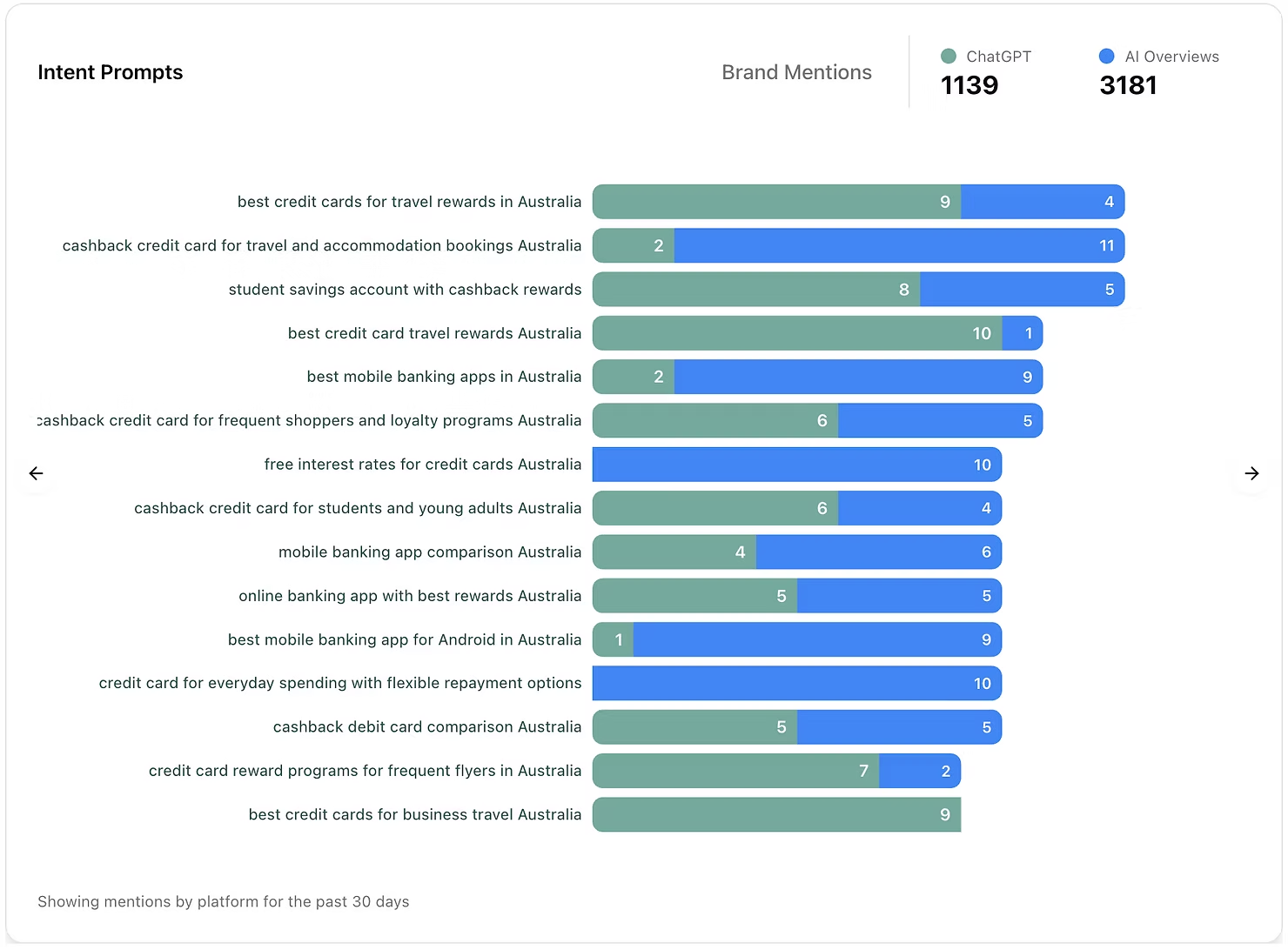
(Top 15 Intent prompts for Commonwealth Bank across ChatGPT & AI Overviews)
Understanding prompt landscapes conceptually is one thing. Operationalising them at scale is another. The challenge most leadership teams face is not recognising that AI search engines influence perception, but developing a structured way to observe and manage that influence across thousands of real user interactions.
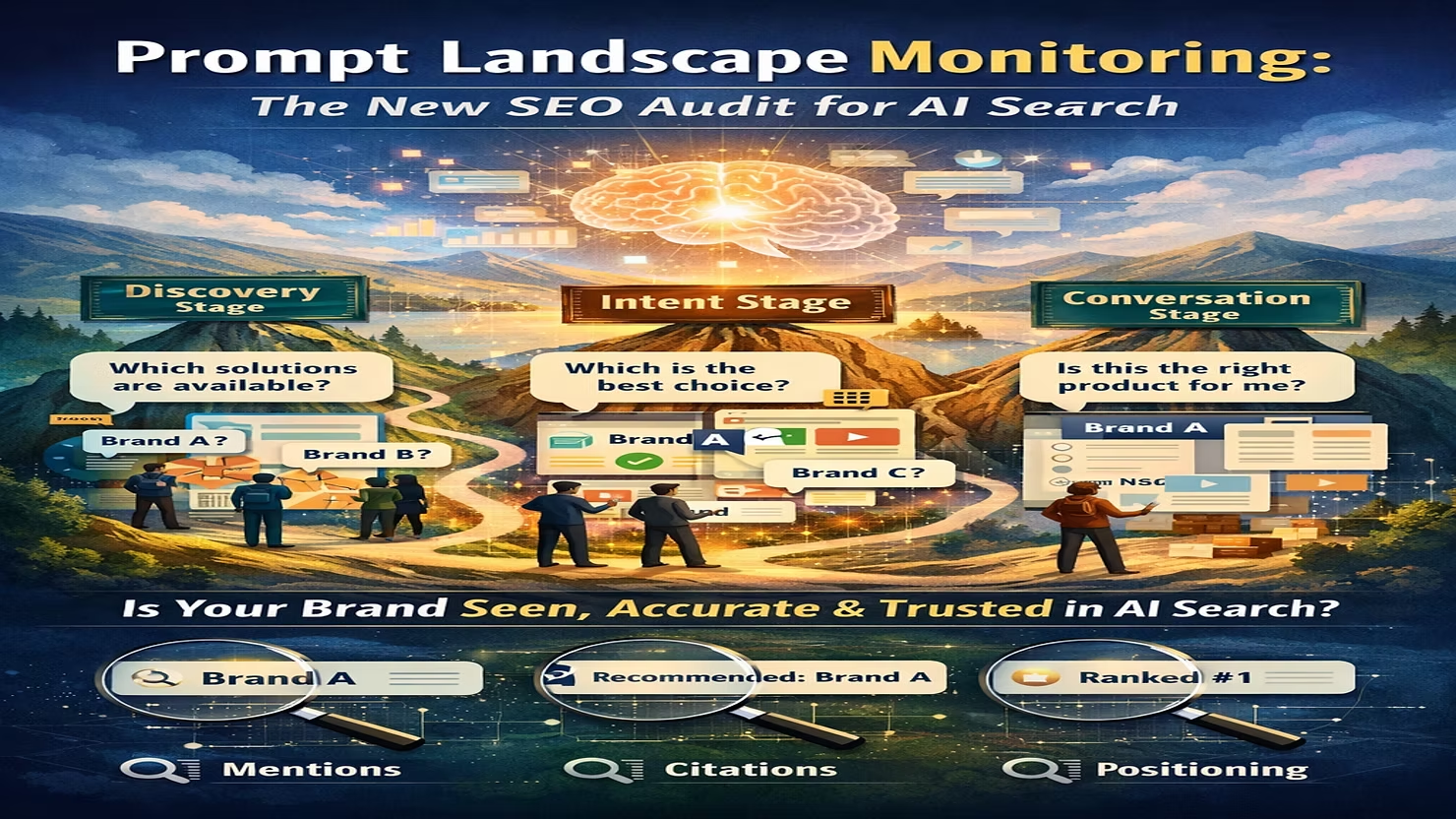
Somantra AI approaches this by mapping how customers actually move through AI search engines, rather than treating prompts as isolated events. Prompts are classified into three distinct but connected stages that reflect how understanding and intent form over time.
-
Discovery prompts represent the earliest stage of an AI search journey. These are broad, exploratory questions where customers begin articulating a need and where brands may first enter the conversation. Visibility at this stage determines whether a brand is introduced at all when AI search engines frame a category or problem.
-
Intent prompts signal a shift from exploration to evaluation. Here, users are narrowing options, comparing providers, and expressing clearer purchasing intent. Brand presence at this level influences whether a brand remains under consideration as choices are refined.
-
Conversation prompts reflect deeper, context-rich interactions. These occur when users ask detailed questions about a specific product or service, often validating decisions before acting. Visibility here affects confidence and final selection.
For each prompt at every stage, Somantra AI tracks how often a brand is mentioned and how often it is cited as a source. This distinction matters: mentions influence recall and association, while citations indicate trust and authority within AI-generated answers. Together, they provide a clear view of how AI search engines interpret, prioritise, and justify a brand’s relevance.
By structuring prompt landscapes this way, brands gain visibility into where they are introduced, where they are evaluated, and where they are relied upon. More importantly, they can see where those transitions break down. A brand may appear frequently in discovery prompts yet disappear at intent, or be discussed without ever being cited as a trusted source. These are not SEO issues; they are AI search visibility gaps that directly affect demand formation.
What Leaders Should Take Away
AI search engines are no longer passive intermediaries. They actively shape how brands are understood before customers engage directly. In this environment, visibility is not defined by rankings or traffic, but by inclusion, accuracy, and authority within AI-generated explanations.
Prompt Landscape Monitoring offers a new audit layer for this reality. It allows brands to move beyond assumptions and see, with precision, how they are surfaced across the full spectrum of customer prompts that influence awareness, consideration, and decision-making.
For CMOs and founders, the implication is clear: if brand perception is being formed inside AI search engines, then it must be measured and managed there. The organisations that do this well will identify gaps early, correct misrepresentation before it compounds, and guide AI-driven discovery deliberately rather than reactively.
As AI search continues to mediate more customer interactions, the question is no longer whether your brand is visible online. It is whether your brand is present, accurate, and trusted at the moment understanding is formed.
Get a complimentary trial with Somantra AI to get your brand visibility insights across AI search engines.
Author: Meher Gulpavan