
Many websites that perform well for users are effectively opaque to AI Search engines. Not because they are poorly built, but because they are built for interaction rather than interpretation.
From a human perspective, the site loads, content appears, and meaning is obvious. From an AI perspective, large parts of that meaning may never materialise. Product definitions, brand context, and key explanations often depend on execution paths that AI agents do not reliably follow.
This is where AI visibility quietly breaks.
It is also where Answer Engine Optimization (AEO) begins. AEO is the practice of making a brand legible and recommendable to AI search engines, and it cannot succeed if the underlying pages are unreadable to those engines in the first place.
Why Website Owners Can’t Ignore AEO
For years, being invisible to a search engine meant slipping to page two. Being invisible to an AI search engine is different, because there is no page two. The model returns a single synthesised answer, and if your brand is not in it, you are absent from the customer’s decision entirely.
Three shifts make this urgent for website owners:
- Customers act on the answer, not the links. As AI search compresses research into one response, more journeys end without a click to your site. If the answer does not mention or recommend you, you never enter the consideration set. That is the brand consideration AEO is designed to protect.
- The cost compounds the longer it is ignored. When AI cannot read your pages, it fills the gap with third-party sources. That framing then gets re-cited and reinforced across models until it hardens into what the AI treats as true about your brand. Correcting an established narrative is far more expensive than shaping it early.
- Whitespace is being claimed now. Competitors who make their content legible to AI are locking in mindshare while the field is still open. Every month that passes, more of the long-tail queries in your category get answered with someone else’s brand.
The commercial impact is direct. Stronger AEO visibility means more branded mentions in AI answers, which lowers acquisition cost over time by putting your brand in front of buyers before they ever reach a comparison site. We cover that link in detail in why increasing brand mentions on AI search reduces CAC.
AEO is not a niche technical exercise. It is the difference between being part of the AI’s recommendation and being replaced by whoever is easier for it to read.
AI Does Not Interpret Websites the Way People Do
A human understands a website as a sequence of experiences. Content reveals itself progressively. Visual hierarchy signals importance. Interaction fills in gaps. Meaning accumulates.
AI search engines do not operate this way. They evaluate what is present, accessible, and structurally explicit at the point of extraction. They do not wait for deferred elements, infer intent from layout, or reconstruct meaning from interaction flows.
If a page’s core context is assembled through scripts, hydration, or conditional rendering, that context is fragile. Sometimes it is captured partially. Often it is missed entirely.
Why Modern Front-End Architectures Create Blind Spots
Modern web architectures optimise for speed, flexibility, and design systems. In doing so, they frequently decouple structure from content.
JavaScript-driven rendering delays the availability of meaningful text. Lazy loading prioritises what is visible to users, not what is needed for comprehension. Deferred components fragment context across execution phases.
For AI agents operating within limited extraction windows, this breaks continuity. The system encounters a skeleton without substance or substance without hierarchy.
When that happens, AI does not fail gracefully. It substitutes.
What AI Systems Actually Use to Form Understanding
AI search engines value information that is stable, immediately accessible, and semantically clear. They extract what is present without reliance on execution, interaction, or visual interpretation.
Text that is available at load time carries disproportionate weight. Clear relationships between elements matter more than presentation. Explicit definitions outperform implied meaning.
Anything that requires reconstruction is risky. Anything that depends on timing is uncertain. Anything that assumes a human-like reading path is unreliable.
This is why two versions of the same page can exist simultaneously: one that communicates effectively to users, and another that communicates very little to AI.
What to Fix First for AI Search Visibility
The first priority is not visual refinement or performance optimisation. It is ensuring that the site communicates meaning without dependency.
Core product and brand information must be present in an immediately interpretable form. Context that explains what the product is, who it is for, and how it should be understood cannot be deferred, hidden behind interaction, or distributed across execution layers.
Structure should make meaning explicit. Hierarchy should be machine-legible, not just visually intuitive. Delayed loading should never apply to information that defines the brand or the offering.
These are not incremental improvements. They determine whether AI search engines can form a coherent understanding at all.
Why This Is No Longer Just a Technical Concern
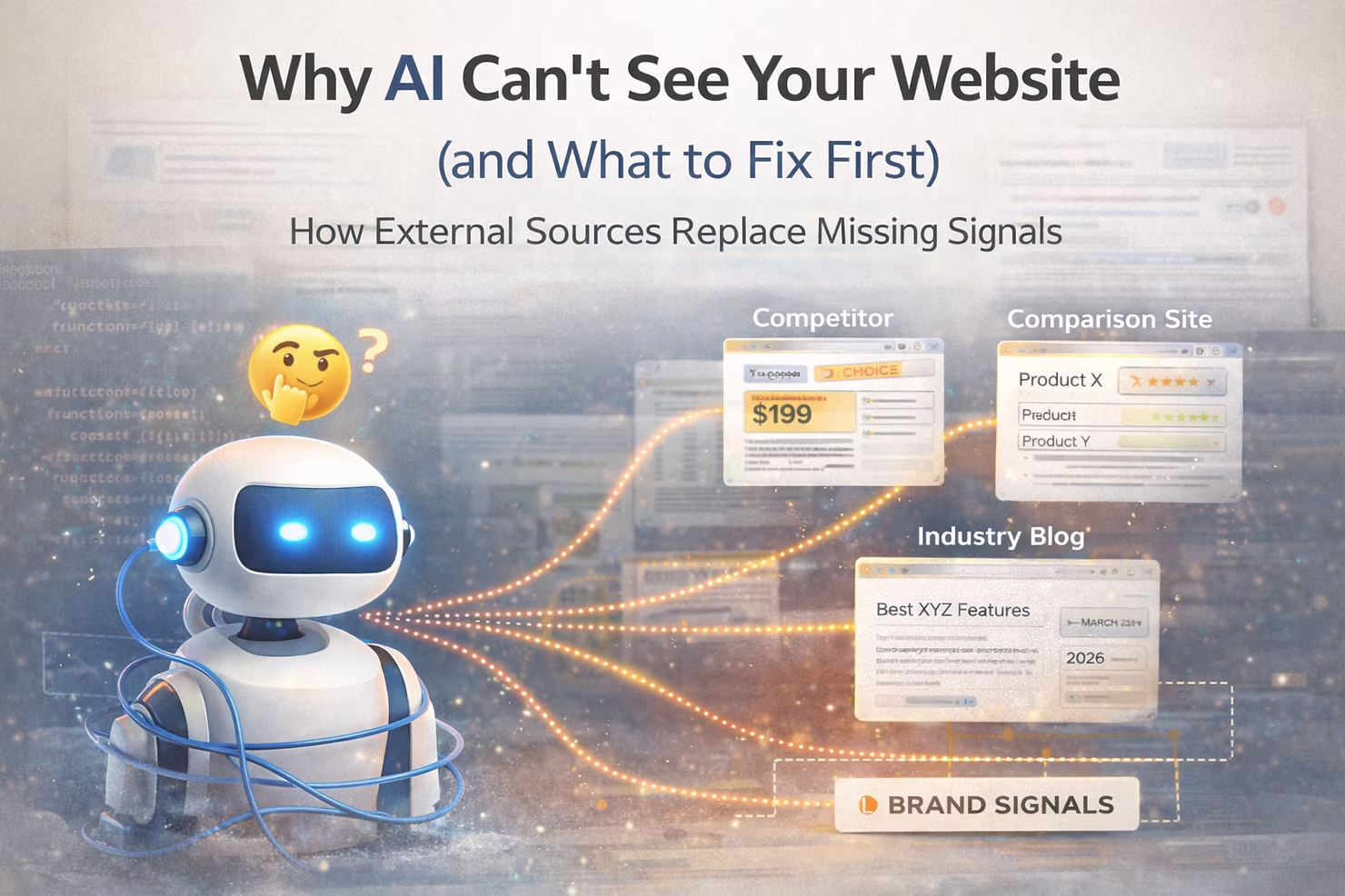
When AI search engines cannot reliably interpret a website, they rely on external signals to complete the picture. Third-party descriptions, historical references, and secondary sources begin to shape how the brand is represented in AI-generated answers.
At that point, brand understanding is no longer anchored in owned material. It is inferred.
This is the practical Answer Engine Optimization (AEO) and Generative Engine Optimization (GEO) challenge. Before brands can govern how they appear in AI answers through AEO, they must ensure AI search engines can clearly read and interpret their primary source of truth.
If that foundation is weak, everything built on top of it is unstable.
What AI Can’t Read, It Replaces
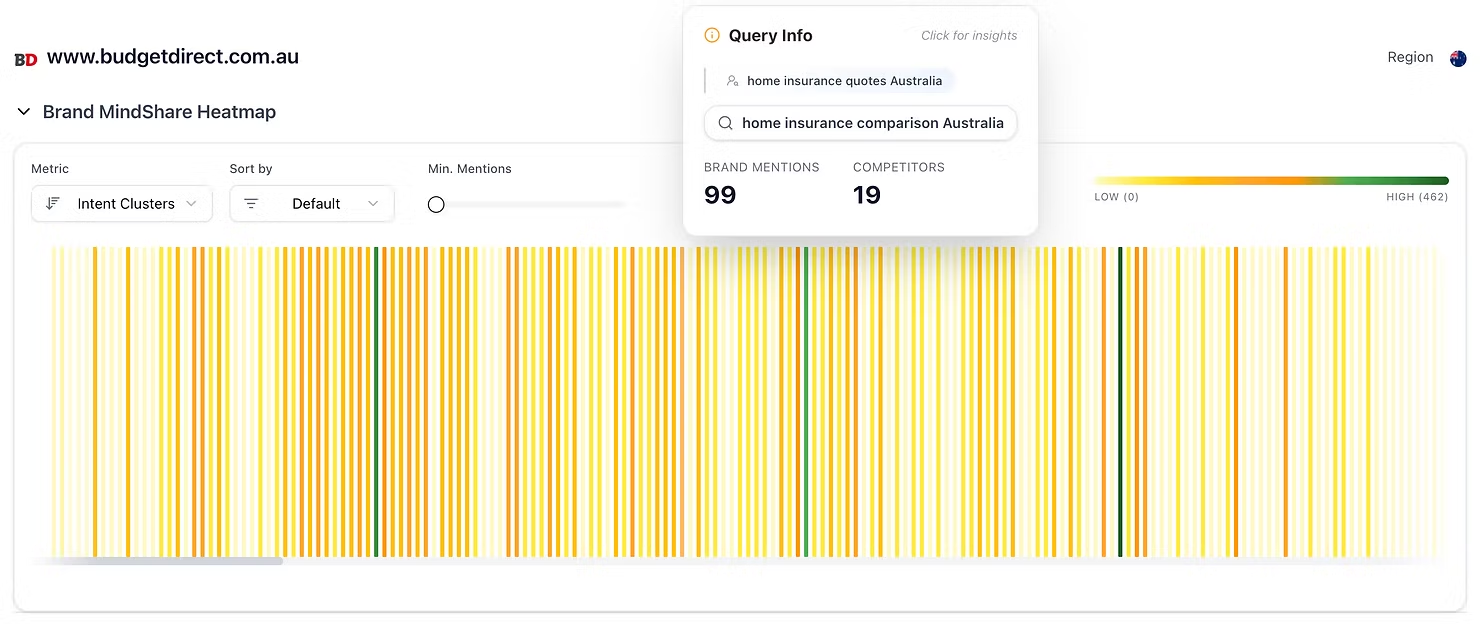
(Showing Mindshare Heatmap for mortgagechoice.com.au)
When AI search engines cannot extract clear meaning from a website, they still produce answers. They do so by relying more heavily on topic authorities that are easier to interpret.
The practical outcome is measurable. Brand visibility in AI search becomes uneven. Some queries consistently include the brand. Others do not.
Somantra AI highlights this through its Brand MindShare Heatmap. The heatmap shows how often a brand appears across AI search prompts, alongside the number of competitors present in each cluster.
The value of the Heatmap is immense as now teams can see where their brand is consistently being mentioned, where it is marginal, and where it is absent across AI search engines. This also helps identify whitespace where a brand can improve its visibility to increase their chances of being mentioned in AI search answers.
If AI search engines are now shaping customer understanding at scale, then knowing where your brand holds mindshare and where it does not is a prerequisite for fixing the problem.
Get your complimentary trial with Somantra AI to see how your brand is represented across AI search prompts and where competitors are gaining ground.
Author: Meher Gulpavan
Tags: