Outdated product content costs AEO GEO optimisation
- Meher Gulpavan

- Jan 20
- 4 min read
Updated: Mar 1
For a growing number of customers, the first exposure to a product is not a website. It is an AI-generated answer that summarises what the product is, how it works, and whether it is worth considering.
AI search engines now explain products to customers before brands are able to do so in their website.
That explanation happens quickly and for most users, it becomes the reference point against which their perception and buying intent is formed.
When those explanations are wrong, the issue is not visibility. It is misrepresentation at the moment understanding is formed.
How Incorrect AI Search Answers Quietly Kill Purchasing Intent
The most expensive failures in product discovery leave no trace. Nothing breaks, and no clear signal appears.
This is exactly how incorrect AI answers affect purchasing intent. Customers rely on AI to resolve uncertainty. When those answers include incorrect pricing, outdated availability, or inaccurate product details, confidence never fully settles and the customer consciously rejects the brand.
From the brand’s perspective, this loss is difficult to detect. Nothing breaks. No clear signal appears. The customer simply never progresses from discovery to intent.
This is what makes incorrect AI answers expensive. They do not block demand. They prevent it from forming.

Why AI Search Might Get Your Product Details Wrong
AI search engines do not gather data from a single, current source. They create an answer by reconciling signals across the web and trusted topic authorities, weighting what appears consistent.
This creates a structural vulnerability for brands. Outdated landing pages, old FAQs, and historical product references often remain accessible long after they are operationally irrelevant. To AI search engines, these signals are not obsolete. They are corroborated.
When the same outdated detail appears in multiple places, it gains authority through repetition. Newer information, even when accurate, can be outweighed simply because it exists in fewer locations.
This is why incorrect answers persist. The Ai search engines are not failing to understand the brand’s intent. It is responding logically to the information footprint it can observe.
Correcting a single page does little when the broader footprint remains fragmented.
The Blind Spot in Every SEO Dashboard
Most organisations have no clear view of how their products are being described inside AI-generated answers.
Internal reporting is still oriented around owned surfaces and known touchpoints. It reflects what the brand publishes, not how that information is interpreted, synthesised, and presented elsewhere.
As a result, brands often assume their product information is accurate because it is accurate on their site. Meanwhile, AI answers continue to surface outdated or inconsistent details that shape customer perception outside that environment.
This is the blind spot. Brand representation is changing in a space that most teams do not actively observe.
AEO / GEO requires a shift from managing pages to shaping answers
The practical implication is not that content management has failed. It is that it is no longer sufficient.
In AI search, accuracy emerges from consistency across the entire information footprint that feeds answer generation. Governing this requires understanding how products are described across answers, which topic authorities reinforce those descriptions, and where outdated signals continue to influence interpretation.
This is the shift AEO and GEO introduce in concrete terms. The unit of concern is no longer the page. It is the answer.
For brands, this means treating answer-level representation as something that must be monitored, analysed, and corrected deliberately. Not as a by-product of publishing, but as a discipline in its own right.
Teams that recognise this early gain clarity into how their products are actually understood. Teams that do not are left guessing why intent softens without explanation.
Governing Answers Starts With Knowing What Shapes Them
Governing AI answers only works if brands can see how those answers are being constructed in practice and this is where most brands get stuck. They know an explanation is incorrect, but they have no visibility into which pages, topic authorities, or references are shaping it. As a result, corrections become speculative. Pages are updated, content is refreshed, and messaging is adjusted without knowing whether any of those changes affect the answer at all.
Somantra AI removes that guesswork. For any individual AI search prompt, the platform shows the sources AI search engines relied on to generate the response, alongside the brands and competitors that were surfaced. This makes it immediately clear whether an answer is being driven by current brand content, legacy pages, or topic authorities that the brand does not control.
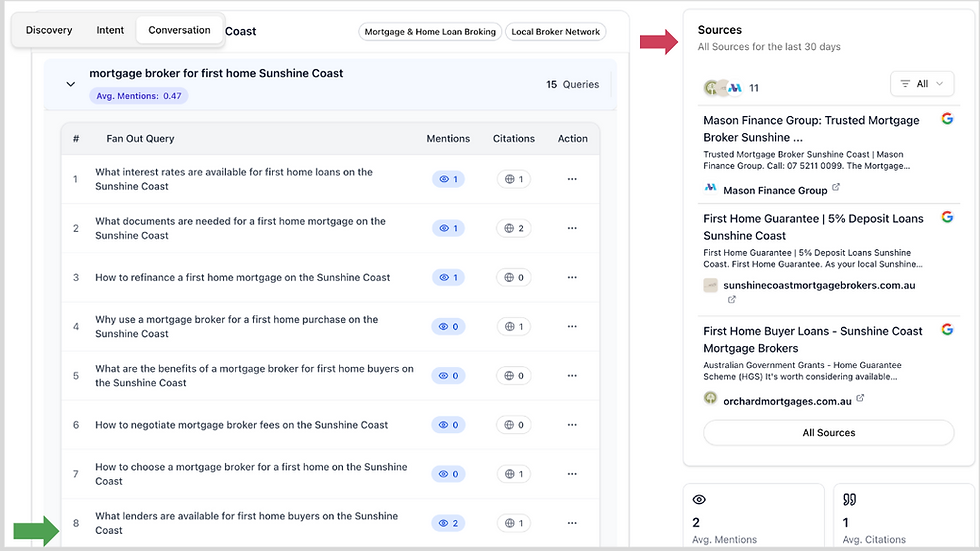
(Showing sources for a prompt related to mortgagechoice.com.au)
This visibility changes the work. Instead of broadly fixing content and hoping AI responds, teams can see which inputs are influencing the explanation and decide what actually needs to change.
If AI search engines are now explaining your products on your behalf, then source-level visibility is no longer a nice-to-have. It is how brands keep those explanations accurate.
Get your complimentary trial with Somantra AI today to manage your brand’s image across AI search engines.
Author : Meher Gulpavan https://www.linkedin.com/in/mehergp/


Comments