
Google Zero: What it means and learnings from publishers who planned and executed to combat it. [ 2024 to 2026 summary ]
Introduction: The Reckoning No One Predicted Fast Enough
In May 2024, Nilay Patel of The Verge while interviewing Google CEO Sundar Pichai, coined a term “Google Zero” and asked pointed question on the Decoder podcast: should the web plan for a future where Google sends it effectively zero traffic? Pichai pushed back. But the data, as it turned out, agreed with Patel.
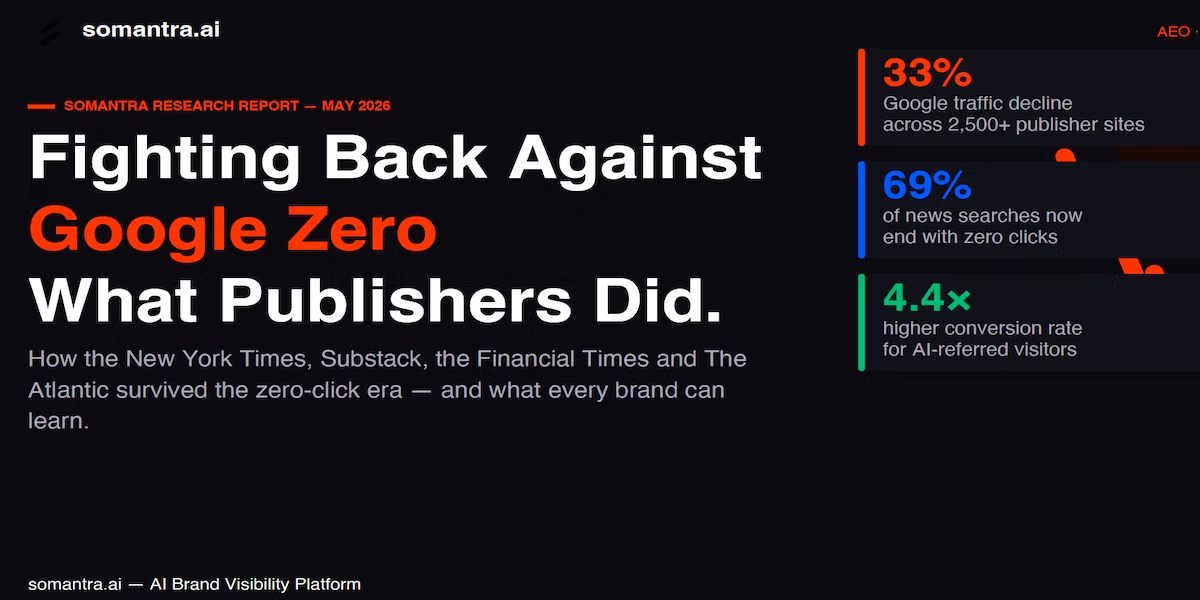
What followed was one of the fastest structural shifts in the history of digital publishing. Within twelve months of Google rolling out AI Overviews, zero click searches had climbed from 56% to 69% of all news-related queries (Similarweb, 2025). Organic visits to news sites collapsed from a peak of over 2.3 billion monthly visits in mid-2024 to under 1.7 billion by May 2025.
Google Search traffic to more than 2,500 publisher sites tracked by Chartbeat fell by 33% worldwide and by 38% in the United States between November 2024 and November 2025.
The page-view economy, the model that had sustained digital publishing for two decades was no longer viable.
But not everyone collapsed. This report examines the publishers, brands, and content creators who have navigated the Google Zero era and what they did, what worked, what didn’t, and what the data reveals about the emerging playbook for brand visibility in the age of AI search.
Part One: Zero Click - Who Got Hurt and How Badly
Before examining who survived, it’s important to understand the full scale of what happened.

Notable Casualty List
Worth.com lost nearly a third of its traffic in a single month, May 2024, precisely when Google AI Overviews first rolled out. There was no algorithm penalty, no redesign of website but just the instantaneous impact of AI summaries absorbing user intent before it could result in a click.
HouseFresh, an independent air purifier review site that had built its reputation on rigorous, first-hand product testing, saw its Google traffic fall 95% after the September 2023 Helpful Content Update from 4,000 daily visitors to approximately 200.
Despite two years of sustained recovery effort, including a YouTube channel and a collaboration with Linus Tech Tips, the site’s managing editor Gisele Navarro reported a cruel irony: the site’s visibility within AI Overviews had actually increased, while actual site visits had continued to decline. The AI was summarising HouseFresh’s work and presenting it without attribution. The content was winning. The business was losing.
Across the top 500 global publishers, Google traffic was down 27%, a loss translating to billions in advertising revenue.
For news publishers specifically, the Pew Research Center’s study of 68,000 real search queries found that users clicked on results 8% of the time when AI summaries appeared, compared to 15% without them; a 46.7% reduction in click-through behaviour.
HubSpot’s experience was particularly instructive, and particularly severe.
The marketing platform had built a traffic empire on exactly the type of content AI Overviews most efficiently summarise: how-to guides, definitions, step-by-step tutorials. Perfectly optimised for the pre-AI era, these content formats were precisely the ones Google’s AI could absorb and deliver to users without requiring a click.
HubSpot saw a 70–80% decline in organic traffic, a result that should serve as a warning to any brand whose content library leans heavily on informational, easily-synthesisable material.
The Mechanism of Damage
Understanding how AI Overviews damage traffic is important, because it reveals which responses are likely to work.
Ahrefs’ published a report in Feb 2026, using a study of 300,000 keywords found that position one click-through rates drop 58% when an AI Overview is present.
The content still ranks. Since users see it summarised, they just no longer need to visit. For publishers generating revenue from display advertising, affiliate links, and page-view-based models, this represents a structural collapse of the underlying business mechanism and is not a temporary setback.
Part Two: The Publishers Who Fought Back Zero Click
Survival in the Google Zero era has not come from a single tactic. The publishers who have maintained or grown their audience through 2024–2026 share a common architecture: they diversified their discovery channels, built direct relationships with their audiences, and restructured their content for the new citation-based visibility model.

Case Study 1: The New York Times — Betting on Subscriptions and Brand Authority
The New York Times entered the AI search era better positioned than almost any other publisher. Its subscription base, which had been growing steadily for years, provided insulation from the traffic collapse that devastated advertising-dependent competitors.
What the Times did differently was structural, not tactical. By investing heavily in products Games, Cooking, Sports via The Athletic, it built multiple direct relationships with paying readers that existed entirely outside the Google discovery funnel.
Readers came for Wordle, stayed for news, paid for access. The Google-to-article pipeline became less important as a revenue mechanism because the revenue mechanism had shifted.
The brand authority signal this creates is also increasingly important in the AI era. When AI systems are trained on web content and calibrated to cite authoritative sources, the New York Times is exactly the kind of entity they are built to surface. Brand authority and AI citation frequency are increasingly correlated and the Times had been building that authority for decades.
The lesson: Subscription revenue is insulation. Brand authority is a citation signal. When combined they compound.
Case Study 2: Substack — Structurally Immune by Design
Substack grew from 4 million paid subscribers in November 2024 to 5 million by March 2025, a 25% increase in four months precisely as the AI Overview traffic collapse was accelerating across conventional publishing. By Q2 2025 the platform had grown 66.67% year-over-year.
The reason Substack was able to grow while others collapsed is structural: it was never meaningfully dependent on Google search traffic in the first place. Substack writers build audiences through internal recommendation networks, direct email delivery, and the Substack app’s own discovery features. Readers subscribe to writers, not topics which is a fundamentally different relationship than the one that connects a search query to a publisher article.
This direct relationship model created a different resilience. A Substack newsletter writer with 10,000 subscribers does not need Google to reach those readers. They land in the inbox regardless of algorithm changes, AI Overviews, or zero click search behaviour. The SISTRIX research from March 2026 reached the same conclusion about Substack’s structural advantage: “ranking alone is no longer a business model,” it concluded, and newsletter platforms with high reader engagement are “well-positioned under current ranking signals.”
The lesson: Email-direct audiences are Google-proof. Building an audience list is building an asset that no algorithm can confiscate.
Case Study 3: The Financial Times — Walling the Garden
The Financial Times took a different approach. Rather than building around subscriptions as a defensive move against Google, it accelerated its subscription model alongside an AI-native product strategy. In April 2025, it made its “Ask FT” chatbot available to all subscribers, allowing them to search the publication’s archive using natural language, essentially building its own internal AI search engine.
The effect was twofold. Subscribers had a new reason to come directly to the FT rather than via Google. The FT positioned its journalism as the authoritative source that AI answers should be drawn from; a content posture that simultaneously serves reader utility and AI citation authority.
The Financial Times grew subscriptions by 30% to 1.3 million which is one of the largest absolute and relative gains among major publishers during this period.
The lesson: Building AI-native products on top of your content creates a direct channel that bypasses Google entirely, while simultaneously training readers to treat your brand as the authoritative source.
Case Study 4: The Atlantic — Depth That AI Cannot Summarise
The Atlantic grew subscriptions to grow over 1 million subscribers during a period when many peers were contracting. Its strategy was built on a content posture that directly resists AI summarisation: long-form, original reporting with strong analytical voice, cultural commentary, and journalism that requires reading in full to get the value. This is increasingly important as a structural advantage.
Not all content is equally susceptible to zero click summarisation. As reported by PressGazette analysis from May 2026 which is based on Sistrix’s data, it found that 72% of health article links in major news brands were displaced by AI Overviews during the first three months of 2026.
Informational content (listicles, explainers, definitions, step-by-step guides) is structurally vulnerable. But content that relies on voice, argument, narrative arc, or original reporting is far harder for AI to absorb and summarise in a way that eliminates the need to read the original.
The Atlantic’s content has always leaned toward the latter category. In the AI era, that editorial philosophy became a business strategy.
The lesson: Content that demands to be read and not just summarised will retain its click value in a zero click world.
Case Study 5: People.com — Structured Content for AI Citation
People.com achieved a 27.52% year-over-year traffic increase through September 2025 by adopting a structured content strategy specifically aimed at AI visibility; their approach was tracked by The Digital Bloom.
The key insight in People.com’s approach was recognising that the goal of content strategy had shifted from ranking to being cited. In the traditional SEO model, success was measured by position, impressions, and click-through rate. In the AI era, the relevant metric is citation frequency, how often your brand appears within AI-generated answers, even when no click occurs.
People.com structured content around the specific patterns that AI systems use to select and surface sources: clear entity associations, structured data markup, consistent topical authority signals, and content formats that LLMs can easily parse, quote, and cite. Importantly, the publication understood that an AI citation, even without a click, still builds brand awareness and influences the purchase or engagement decisions of readers who receive AI-generated answers.
HubSpot’s CEO articulated the philosophy that sits behind this approach: companies must now focus on being “cited in LLMs more than any other competitor.” Success is measured by presence in synthesised responses, not position in a list of blue links.
The lesson: AI citation frequency is the new page-one ranking. Structuring content for citation is a distinct skill from optimising for search position, and the publishers who understood this earliest gained a meaningful advantage.
Case Study 6: HouseFresh — Recovery Through Brand, Not Just Content
HouseFresh’s story is often told as a cautionary tale, but its partial recovery by October 2025 is equally instructive. After losing 95% of search traffic, the team did not simply produce more content. They built a YouTube channel, developed a recognisable editorial voice, and formed a collaboration with Linus Tech Tips that expanded brand recognition far beyond search.
The recovery was partial, and the team themselves described it as “hard work and a lot of luck.” But the direction of the recovery path revealed something important: brand recognition is increasingly a ranking signal in both traditional and AI search. Google’s AI systems, like its ranking algorithms, are calibrated to surface sources that humans trust and engage with across multiple platforms. A brand that exists only as a website, with no social presence, no video content, and no off-site authority signals, is increasingly invisible to AI.
The brands that AI systems cite are brands that have weight across the web and not just in a single content channel.
The lesson: Brand-building is no longer a marketing luxury. In the AI citation era, it is a visibility strategy.
Part Three: What the Data Reveals About the New Playbook to prepare for Google Zero/Zero Click
Synthesising the evidence from publisher recoveries, industry research, and AI search behaviour data, a clear pattern emerges on how to prepare for the Google Zero/Zero Click era. The publishers who are surviving and in some cases thriving share five characteristics.
1. They Changed the Metric
The most fundamental shift is a change in what success looks like.
Traffic volume is no longer the primary measure. The publishers who are adapting successfully have moved to measuring brand citation frequency in AI responses, direct audience relationships (subscribers, email lists, app users), revenue per visit rather than visit volume, and conversion rates from AI-referred traffic.
This matters because AI-referred visitors, when they do click through, are dramatically more valuable. AI search traffic converts at 4.4 times the rate of traditional organic traffic (Frase.io/Ahrefs, 2025). As per Adobe (Adobe, 2026):
- Bounce rate on AI traffic was 27% lower than bounce rate on non-AI traffic.
- Time spent per visit was 38% longer.
- Page views per visit were 10% higher.
The referral volume is lower but the quality is higher in AI Search and the publishers who have adapted are optimising for quality.
2. They Restructured Content for Citation
Being cited in AI answers is not the same as ranking in search. The content formats that AI systems select for citation are: clearly attributed to recognised entities, supported by structured data markup (Schema.org), demonstrably authoritative in their topic area, written with enough specificity and original insight that they add value to a synthesised answer, and published on domains with strong E-E-A-T signals (Experience, Expertise, Authoritativeness, Trustworthiness).
Conversely, the content formats most harmed by AI Overviews are the ones that can be fully summarised: definitions, step-by-step guides, listicles, and general informational articles. If Google can answer the question directly from the AI Overview, then the click never happens. Publishers who have pivoted away from these formats toward original reporting, proprietary data, expert analysis, and content that requires reading in full have retained and in some cases grown their audience.
3. They Built Channels Google Cannot Touch
Email newsletters, push notifications, podcast feeds, app direct access, and subscription models all represent audience relationships that exist outside the Google traffic pipeline. The publishers who invested in these channels before the AI Overview rollout were insulated. Those who are investing in them now are building delayed insulation for the next wave.
Substack’s structural immunity to the Google Zero effect is the most dramatic illustration of this principle. But the same logic applies to any publisher that has built a significant direct audience whether through email, app, podcast, or subscription.
4. They Targeted AI Citation Explicitly
A growing number of publishers and brands are now optimising content specifically for AI citation and not just for search ranking. This includes implementing structured data markup more comprehensively than ever, building topical authority signals through consistent, expert-level content in specific subject areas, securing mentions and citations in high-authority third-party sources, ensuring AI crawlers (ChatGPT-User, GPTBot, PerplexityBot, ClaudeBot) are permitted access in robots.txt files, and auditing existing content to identify where AI systems are summarising their work without citing the source.
The opportunity is significant. Seventy percent of organisations believe AEO will significantly impact their digital strategy within one to three years, but only 20% have begun implementing it (Acquia, 2025). The adoption gap represents a window but that window is closing quickly.
5. They Took Brand Seriously
In the AI citation era, brand recognition is a visibility signal. AI systems are trained to surface sources that humans trust. Trust is built through brand recognition across multiple platforms: social media presence, video content, podcast authority, press coverage, industry citations, and community engagement. The brands that AI reliably recommends are the ones humans already recognise and respect.
This is a significant change from the traditional SEO model, where a well-optimised page on an unknown domain could outrank a recognised brand. In AI search, brand authority and citation frequency are increasingly correlated. Publishers and brands that have invested in brand-building not just content production, are discovering that their brand work has become a core element of their AI search strategy.
Part Four: The Somantra Perspective
The evidence from two years of publisher experience in the Google Zero era points to a single overarching conclusion: the brands that are surviving and growing are the ones that understood, early, that the visibility game had changed from ranking to being cited.
This distinction matters enormously. Ranking is a position in a list while Citation is a reference in an answer.
The user who receives a traditional search result sees ten blue links and can choose to visit any of them. Compare this experience to that of a user who receives an AI-generated answer, they may see your brand name referenced inside a response they trust and that reference shapes their perception of you before they have visited your site, or even decided to.
Brand visibility is no longer just about traffic but increasingly about presence in the answers your buyers are receiving.
This is why Somantra was built. Somantra’s brand audit platform measures exactly this: where your brand appears in AI-generated answers across Google, ChatGPT, and Perplexity and where it does not. We identify the specific queries, topics, conversations and competitor contexts where your brand is invisible to the AI systems your buyers are already using. And we show you precisely what content, structure, and authority signals are required to close those gaps.
The publishers who adapted earliest to the Google Zero era did so because they had visibility into the problem before their competitors did. They could see where they were losing ground, understand why, and act.
The same principle applies to every brand navigating the AI search era. You cannot fix what you cannot see.
Conclusion: The Playbook for the AI Citation Era

The Google Zero era has produced a clear set of lessons for any brand that depends on search-driven discovery:
- Traffic is no longer the goal. Citation frequency, brand authority, and direct audience relationships are the metrics that matter in a world where 60% of searches end without a click.
- Not all content is equally at risk. Informational content that AI can fully summarise is structurally vulnerable. Original reporting, proprietary data, expert analysis, and content that requires reading in full retains its click value.
- Direct audience channels are the only Google-proof assets. Email lists, subscriptions, app audiences, and communities exist outside the search traffic pipeline. Building them is building resilience.
- Brand authority is a citation signal. AI systems cite the sources humans trust. Brand-building is no longer separate from search strategy — it is search strategy.
- The adoption gap is the opportunity. Seventy percent of organisations know AEO is important. Only 20% have begun. The publishers who moved first gained the most ground.
The search traffic era of the internet is ending. The AI citation era has begun. The question is not whether to adapt — it is how quickly.
Sources: Similarweb (2025), Chartbeat/DCN (2026), Pew Research Center (2025), Digiday (2025, 2026), Press Gazette (2025), The Digital Bloom (2025), Frase.io (2025), Ahrefs (2025), Adobe Analytics (2025), Acquia (2025), Search Engine Journal (2025), ALM Corp (2026), SISTRIX (2026), ppc.land (2026), editorialge.com (2026)
About Somantra
Somantra.ai is an AI brand visibility platform that helps businesses audit, measure, and improve their presence across AI-generated search answers. Our brand audit maps exactly where your brand is cited and where it is invisible across Google AI Overviews, ChatGPT, and Perplexity. To receive a free brand audit, visit somantra.ai or contact us at marketing@somantra.ai.

About the author
Arun Prasad
Founder, Somantra
Arun Prasad is the founder of Somantra, an AI search visibility platform for brands, where he writes about answer engine optimisation (AEO) and AI search. His research analyses how brands surface in AI answers across ChatGPT and Google AI Overviews, including Somantra's studies of the Australian insurance market. He focuses on measuring brand visibility through systematic, large-scale conversational testing rather than one-off screenshots.