AI Search Visibility : Australian General Insurance Brands , March 2026 report
- Arun Prasad

- May 9
- 9 min read
Updated: May 24
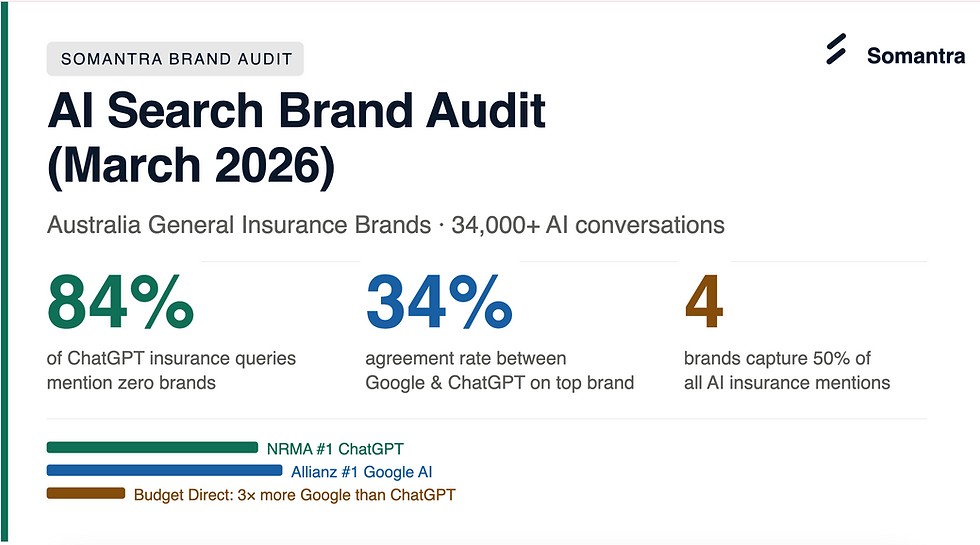
We tracked 18 Australian Insurance Brands across 34,000+ conversations on AI Search. Here are the brands that AI Search actually recommends.
Brand Visibility Landscape on AI Search - Australian Insurance Sector
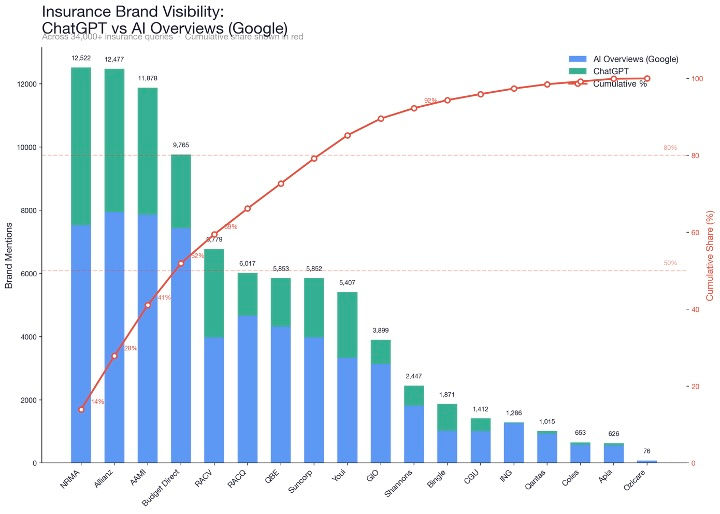
We monitored 18 Australian insurance brands across 34,000+ real consumer conversations on both Google AI Overview and ChatGPT. The goal was to find out which brands show up when people ask AI for insurance advice.
The top 4 brands are ranked as follows:
NRMA leads with 12,522 total mentions.
Allianz is right behind at 12,477.
AAMI rounds out the top three with 11,878. These three brands dominate both platforms but the gap between them and everyone else is massive.
Budget Direct comes in fourth with 9,765 mentions, 17% behind AAMI.
After that we see a steep drop with brands like GIO, Shannons, and CGU sitting well below half the visibility of the top 3.
And then there are the brands barely registering at all. These are brands with customers but have low visibility in AI Search.
Ozicare (76 mentions),
Coles Insurance (653 mentions),
Qantas Insurance (1,015 mentions).
An interesting finding for marketers is that Google and ChatGPT do not agree on rankings. NRMA leads on ChatGPT while Allianz leads on Google. Budget Direct ranks fourth overall but gets three times more mentions on Google than ChatGPT.
The gap between Google visibility and ChatGPT visibility is not small, which means it is structural.
If your brand has spent years building SEO authority, that work does not automatically carry over. AI search is a different game with different rules. The brands winning right now are the ones that figured that out early.
The 2 questions for every insurance CMO are,
(i) where does your brand sit on this chart?
(ii) what tactics can you adopt to grow and maintain lead over competition across multiple AI Search engines?
Myth: Google AI Overview Visibility translates into ChatGPT Visibility
Google AI Overview Visibility Vs ChatGPT Visibility
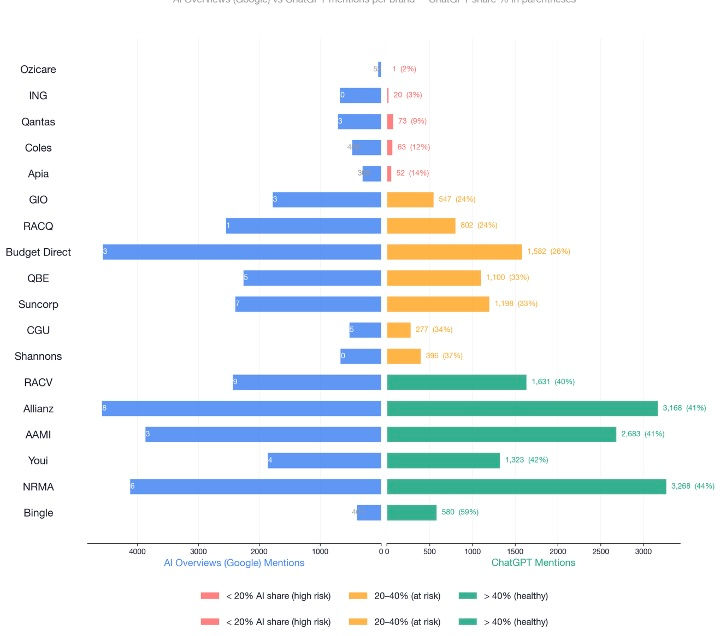
Out of 18 Australian insurance brands we track, several are effectively invisible on ChatGPT , e.g.
Ozicare gets just 1.9% of its total visibility from ChatGPT,
ING 2.9%, Qantas Insurance 9.3%,
Coles 11.6%.
These brands show up on Google AI Overview. They have websites and run online ads. But when a consumer asks ChatGPT "what is the best car insurance in Australia" these brands do not get mentioned.
On the other end, Bingle is the only brand that is actually more visible on ChatGPT than Google. 59% of Bingle's total query visibility comes from ChatGPT which is an outlier. Something about Bingle's content, positioning, or brand signals is resonating with how large language models surface recommendations.
The brands ranked by managing the best balancing act by maintaining presence on both Google AI Overview and ChatGPT are
NRMA,
AAMI,
Allianz,
Youi
RACV.
If we assume a Google AI Overview visibility is correlated to ChatGPT visibility in the total mentions then the split of the source of their brand mentions :
BRAND | Google AI Overview Brand Mentions Split (%ge) | ChatGPT Brand Mentions Split (%ge) |
NRMA | 56% | 44% |
Youi | 58.5% | 41.5% |
AAMI | 59% | 41% |
Allianz | 59% | 41% |
RACV | 60% | 40% |
Budget Direct | 74.3% | 25.7% |
Budget Direct which is one of the most visible brands on Google AI Overview, sees only 25.7% of its total mentions coming from ChatGPT. That means for every four times Budget Direct appears across both platforms, three of those are on Google and only one is on ChatGPT.
If your brand is strong on Google AI Overview but weak in ChatGPT, it has a visibility gap which could potentially widen. The fix is not more SEO but a fundamentally different strategy.
We are seeing this behaviour across industries which proves that winning in Google AI Overview does not automatically guarantee success in ChatGPT visibility or vice-versa.
Google and ChatGPT Agree on the Best Insurance Brand Only 34% of the Time. Here's What That Means.
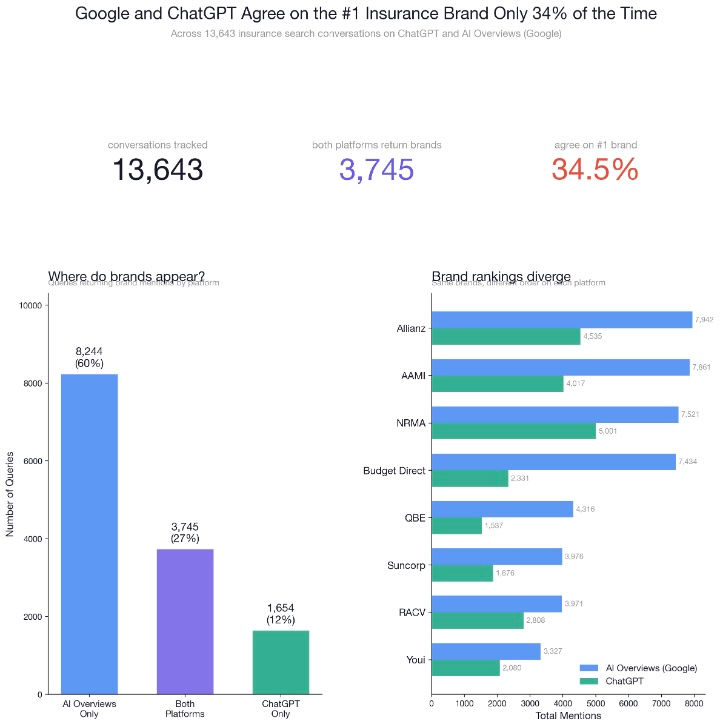
When users ask Google AI Overviews and ChatGPT the same insurance question. You will get different answers most of the time.
We identified 13,643 insurance-related queries where either ChatGPT or GoogleAI Overview had mentioned the brand.

In 8,244 of those queries 60% Google AI Overviews returned brand mentions but ChatGPT did not mention any brand at all.
In 1,654 queries 12% it was the reverse: ChatGPT named brands while Google stayed silent.
Only 3,745 conversations 27% had both platforms returning brand mentions.
That overlap is where the real comparison happens.
Of those 3,745 shared conversations, Google and ChatGPT agreed on the number one recommended brand just 34.5% of the time.
In 2,452 queries nearly two out of three named a different brand as the top choice.
The rank differences are striking.
On ChatGPT, NRMA leads at number one with 5,001 total mentions.
On Google AI Overviews, NRMA drops to third while Allianz takes the top spot with 7,942 mentions and AAMI is second with 7,861.
Budget Direct is the most dramatic example. It ranks 4th on Google with 7,434 mentions but falls to fifth on ChatGPT with just 2,331 a 3:1 gap.
RACV moves the other direction. It sits at eighth on Google but climbs to fourth on ChatGPT. Something about RACV's content signals resonates differently with AI models.
For marketers, the takeaway is not just about the 34% agreement rate. It is about the 60% of queries where Google mentions your brand and ChatGPT does not mention anyone. That is a massive uncontested space on AI search.
The brands that treat these as two separate channels each requiring its own strategy, its own content, its own measurement will be better positioned than the brands that assume Google rankings carry over to AI.
These Are the 10 sources AI Search Engines Trust for Insurance Sector

SEO has always been about earning trust from Google. But there is a new gatekeeper which does not care about your backlink profile.
We analysed the sources that ChatGPT and Google cite across 34,000+ insurance search conversations in Australia. The findings reshape everything we thought we knew about digital authority.
Canstar is the single most cited domain with 16,232 total citations across both platforms.
On Google AI Overview, Canstar appears 16,000 times. It is the undisputed king of traditional search for insurance content.
But ChatGPT tells a different story.
Canstar still leads on ChatGPT with 232 citations.
Finder is second at 173.
Then comes the surprise which is Reddit. With 147 citations, Reddit is ChatGPT's third most trusted source for insurance advice which is a forum and not a traditional comparison site.
Moneysmart.gov.au, the government's financial literacy site, ranks fifth on ChatGPT with 105 citations.
Forbes comes in at 101. These are editorial and institutional sources. Brands may have to start thinking of engaging with editorials at a strategic level to raise brand visibility.
The comparison site effect is real for insurance brans but smaller than you might expect on ChatGPT. Canstar, Finder, Compare the Market, iSelect, Choosi, and Savvy account for 12.3% of all citations. They are meaningful as a group, but none is dominant on its own.
The old game was about getting Google to rank your page. The new game is about getting the topic authorities to talk about you because that is what AI reads, learns, and repeats. Some thoughts,
Brand direct sites make up 22.7% of citations, while the rest, which is the majority, comes from third-party editorial, media, government, and community sources.
If you want ChatGPT to recommend your brand, being on your own website is not enough. You need to be mentioned positively on the sites that AI trusts. This requires a shift from link building to building reputation across the sources that train and inform AI models.
Car Insurance vs Pet Insurance - Where AI Sends You Is Very Different.
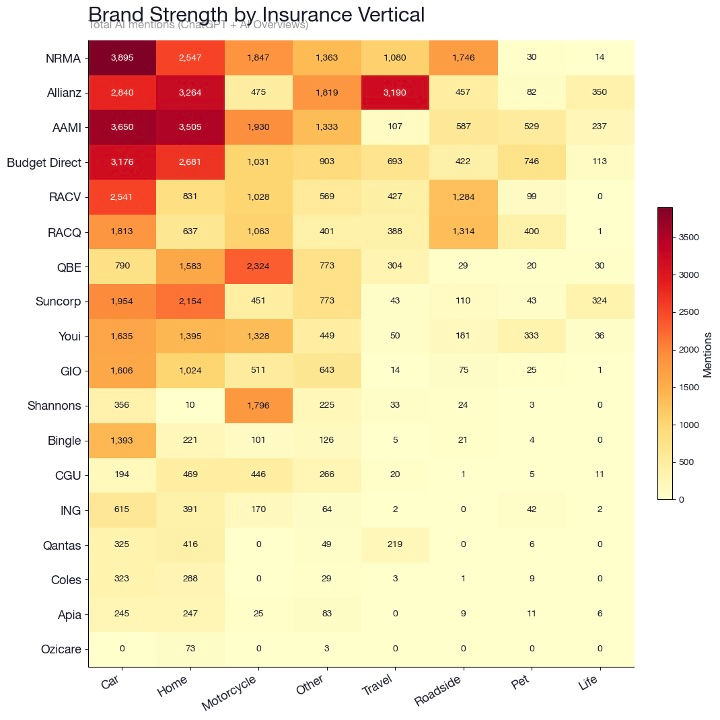
Not all insurance verticals are created equal in the eyes of AI.
We broke down brand visibility across eight insurance categories including car, home, motorcycle, travel, pet, life, roadside, and others. Car, Home, Motorycle insurance are crowded, competitive spaces where the big brands fight hard for visibility.
Car insurance dominates with 27,353 total brand mentions across ChatGPT and Google.
Home insurance follows at 21,746.
Motorcycle comes third at 14,528 mentions.
Pet insurance sits near the bottom with just 2,389 mentions.
Life insurance is even lower at 1,125.
Pet and Life insurance verticals are underserved with fewer brands competing and more room for a brand to own the conversation.
The brand concentration varies wildly by vertical too.
NRMA leads in car insurance with 3,895 mentions.
But QBE, a brand you might not immediately associate with motorcycles, leads in motorcycle insurance with 2,324 mentions.
Allianz dominates travel insurance with 3,190 mentions, nearly three times the next closest competitor.
Source diversity paints an even sharper picture. Fewer sources means fewer brands get a voice.
When someone asks about car insurance, Google pulls from 3,088 unique domains. ChatGPT uses 298.
For motorcycle insurance Google cites 1,441 domains, ChatGPT only 127.
And then there is the comparison site effect.
Pet insurance has the highest share of comparison site citations at 15.8%.
Roadside assistance has the lowest at 2.2%.
If you are in pet insurance, you are leaning on Canstar and Finder for every mention.
If you are in roadside assistance, the conversation is more direct - brand to consumer. If you are in a crowded vertical like car or home, you need to fight for every AI mention. If you are in pet or life insurance, there is a wide-open opportunity to become the brand AI defaults because right now, almost nobody owns that space.
In highly competitive areas, brands will have to engineer content exclusively for selection by AI, while in whitespace categories they would have flexibility to create content for awareness and discoverability.
Is AI Creating Brand Mindshare Monopolies in Insurance? The Data Says Yes.

We measured brand concentration across 34,000+ insurance related conversational searches on both platforms. The nature of AI search is a multi step conversation, funneling consumers toward fewer brands than traditional search.
In ChatGPT, just four brands account for 50% of all insurance mentions, NRMA, Allianz, AAMI, and RACV.
Five brands control 60%.
If you are not in the top seven, you are fighting over the last 25% of visibility.
In Google AI overview,
four brands make up 50% of mentions which include Allianz, AAMI, NRMA, BudgetDirect,
but you need six brands to reach 60%, eight for 75%, and eleven for 90%.
The long tail is longer, therefore more brands get an opportunity to meaningfully get discovered by the consumer.
Google and ChatGPT agree on the top brand for a given query only 34.5% of the time. That means in two out of three responses, the platforms recommend different brands as the top choice.
You cannot assume that winning Google means winning ChatGPT. They are different systems with different logic. And for the brands that dominate one but not the other, the gap represents both a risk and an opportunity.
If your brand is not in the top five on AI Search across both ChatGPT and Google AI Overview, you need a strategy to get there. Because the window to build AI visibility is closing and the brands that act now will lock in a strategic advantage.
84% of Insurance Questions asked to ChatGPT do not mention any brands. That Is a Massive Opportunity.
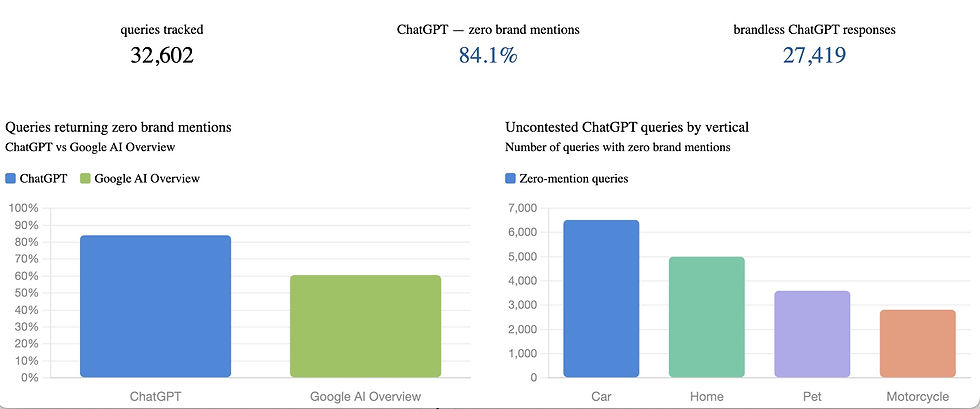
We tracked 32,602 detailed insurance queries on ChatGPT which are long-tail, specific questions real consumers actually ask. Things like "how to claim pet insurance for overseas pets" and "what car insurance discounts are available for new cars" and "how to insure a motorcycle with a history of accidents."
84.1% of those queries returned zero brand mentions.ChatGPT answered the question, gave advice, explained options, laid out considerations but did not name a single brand.
Compare that to Google AI Overview, where 60.6% of the same queries had zero brand mentions.
Google AI Overview is better at surfacing brands in long-tail searches. But even on Google AI Overview, more than half of detailed queries are brand-free zones.
This is not a problem. This is an opportunity.
Every one of those 27,419 brandless ChatGPT responses is a gap in the market. A place where the right content, structured the right way, published on the right sources, could put your brand into the AI's answer.
The verticals with the most uncontested queries tell you where to start. These are real questions from real consumers that AI is answering without mentioning anyone.
Car insurance has 6,520 zero-mention queries on ChatGPT.
Home has 5,000. Pet has 3,595. Motorcycle 2,811.
Brand can capitalise on these whitespaces for category dominance.
The long tail conversation is where intent lives. When someone searches "best car insurance Australia" that is browsing. When someone searches "how to get coverage for artwork in renters insurance" that is buying. And right now, nobody owns that space on AI.
The brands that build content around these specific, high-intent queries and get that content onto the sources AI trusts will be the first names that appear when the models update.
First mover advantage in AI search is real. And right now, 84% of the field is wide open.
Why Somantra:
Somantra measures brand mindshare in conversations that consumers have with AI Search Engines. Our research shows that consumers treat AI Search as a “conversational experience”, a differentiated experience from traditional search which consumers recognise as “information retrieval”.
In this “conversational experience” , AI Search Engine exhibits memory, nuance, and builds context as it progresses which gives the AI Search Engine time to make up its mind across a multi-turn conversation. Your brand might enter mid-conversation, only to be quietly dropped further in the conversation as the consumer probes further for product, service alignment to their needs.
Somantra’s brand audit helps brands measure their engagement across thousands of conversations and hundreds of personas directly relevant to their products and services.
Contact Us to know more about how we can drive your brands mindshare on AI Search Engines.


Comments